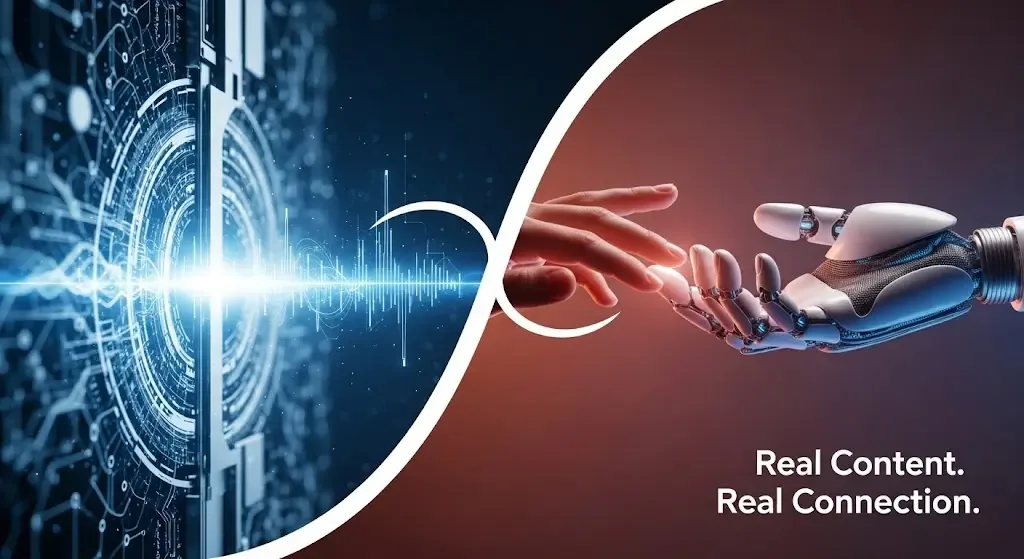
We’re in the middle of an AI-fueled content explosion. Brands are scaling content like never before—and the internet is filling up fast. But here’s the flip side: audiences are craving real connection. They can tell when content is mass-produced, lacking soul, or misaligned with your brand's voice. The more AI floods the market, the more human authenticity becomes your most powerful differentiator.
Why this matters now more than ever:
- Google's AI-First Search Experience (SGE): AI-generated summaries and content are changing how information is discovered—and mediocre, generic content gets buried.
- Content Saturation is Real: With AI lowering the barrier to entry, everyone can create content—but standing out requires a human touch.
- Audience Expectations Have Shifted: Consumers expect transparency, relatability, and authenticity. They trust brands that sound human, not robotic.
We’re entering a new era where Human + Machine isn’t optional—it’s the formula for relevance, reach, and trust in the AI-driven marketing ecosystem.
The Rise of AI-Generated Content
What used to take hours or days—blog posts, social media captions, email sequences—can now be generated in minutes with AI.
The Efficiency Gains Are Undeniable:
- Speed: AI accelerates ideation, drafting, and even editing, getting content to market faster.
- Scale: Brands can produce more touchpoints, more consistently, across platforms.
- SEO Advantages: AI can help optimize for keywords, search intent, and formatting—boosting visibility in traditional search and AI-powered discovery engines.
AI breaks the ceiling on how much content you can create—fueling everything from inbound marketing to thought leadership campaigns.
But There’s a Catch…
With mass AI adoption comes mass-produced, soulless content. We’re seeing an explosion of:
- Generic blogs that lack unique perspective
- Robotic website copy that feels disconnected
- Misaligned messaging that dilutes brand voice
- AI-written content filled with subtle inaccuracies or off-brand language
And here’s the truth: audiences notice. Trust erodes quickly when content feels automated, disconnected, or designed to game algorithms instead of building real relationships.
The rise of AI-generated content is inevitable—but your approach determines whether it’s a growth engine or a brand liability.
Why Authenticity is Non-Negotiable
Authenticity is not a buzzword—it’s a business imperative.
The numbers don’t lie:
- Studies show that trust in brands is eroding, with consumers growing increasingly skeptical of content that feels robotic, formulaic, or mass-produced.
- According to Edelman’s Trust Barometer, nearly 70% of people say authenticity is critical when deciding which brands they support—yet AI-driven content often falls short.
Human-Driven Storytelling Is the Ultimate Differentiator
AI can draft copy, surface keywords, even simulate tone—but it can’t replicate the lived experiences, nuanced perspectives, and emotional resonance that human creators bring to the table.
Your audience connects with:
- Real stories from real people
- Unique insights that challenge the status quo
- Consistent brand voice that builds familiarity and trust
- Content that feels intentional, not automated
In the race to scale content with AI, brands risk losing what makes them relatable—and that’s where the cracks begin to show.
The “Authenticity Gap” in AI-Dominated Feeds
Scroll any platform today and you’ll see it:
- Posts that feel flat, templated, or eerily similar across brands
- Articles optimized for SEO but devoid of personality
- Generic marketing speak designed to please algorithms, not people
This is the Authenticity Gap—the widening divide between high-volume AI content and the genuine, human-centered messaging audiences crave.
Brands that bridge this gap don’t just stand out—they build lasting trust, loyalty, and authority in an AI-first content ecosystem.
The Human + Machine Framework
Let’s clear something up: this isn’t a battle of AI vs. Humans. That’s outdated thinking.
The real opportunity—the competitive edge—is AI with Humans.
When done right, AI isn’t your replacement—it’s your amplifier. But that only works if there’s a deliberate structure for balancing machine efficiency with human authenticity.
The Four Core Balance Pillars
1. Strategy First: Humans Lead, AI Amplifies
- AI is powerful, but directionless without human strategy.
- Your team defines the narrative, target audience, and business goals—AI executes within those boundaries.
- The best content starts with human creativity, then leverages AI for scale, research, and production.
2. Voice & Brand Integrity: Guardrails Are Non-Negotiable
- AI can mimic tone, but it lacks instinct for nuance.
- Brands must establish clear voice guidelines—language, cultural references, tone boundaries—to keep AI output consistent and on-brand.
- Without guardrails, AI can generate off-brand, tone-deaf, or even reputationally risky content.
3. Editorial Layer: Humans as the Authenticity Filter
- AI drafts fast, but humans refine.
- Every AI-generated piece needs a human layer of review—for authenticity, emotional resonance, and alignment with your audience's expectations.
- Think of AI as your assistant—the final say stays human.
4. Ethical AI Use: Transparency Builds Trust
- Audiences are savvy—they know AI plays a role.
- Be upfront about AI's involvement in your content creation process.
- Transparency isn’t just ethical—it differentiates your brand as credible, human-centered, and aligned with evolving consumer expectations.
AI can supercharge your content engine—but without human oversight, it risks eroding trust, authenticity, and long-term brand equity.
When humans lead and AI amplifies, you scale without sacrificing soul.
Practical Tactics to Maintain Authenticity with AI
Balancing AI efficiency with human authenticity isn’t theory—it’s execution. Here’s how future-ready brands are using AI strategically, without sacrificing trust, voice, or emotional connection:
1. Master the Prompt: Guide AI for Aligned, On-Brand Content
AI is only as good as the input you provide. To get content that sounds like you, not a machine:
- Craft detailed prompts that include:
- Brand voice characteristics (conversational, bold, authoritative, etc.)
- Target audience insights
- Specific tone instructions (e.g., direct but approachable, no jargon, action-oriented)
- Desired emotional undertone (urgency, inspiration, trust-building)
- AI tools need to be trained on your own data to establish consistency
- Avoid vague prompts—precision equals better, brand-aligned output
Pro Tip: Develop internal AI prompt libraries for your team to ensure consistent, high-quality results.
2. Let AI Handle Drafts, Research, and SEO—Humans Own the Story
AI thrives at:
- Rapid first drafts
- Market and competitor research
- SEO optimization (keywords, structure, meta descriptions)
But AI cannot:
- Tell your unique brand story with lived experience
- Tap into real-time cultural nuance or emotional triggers
- Build trust through human relatability
Divide and conquer: Let AI set the foundation, but human creators refine, inject storytelling, and ensure emotional resonance.
3. Use Tools to Monitor AI Output Quality and Originality
Safeguard authenticity with tech that audits AI content:
- Brand-specific AI tools with tone-checking and bias detection
- Manual editorial reviews focused on:
- Brand voice alignment
- Cultural sensitivity
- Factual accuracy
Reminder: AI can hallucinate—fact-check everything.
4. Real-World Examples: Brands Getting the Balance Right
- HubSpot: Uses AI for scaling educational content, but all materials go through human editors for tone, clarity, and brand consistency
- Lush Cosmetics: Combines AI data insights with human-led storytelling to create values-driven, authentic campaigns
- Spotify Wrapped: A blend of AI-generated data and human-centric, playful narratives that feel personal and authentic to users
These brands aren’t replacing people with AI—they’re using AI to elevate human creativity, not erase it.
AI is your leverage—but authenticity is your brand currency. Smart marketers know how to blend both without losing what makes their message real.
The Future of Content — Human-Led, AI-Empowered
We’re standing at the intersection of two unstoppable forces: the rise of AI content generation and the demand for real, human connection. The brands that win? They don’t pick sides—they master the balance.
The AI Search Ecosystem: Why Human Authenticity Boosts Discoverability
Search is no longer just about keywords—it’s about context, authority, and credibility within an evolving AI Search Ecosystem:
- Google’s AI Overviews, ChatGPT Search, Perplexity, and other AI-driven platforms prioritize relevance, originality, and trust signals
- Authentic, human-guided content rises to the top—because AI engines are trained to surface what feels credible, nuanced, and genuinely useful
- Shallow, purely AI-generated content gets buried under the noise
Your audience isn’t just searching—they’re navigating AI-curated experiences. Human authenticity is no longer optional—it’s algorithmically rewarded.
Generative Engine Optimization (GEO) — With a Human Touch
GEO is the new SEO—optimizing not just for Google, but for AI search engines, conversational platforms, and generative content aggregators.
But here’s the trick:
- AI-generated, cookie-cutter content gets filtered out
- GEO success depends on:
- Unique, human-informed insights
- Brand voice that feels real, not robotic
- Content designed for human consumption, amplified for AI discovery
AI can help you draft, structure, and optimize—but only human input creates the depth AI engines favor.
Where AI + Human Synergy is Headed
The content future is hybrid:
- AI accelerates production, personalization, and scale
- Humans lead with creativity, emotional intelligence, and authenticity
- Brands evolve into content laboratories—blending AI tools with editorial oversight to create faster, smarter, and more human-centric messaging
Expect:
- AI assisting with real-time content personalization at scale
- Human creators guiding narrative arcs, emotional hooks, and trust-building
- Increased consumer scrutiny—making authenticity, transparency, and ethical AI use non-negotiable
The winners? Brands that see AI as a tool, not a shortcut—and keep humans at the heart of their message.
In the AI-powered content economy, the most human brands will be the most discoverable, the most trusted, and the most unforgettable.
FAQs: AI Content vs Human Authenticity
Is AI-generated content bad for SEO?
No, AI-generated content isn’t inherently bad for SEO. However, low-quality, generic, or unedited AI content can hurt rankings. Search engines prioritize helpful, original, and human-refined content.
How can brands maintain authenticity when using AI?
Brands can maintain authenticity by using clear brand voice guidelines, adding human editing layers, sharing real experiences, and ensuring all AI-generated content aligns with their messaging and audience expectations.
What is the “Human + AI” content strategy?
It’s an approach where AI is used for speed, research, and drafting, while humans handle strategy, storytelling, and final editing to ensure authenticity and emotional connection.
Does Google penalize AI-generated content?
Google does not penalize AI content specifically. It penalizes low-quality or spammy content, regardless of how it’s created. High-quality, helpful AI-assisted content can perform well.
Why does AI content often feel generic?
AI pulls from existing data patterns, which can lead to repetitive or surface-level content. Without human input, it lacks unique insights, personality, and real-world perspective.
What role do humans play in AI content creation?
Humans define strategy, brand voice, and storytelling. They also review, refine, and fact-check AI-generated content to ensure accuracy and authenticity.
How can businesses use AI without losing their brand voice?
By setting strict tone guidelines, training AI with brand-specific prompts, and ensuring all outputs go through human editing before publishing.
What is the “authenticity gap” in content marketing?
The authenticity gap refers to the difference between mass-produced AI content and the genuine, human-centered content that audiences actually trust and engage with.
Is human-written content better than AI content?
Not necessarily. The best results come from combining both—AI for efficiency and humans for creativity, emotion, and trust-building.
What is the future of content marketing with AI?
The future is hybrid: AI will handle scale and personalization, while humans will lead storytelling, strategy, and brand connection. Brands that balance both will outperform others.






.webp)