Profound Alternatives: A Practical, Vendor-Neutral Framework For Evaluating AI Visibility Platforms
Marcela De Vivo
Marcela De Vivo
June 19, 2026
15 min
Profound Alternatives: A Practical, Vendor-Neutral Framework For Evaluating AI Visibility Platforms
The way consumers discover products and brands has fundamentally changed. Buyers no longer start their journey by scrolling through a list of links on a traditional search engine results page. Instead, they ask complex, conversational questions to AI-powered answer engines like ChatGPT, Gemini, Perplexity, and Google AI Overviews. The AI synthesizes an answer, cites a handful of sources, and the user rarely looks further. If your brand is not mentioned in those first synthesized responses, your competitors are capturing the business instead.
This shift has created an urgent demand for a new category of marketing technology: AI visibility platforms. These tools monitor how brands appear in AI-generated answers, identify which sources are cited, and provide actionable guidance to improve presence across the generative search ecosystem. If you are researching profound alternatives, this guide offers a structured, vendor-neutral framework to evaluate platforms based on outcomes, capabilities, and necessary tradeoffs. The goal is not to recommend a specific tool, but to give you the evaluation criteria that will lead you to the right fit for your organization.
What "Profound-Style" Platforms Actually Do And Where They Fit In Your Marketing Stack
Before evaluating profound alternatives, it is essential to understand what this category of platform actually does and how it differs from the tools already in your stack. Traditional SEO rank trackers measure keyword positions on static search engine results pages. Web analytics platforms measure traffic, engagement, and conversions on your own website. AI visibility platforms do something fundamentally different: they measure how your brand is represented inside AI-generated answers, which exist on platforms you do not own and cannot directly control.
The core functions of an AI visibility platform span several interconnected disciplines. At the foundational level, these tools perform AI answer monitoring, tracking how often and in what context your brand appears in responses generated by major AI engines. They analyze brand and competitor mentions, giving you a comparative view of how your entity stacks up against others in your category. Citation and source analysis reveals which of your pages are being referenced, how prominently, and why. Prompt discovery and tracking help you understand the specific questions and conversational queries that trigger AI responses in your category. Multi-engine coverage ensures you are not blind to what is happening on any single platform, and multi-language and regional capabilities allow global brands to monitor localized narratives.
What separates a mature AI visibility platform from a basic monitoring tool is the ability to move from observation to action. The best platforms do not just tell you what is happening; they generate insights, surface content recommendations, and produce reporting that connects AI visibility to business outcomes. Understanding this distinction is the first step in evaluating profound alternatives with clarity.
To get oriented in this space, it helps to have a working vocabulary. AI Overviews are the generative summaries that appear at the top of Google search results. AI Mode refers to the conversational interface of standalone platforms like ChatGPT and Claude. Citations are the embedded links within an AI answer that point back to source material. Prompts are the natural language queries users submit to these engines. And share of voice measures how much of the AI-generated conversation in your category your brand owns relative to competitors. For a deeper dive into how these platforms are reshaping the search landscape, see our guide on GEO SEO vs Traditional SEO: What To Change For AI Visibility.
How To Map Your Business Outcomes To Platform Capabilities Before You Shortlist
The most common mistake teams make when evaluating profound alternatives is leading with features rather than outcomes. A platform may offer an impressive array of dashboards and data points, but if those capabilities do not align with your specific business goals, you will find yourself paying for complexity you cannot use. Anchoring your evaluation in outcomes first is the discipline that separates effective buyers from overwhelmed ones.
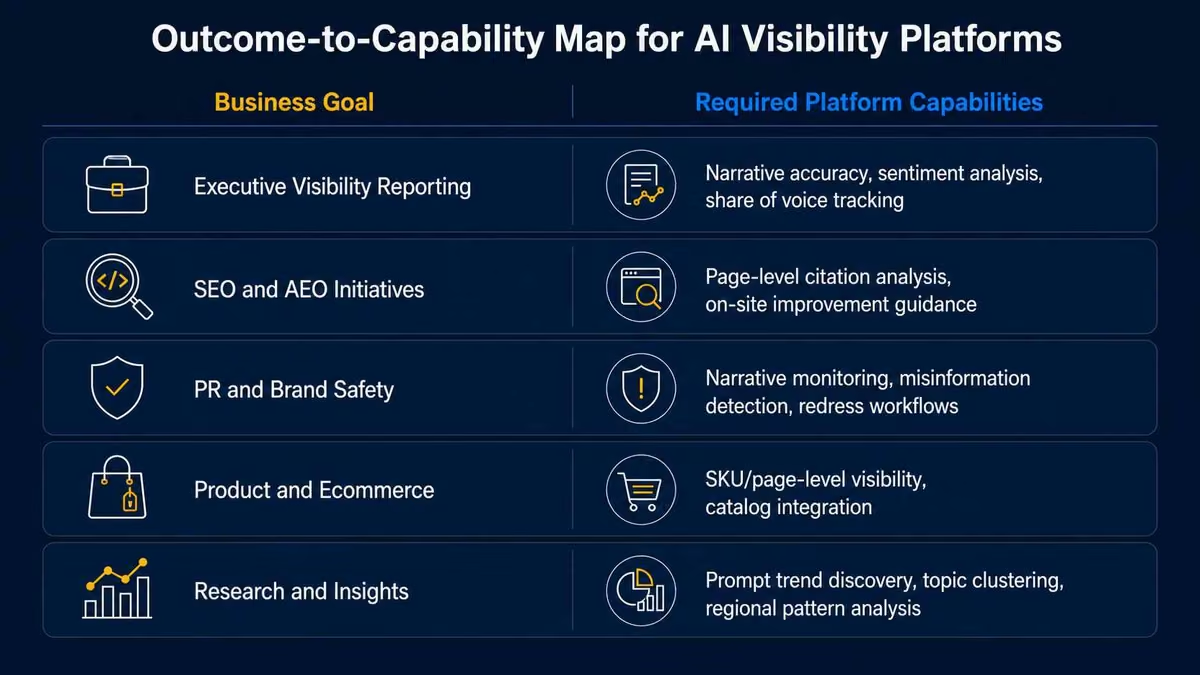
Consider the range of outcomes that different teams typically pursue. Marketing leaders focused on executive visibility reporting need a platform that tracks narrative accuracy, sentiment, and share of voice across the AI ecosystem. They need to be able to answer the question: "When AI engines discuss our category, how often are we mentioned, and what is the tone of that mention?" For SEO and AEO teams, the priority is page-level citation analysis and actionable on-site improvement guidance. These practitioners need to know which specific URLs are being cited, how frequently, and what changes to the content or structure would increase that frequency. Our resource on How To Rank In Google AI Overviews: Factors, Schema, And Steps provides a useful foundation for understanding the content signals that matter most.
PR and brand safety teams have a different set of needs. For them, narrative monitoring, misinformation detection, and redress workflows are essential. They need to know when an AI engine is generating inaccurate or unfavorable content about their brand and have a clear process for addressing it. Product and ecommerce teams, meanwhile, require SKU and page-level visibility data, along with connections to merchandising and catalog systems. And for research and insights functions, the platform must enable prompt trend discovery, topic clustering, and the identification of regional patterns.
With your goals clearly defined, the next evaluation dimension is coverage. A platform that does not monitor the right engines, regions, and languages cannot deliver reliable insights, regardless of how sophisticated its analysis layer is.
What Coverage Actually Means: Engines, Regions, Languages, And Contexts
When assessing profound alternatives, coverage is one of the most consequential criteria you will evaluate. Coverage determines whether the data you receive is representative of the actual landscape your audience is navigating. A platform that only monitors one or two AI engines, or that performs weekly scans in a market that changes daily, will produce insights that are incomplete at best and misleading at worst.
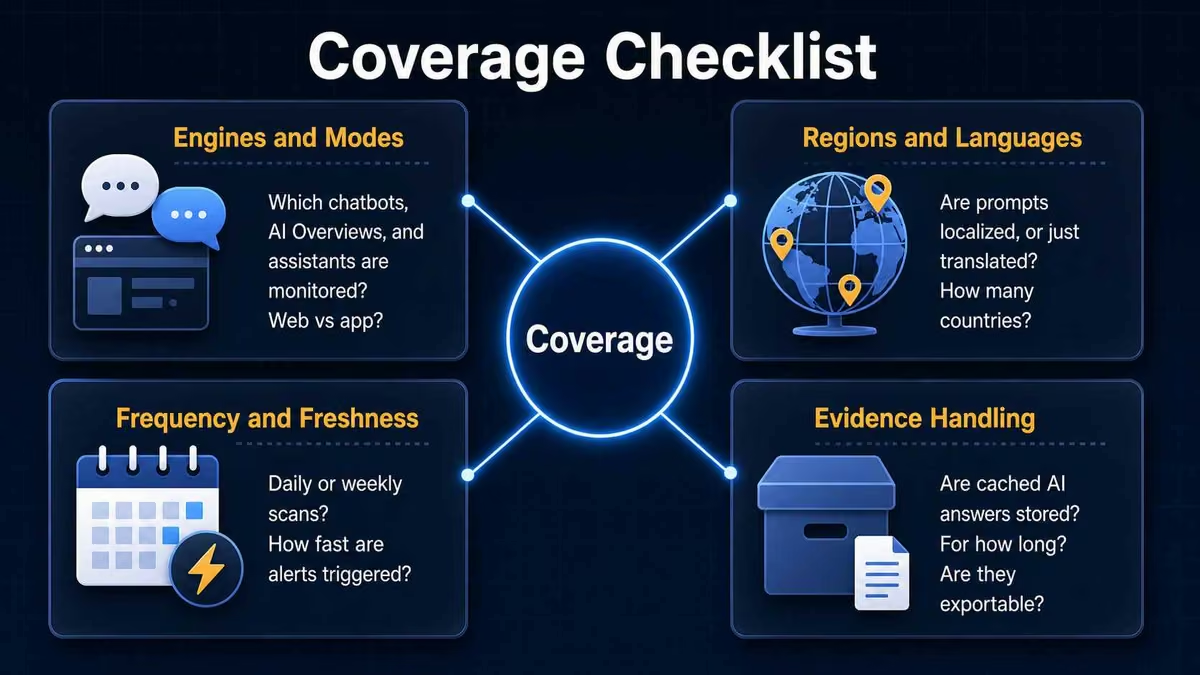
Start by examining which engines and modes the platform monitors. The major conversational AI interfaces include ChatGPT, Claude, Gemini, and Perplexity. Search-engine-native features like Google AI Overviews and Microsoft Copilot represent a separate but equally important surface. A comprehensive platform should monitor both standalone conversational interfaces and integrated search overviews, and it should differentiate between web and app contexts, since the answers generated in each environment can differ. Our article on AI Search Visibility: How Brands Can Appear In AI-Generated Answers provides additional context on how these different surfaces operate.
Regional and language coverage is the next dimension to assess. If your business operates in multiple countries, you need a platform that runs localized prompts, not just translated versions of your English queries. AI engines generate different answers for the same question depending on the user's location, language, and cultural context. A platform that cannot account for this variability will give you a distorted picture of your global visibility.
Frequency and freshness are also critical. Determine whether the platform performs daily or weekly scans, how quickly it detects changes in AI responses, and how responsive its alerting system is. In fast-moving news cycles or competitive categories, a delay of even a few days can mean missing a significant shift in how AI engines are representing your brand.
How Prompt Strategy And Scale Shape The Quality Of Your Insights
The prompt library is the engine of any AI visibility platform. The quality, breadth, and methodology of the prompts you track directly determine the quality of the insights you receive. This is a dimension of profound alternatives that is often underestimated during evaluation, but it has an outsized impact on both the value you extract and the costs you incur.
A strong platform should support robust prompt discovery methods. This includes keyword expansion to surface related queries, question mining to identify the specific questions your audience is asking AI engines, and the identification of conversational variants that capture the natural language patterns users employ. The goal is to build a prompt library that reflects the actual behavior of your target audience, not just the keywords you have historically optimized for.
Once prompts are discovered, effective management becomes essential. Look for features that handle deduplication to prevent redundant tracking, grouping to organize prompts by topic or intent, and tagging to align prompts with specific campaigns or business units. A well-managed prompt library is a strategic asset that grows more valuable over time.
Understanding the limits and costs associated with prompt tracking is equally important. Clarify the platform's prompt allowances, scan frequency limits, and overage policies before you commit. Some platforms charge per prompt per scan, which can make costs unpredictable as your library grows. Others offer flat-rate models with defined limits, which are easier to budget but may constrain your ability to scale.
Reliability is the final dimension of prompt strategy to evaluate. AI engines are probabilistic, meaning the same prompt can yield different answers across different sessions. A rigorous platform will maintain consistent phrasing, control prompt rotation, and perform test/retest procedures to account for this variability. Without these controls, your data will be noisy and difficult to act on. For a deeper understanding of how to structure your prompt strategy for maximum impact, explore our guide on AI SEO: How Should You Define And Report Good Prompt Coverage?
From Mentions To Action: What Citation And Source Analysis Depth Looks Like
Monitoring whether your brand is mentioned in an AI answer is only the beginning. The real value of an AI visibility platform lies in its ability to explain why you are or are not being cited, and to provide a clear path to improvement. This is where citation and source analysis depth becomes a decisive differentiator when evaluating profound alternatives.
At the URL level, the platform should identify which specific pages on your site are being referenced, their positions within the AI answer, and their recurrence across different prompts and engines. A page that is cited once for a single prompt is interesting. A page that is consistently cited across dozens of related prompts is a strategic asset that tells you something important about the content signals AI engines value most.
Source influence analysis takes this a step further. The platform should help you understand how AI engines weight different types of sources, the mix of publishers they favor, and the distribution of content types across citations. If AI engines in your category consistently cite industry publications, technical documentation, or user-generated review content, that is a signal about where you need to invest your content and authority-building efforts.
Competitive share within answers is another critical dimension. Without naming specific vendors, a strong platform should reveal which entities are co-mentioned with yours, which themes are associated with your competitors, and where the gaps in your own coverage lie. This intelligence is the foundation of a Generative Engine Optimization (GEO) strategy that is grounded in data rather than assumptions.
Finally, the platform should surface gaps and opportunities. This includes pages that are close to earning citations but are not quite there, missing evidence that could strengthen your case for inclusion, and format issues that make your content difficult for AI engines to parse and extract. Turning these insights into a content brief is the direct line between monitoring and measurable improvement. To understand the technical foundations that support citation earning, see our resource on AI Schema Generator: Create Valid JSON-LD In Seconds.
Workflow Reality: How Teams Actually Use Insights And Where Friction Appears
A platform can have excellent data and still fail to deliver value if it creates friction in your team's workflow. When evaluating profound alternatives, you must think carefully about how the insights will be used in practice, who will use them, and what processes need to be in place for them to translate into shipped improvements.
Integrations are the first place to look for friction. The platform should connect seamlessly with your analytics tools, dashboards, business intelligence systems, ticketing software, and CMS. It should offer robust data export capabilities and a well-documented API for teams that need to build custom workflows. A platform that exists as an isolated island of data will quickly become underutilized, regardless of the quality of its insights.
Actionability is the next dimension to evaluate. The platform should not just surface problems; it should facilitate solutions. This means providing research notes that can be handed off to content teams, generating content briefs that are grounded in citation data, and offering on-page checks that help writers and editors implement the recommended changes. Governance and approval workflows are also important for larger organizations, ensuring that changes are reviewed and implemented correctly before they go live.
Collaboration features matter enormously for teams that involve multiple stakeholders. Look for role-based permissions that allow you to control who sees what data, commenting capabilities that enable asynchronous discussion, change logs that create accountability, and automated recurring reports that keep leadership informed without requiring manual effort.
The ultimate measure of workflow effectiveness is time-to-impact: how quickly can your team move from identifying a visibility gap to shipping an improvement that closes it? Platforms that streamline this path deliver compounding value over time. For a broader view of how AI tools can accelerate your marketing operations, explore our AI For Digital Marketing: Strategies, Tools, And Trends resource hub.
Understanding The True Cost Structure And Total Cost Of Ownership
Understanding the pricing levers of AI visibility platforms is crucial to avoiding surprises as your usage grows. When choosing among profound alternatives, you must analyze the Total Cost of Ownership (TCO) across both the initial contract period and a realistic 12-month growth scenario.
The core cost drivers typically include prompt volume, scan frequency, the number of engines and regions tracked, and the number of user seats. These variables interact in ways that can make costs grow quickly. A 50% increase in your prompt library, combined with a shift from weekly to daily scans, can multiply your costs several times over. Understanding these interactions before you sign a contract is essential.
Pay close attention to overage rules. Some platforms throttle your access when you exceed your plan limits, which can disrupt your monitoring program at the worst possible time. Others charge per-unit overage fees that can make a single month of heavy usage significantly more expensive than your baseline plan. Credit models, archival limits, and fees for export or API access are other areas where unexpected costs can accumulate.
Support tiers also impact the overall TCO. Evaluate the level of onboarding assistance, Service Level Agreements (SLAs), solution engineering, and custom reporting included in each tier. A platform with a lower base price but minimal onboarding support may cost more in total when you factor in the internal time required to get your team up to speed.
Do not ignore the hidden costs that live outside the platform itself. These include the internal content operations required to act on the insights the platform generates, the effort needed to stitch data from multiple sources together, ongoing BI maintenance, and the organizational change management required to integrate a new workflow into your team's routine.
A 30-Day, Low-Risk Proof Of Concept: How To Evaluate Any AI Visibility Platform
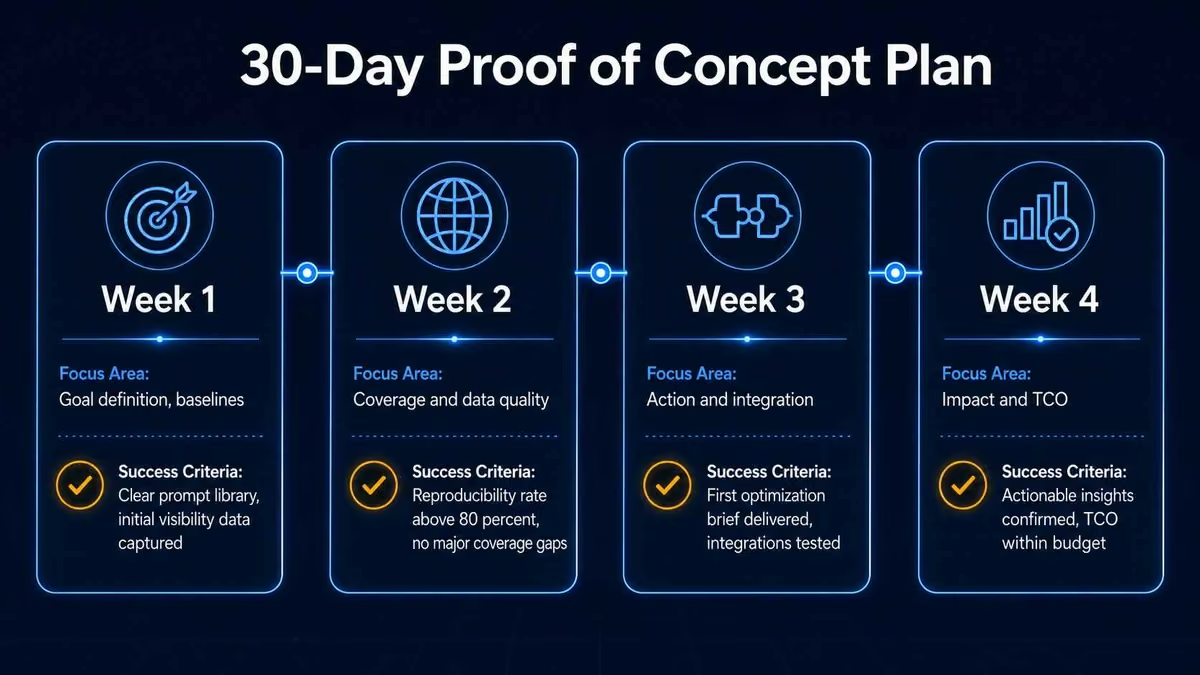
The most effective way to de-risk your selection process is to run a structured 30-day proof of concept before committing to a full contract. This evaluation plan translates the framework above into a concrete, time-bound process that will give you the evidence you need to make a confident decision.
Week 1: Goal Definition, Prompt Sampling, And Baseline CaptureBegin by clearly documenting your business goals and the specific questions you need the platform to answer. Build an initial prompt library of 50 to 100 high-priority queries that reflect your core business objectives. Run your first set of scans and capture baseline visibility metrics across your target engines and regions. This baseline is the benchmark against which all future progress will be measured.
Week 2: Coverage Validation, Data Quality Tests, And Answer Archiving ChecksValidate the platform's coverage by cross-referencing its outputs against manual spot checks. Submit the same prompts across multiple sessions to assess reproducibility. Verify that the answer archiving is functioning correctly and that you can access cached copies of AI responses. Document any gaps or anomalies you discover.
Week 3: First Optimization Brief, Integration Testing, And Reporting CadenceUse the platform's citation and source analysis to generate your first content optimization brief. Test the platform's integrations with your existing tools and evaluate the quality of its data export capabilities. Set up a recurring reporting cadence and assess how well the platform's collaboration features support your team's workflow.
Week 4: Impact Review, TCO Projection, And Rollout RecommendationReview the insights generated during the pilot and assess whether they are actionable and defensible. Project the TCO based on your actual usage during the pilot and compare it against your initial estimates. Make a final rollout recommendation based on the platform's performance against your success criteria.
Conclusion: Choosing Among Profound Alternatives Is About Alignment, Not Features
The landscape of AI visibility platforms is evolving rapidly, and the criteria for evaluating profound alternatives will continue to mature as the technology does. But the fundamental principle of this framework will remain constant: the right platform is the one that aligns your specific business outcomes with reliable coverage, rigorous methodology, and workflows that your team can actually use.
Prioritize reproducibility and actionability over raw data volume. A platform that delivers a smaller set of highly reliable, actionable insights will consistently outperform one that generates enormous volumes of noisy data. Teams that succeed in the generative search era do so by reliably influencing a focused set of high-leverage prompts before expanding their efforts. Start narrow, validate your methodology, and scale with confidence.
The shift to AI-driven discovery is not a future trend to prepare for; it is the present reality your buyers are already navigating. Understanding how your brand is represented in AI-generated answers, and having the tools and workflows to improve that representation, is now a core competency for any marketing team that intends to remain competitive. To learn more about how Gryffin measures, analyzes, and improves your brand's AI visibility, explore the platform and see your AI Visibility Score.
Frequently Asked Questions
Are There Free Profound Alternatives, And What Are The Tradeoffs?
Free or entry-level tools in this category typically offer limited prompt tracking, infrequent scans, and minimal citation analysis. While they can provide a useful introduction to the category, they rarely deliver the coverage depth, data quality, or workflow integrations required for a professional marketing program. The tradeoffs include restricted engine coverage, no answer archiving, and the absence of reproducibility controls that make data defensible to stakeholders. For teams serious about AI visibility, investing in a platform with a structured methodology is essential. To understand what a professional-grade approach looks like, review our guide on AI Brand Visibility Tracking.
How Often Should AI Answers Be Checked To Catch Meaningful Changes?
The right cadence depends on the volatility of your category and the stakes of the queries you are tracking. For high-priority prompts in competitive or fast-moving categories, daily monitoring is recommended. For more stable, evergreen topics, weekly scans may be sufficient. The key is to establish a baseline and then set alerting thresholds that notify your team when visibility shifts meaningfully. A change detection system that flags significant drops or spikes in citation frequency is far more efficient than manual review. Learn more about establishing a measurement framework in our article on AI Search Tracker: A Practical Framework For Monitoring Visibility In AI Answers.
What Is The Difference Between Monitoring Mentions And Earning Citations?
A mention occurs when an AI engine references your brand name within the body of a generated response, even without a hyperlink. A citation occurs when the AI engine embeds a direct link to your content, designating it as a credible source for a specific claim. Citations are significantly more valuable than mentions because they drive direct referral traffic, signal strong topical authority to the AI engine, and indicate that your content is structured in a way that the AI can extract and verify. Building a strategy to earn citations requires a fundamentally different approach than simply increasing brand awareness. For a practical framework, explore our resource on Generative Engine Optimization: What It Is And How To Implement It.
How Do I Measure Progress If Traffic Attribution From AI Answers Is Indirect?
Direct traffic attribution from AI answers is challenging because many AI interactions are zero-click, meaning the user gets their answer without visiting your website. Progress should be measured through a combination of leading and lagging indicators. Leading indicators include your share of voice in AI answers, the frequency of citations, and the sentiment of the responses that mention your brand. Lagging indicators include increases in branded search volume, which often rise as AI recommendations drive users to search for your brand directly, and changes in direct traffic. For a comprehensive view of the metrics that matter, see our guide on How To Measure AI Visibility.
What Should A Defensible Methodology Include For This Category?
A defensible methodology for AI visibility monitoring must include transparent sampling design documentation, reproducible results with quantified variability, and robust anti-blocking strategies that ensure consistent data collection. It should clearly define how brand entities are resolved and deduplicated across different naming conventions, how sentiment and stance are calculated, and how the platform handles the inherent probabilistic variability of AI-generated responses. Before committing to a platform, request a written methodology brief and run a reproducibility check. For more on the technical foundations that support a rigorous program, see our post on AI SEO Audit: A Technical Playbook For AI Search Visibility.
How Many Prompts Do We Need To Start, And How Do We Scale Responsibly?
The most effective approach is to start with a focused set of 50 to 100 high-priority prompts that directly address your core business objectives and the most common questions your target audience asks AI engines. This focused starting point allows you to establish reliable baselines, test your workflows, and validate the platform's methodology before investing in scale. Once you have confirmed that the data is reliable and actionable, expand your library by adding conversational variants, exploring adjacent topic clusters, and incorporating regional or language-specific prompts. Scaling responsibly means growing your prompt library in proportion to your team's capacity to act on the insights it generates. For a deeper understanding of prompt strategy, read our guide on AI SEO: How Should You Define And Report Good Prompt Coverage?
Published by Gryffin | Updated June 2026
Gryffin is an AI-powered marketing intelligence platform that measures, analyzes, and improves your brand's visibility across AI-driven search engines like ChatGPT, Gemini, and Perplexity. Get started for free.
At first, we weren’t even thinking about AI visibility. We were focused on rankings and traffic like everyone else. But once we started testing our brand in ChatGPT and other AI tools, we realized we were barely showing up — even for topics we ‘ranked’ for. Gryffin gave us a clear picture of where we stood, how competitors were being cited instead, and what that actually meant for our pipeline. It shifted how we think about search entirely.







.webp)