AI SEO and Share of Voice: Measuring Visibility in the Age of Answers
Marcela De Vivo
Marcela De Vivo
June 17, 2026
12
The digital landscape is undergoing its most profound transformation in decades. For years, visibility meant securing a top position on a search engine results page (SERP) and hoping for a click. Today, that model is being rapidly eclipsed by a new paradigm. Buyers are increasingly turning to AI assistants and answer engines like ChatGPT, Gemini, and Perplexity to bypass the traditional search journey entirely. They don't want a list of links; they want a synthesized, definitive answer.
If your brand isn't included in those initial AI-generated responses, you are functionally invisible at the exact moment of highest purchasing intent. This shift demands a complete rethinking of how we define, measure, and optimize for visibility. Enter AI SEO and the new metric of success: AI Share of Voice.
This comprehensive guide provides a practical, vendor-neutral framework for understanding how AI SEO reshapes share of voice, how to measure it accurately, and the strategic signals required to ensure your brand remains a trusted, frequently cited entity in the age of answers. We will explore how to transition from legacy rank tracking to entity-first measurement, how to build a robust prompt universe, and how to connect AI visibility directly to business impact. If you are new to this space, our overview of generative engine optimization (GEO) is a strong starting point before diving into measurement.
From Rankings to Recommendations: Why Visibility Has Changed
To understand the necessity of AI Share of Voice, we must first examine the structural differences between traditional search engines and generative AI platforms.
Traditional search is a retrieval system. It crawls, indexes, and ranks web pages based on signals like keyword relevance, backlinks, and domain authority. The output is a list of options (the classic "ten blue links"), leaving the user to evaluate the sources, click through multiple pages, and synthesize the information themselves.
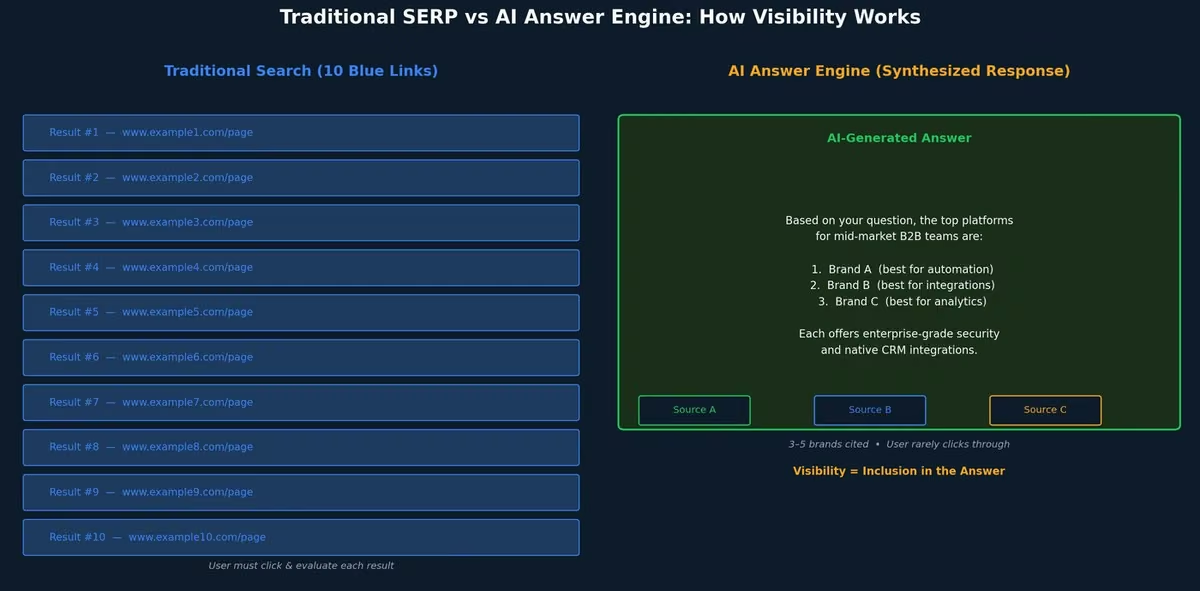
AI answer engines, conversely, are synthesis systems. They utilize Retrieval-Augmented Generation (RAG) to not only find relevant information but to read it, interpret it, and generate a conversational response. This process compresses the evaluation phase. Instead of presenting ten options, the AI acts as a curator, synthesizing a single answer that typically mentions only three to five brands.
Traditional search presents a list of options; AI answer engines synthesize a single curated response that mentions only a handful of brands.
Chart: Traditional SERP vs AI Answer Engine — how visibility is defined in each model.
This structural shift fundamentally alters what "visibility" means. When an AI provides a complete answer directly in the interface, the need for the user to click through to a website diminishes significantly. We are moving into a zero-click reality for many informational and evaluative queries.
Therefore, traditional rank tracking is no longer sufficient. It drastically underreports decision-stage influence because it cannot measure presence inside the synthesized answer. You might rank #1 on Google for a specific term, but if ChatGPT recommends three of your competitors instead of you when asked the same question, your traditional ranking holds little value in that user's journey. Visibility is now defined by inclusion and recommendation, not just retrieval. For more on this transition, explore the differences between GEO SEO vs traditional SEO and what it means for your content strategy.
The Zero-Click Dilemma and Decision-Stage Influence
The rise of zero-click searches means that brand perception and evaluation are happening entirely within the AI interface. If a prospect asks an AI, "What is the best marketing automation platform for mid-sized B2B companies?" the AI's response shapes their consideration set immediately.
If your brand is mentioned favorably, you have established influence without requiring a website visit. If you are omitted, you are excluded from the evaluation process before it even begins. This is why tracking your AI search visibility is critical; it measures your presence where the actual decision-making is occurring. Understanding how to rank better in ChatGPT is no longer optional for brands competing in AI-mediated markets.
Defining AI Share of Voice: Beyond Simple Mentions
In traditional marketing, Share of Voice (SoV) measured a brand's advertising weight or organic search presence relative to competitors. In the context of AI SEO, we must redefine this metric.
AI Share of Voice is the frequency, quality, and context of a brand's inclusion in AI-generated answers across a defined set of commercially relevant user prompts.
It is crucial to understand that AI SoV is not simply a raw count of mentions. Being mentioned in a negative context or as an outdated example is detrimental, not beneficial. A robust AI Share of Voice model must incorporate multiple dimensions to provide a true picture of your brand's standing.
Core Dimensions of AI Visibility
A decision-grade AI SoV metric evaluates four primary dimensions. The first is Frequency and Placement: how often does your brand appear in responses to your target prompts, and is it listed as the primary recommendation, a secondary alternative, or buried in a long list? The second is Sentiment and Framing: how does the AI describe your brand, and what specific attributes or use cases are associated with it? Tracking AI brand sentiment in LLMs is vital for understanding your qualitative positioning. The third dimension is Accuracy and Factuality: is the information the AI presents about your brand correct, or does it cite outdated pricing and hallucinate features? The fourth is Entity Clarity: does the AI clearly understand your brand as a distinct entity, or does it confuse it with a competitor or a generic concept?
A complete AI Share of Voice model evaluates four dimensions: Placement, Sentiment, Accuracy, and Entity Clarity.
A Practical Scoring Approach
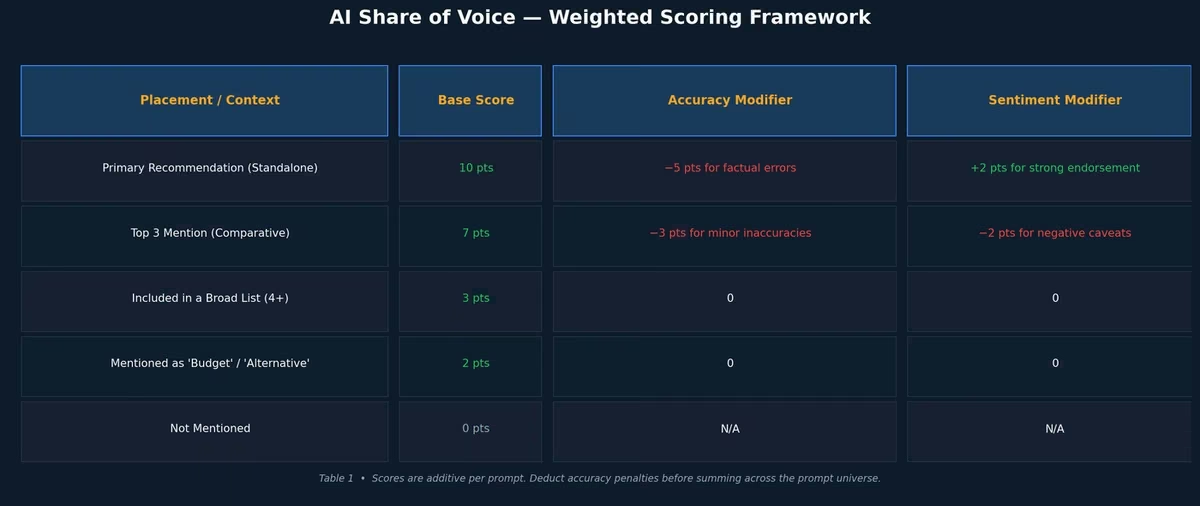
To operationalize AI SoV, you need a weighted scoring system. A foundational approach assigns points based on placement and subtracts points for inaccuracies or negative sentiment. The table below illustrates how this works in practice.
Table 1: Example Weighted Scoring Framework for AI Share of Voice. Scores are additive per prompt; deduct accuracy penalties before summing.
For instance, if your brand is the primary recommendation (10 pts) but the AI hallucinates a feature you don't offer (-5 pts), your net score for that prompt is 5. This weighted approach ensures your AI visibility score reflects the actual quality of your presence, not just raw volume. The Gryffin AI visibility platform is built around exactly this kind of multi-dimensional measurement.
Query Mapping for AI SEO Measurement
The validity of your AI Share of Voice metric depends entirely on the prompts you test. Testing generic, single-keyword prompts will not yield accurate insights because users interact with AI assistants using conversational, complex queries.
To measure AI SoV accurately, you must build a representative prompt universe that mirrors real buyer research behavior. This requires moving away from traditional keyword lists and embracing intent-based query mapping. The concept of query fan-out in AI search describes exactly this process of expanding a single topic into the full range of questions a buyer might ask.
Constructing the Prompt Universe
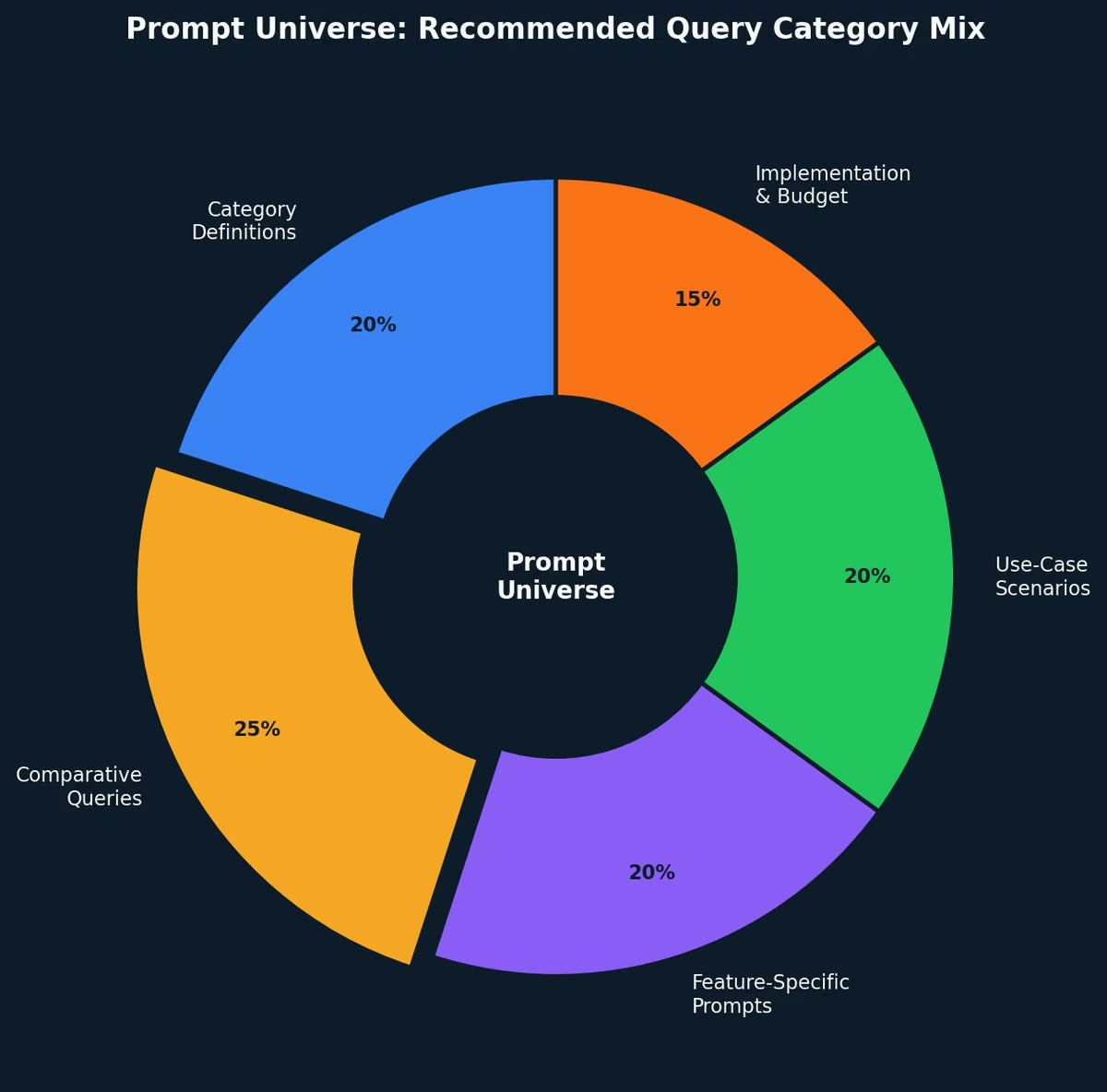
A robust prompt universe should cover the entire buyer journey, from early-stage problem identification to late-stage vendor comparison. Category definition prompts establish what your brand does ("What are the essential features of an enterprise CRM?"). Comparative queries test your brand against alternatives. Feature-specific prompts probe individual capabilities. Use-case scenarios reflect real-world purchasing contexts. Implementation and budget prompts capture late-stage evaluation intent. By logging the intent class for each question, you can slice your AI SoV data to see where you are strong and where you are absent.
A balanced prompt universe distributes testing across all five query intent categories to capture the full buyer journey.
Sampling Rules and Cadence
Your prompt universe must be dynamic. Test your core category prompts weekly to catch sudden shifts, and rotate secondary feature prompts bi-weekly or monthly. Update the universe quarterly to reflect new industry trends, feature releases, or shifts in user terminology. If you operate globally, include multilingual prompts, as AI responses can vary significantly by language and region. For a deeper look at how search intent maps to prompt construction, that framework translates directly into the AI context.
Cross-Engine Sampling and Consistency Controls
AI Share of Voice is not a monolithic metric because the AI landscape is fragmented. Visibility varies significantly across different answer engines due to differences in their underlying models, training data, and retrieval mechanisms. To gain a comprehensive view of your market position, you must implement cross-engine sampling.
Testing across multiple platforms introduces variance. A brand might dominate citation-heavy responses on one platform but be entirely absent from another's summaries. To make your AI SoV metric reliable and decision-grade, you need strict consistency controls. Run the exact same prompt universe across all target engines simultaneously. Conduct your tracking within a narrow time window to minimize the impact of mid-week model updates. Run critical prompts multiple times to establish a confidence interval and ensure your visibility isn't a one-off result. Always capture the URLs the AI cites to support its answer, as this is crucial for reverse-engineering why a competitor was chosen over you.
By tracking per-engine AI SoV alongside an aggregate index, you can provide leadership with a nuanced understanding of your performance across the entire AI search landscape. An AI search tracker built for this purpose automates much of this cross-engine monitoring workflow.
Weighting, Accuracy, and Context: Making the Metric Decision-Grade
Raw data is not a metric. To elevate AI Share of Voice from an interesting observation to a decision-grade KPI, you must apply rigorous weighting, accuracy validation, and contextual analysis.
Not all mentions are created equal. A standalone recommendation as the "best overall solution" carries exponentially more weight than being listed fifth in a generic roundup. Your scoring model must reflect this hierarchy. Top positions and explicit endorsements should receive significant multipliers, while passing mentions receive base points.
AI models hallucinate. They confidently state incorrect facts, invent features, and misquote pricing. If an AI recommends your software but states it costs $10/month when it actually costs $100/month, that is a negative outcome. It sets false expectations and damages trust. Your measurement framework must include an accuracy validation step. Flag instances where the AI presents outdated information, feature hallucinations, or misclassifications, and apply appropriate deductions to your score.
Context matters immensely. Segment your mentions by how the AI frames your brand. If your marketing strategy is focused on moving upmarket to enterprise clients, but AI engines consistently frame you as the "best budget option for small businesses," you have a severe entity alignment problem. Tracking narrative framing allows you to identify these disconnects and adjust your semantic SEO and content strategy accordingly. This is also where AI competitor analysis becomes invaluable for benchmarking your narrative positioning against rivals.
Signals That Shape Inclusion in AI Answers
Understanding how to measure AI SoV is only half the battle; you must also know how to influence it. AI engines do not rank pages; they retrieve and synthesize information based on specific signals. To improve your inclusion rate, you must optimize for machine readability and entity authority.
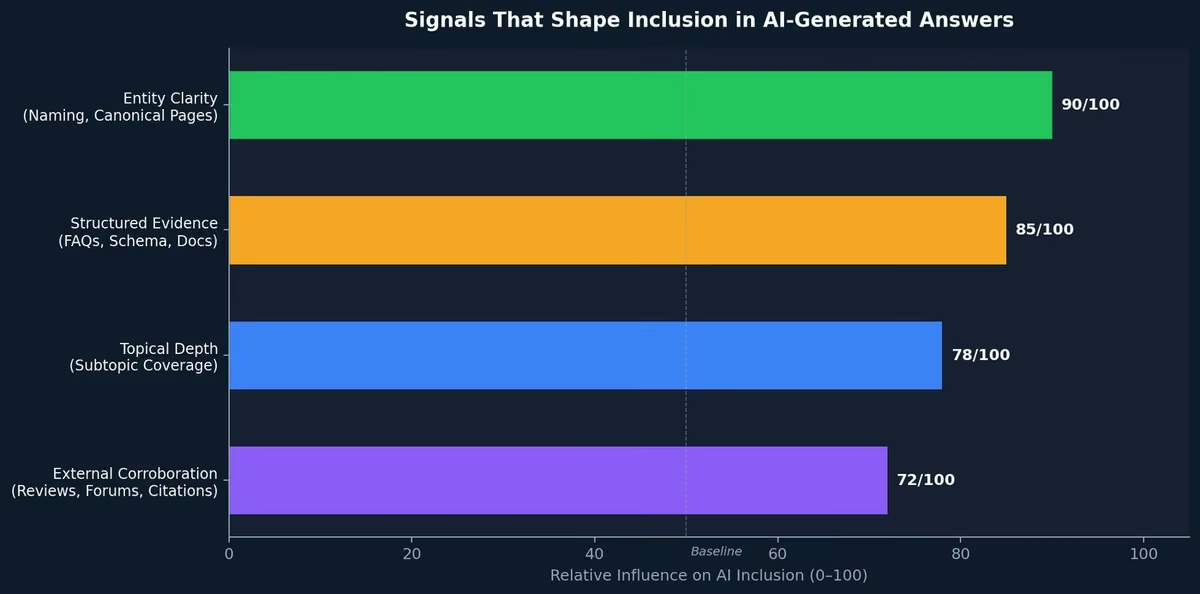
Building strong AI visibility requires a structured content architecture that signals entity clarity, topical depth, and external corroboration to AI models.
Entity Clarity and Structured Evidence are the highest-impact signals for improving inclusion in AI-generated answers.
AI models organize information around entities (people, places, organizations, concepts). If your brand identity is fragmented across the web, the AI will struggle to understand who you are and what you do. Your website must explicitly state what your brand is and what category it belongs to. Use clear, definitive language rather than clever marketing jargon. Use your brand name, product names, and key terminology consistently across all your digital assets, PR releases, and social profiles. Ensure you have a single, authoritative page that defines your brand and its core offerings.
AI models also prefer content that is easy to parse and extract. They look for structured evidence to support their generated answers. Frequently Asked Questions are incredibly effective because they mirror the prompt-and-response format of AI interactions. Utilize appropriate schema markup (Organization, Product, FAQPage) to explicitly define your content for machine readers. Ensure your pricing, feature lists, and technical documentation are clearly structured, preferably using tables and bulleted lists. Our guide on using AI for on-page SEO covers many of these structural optimization techniques in detail.
To be considered an authoritative source, you must also demonstrate deep expertise in your category. Build robust content clusters that cover your primary topics and all related subtopics in exhaustive detail. This signals topical authority to the AI. If your claims are corroborated by authoritative third-party sources, industry reports, and user discussions, the AI is more likely to trust and cite your information. The AI visibility platform guide provides a comprehensive framework for identifying exactly where those citation gaps exist.
Finding and Closing Citation Gaps
The most actionable output of measuring AI Share of Voice is identifying citation gaps: the specific prompts and topics where your competitors are mentioned, and you are not. Closing these gaps is the core workflow of AI SEO.
When you analyze the AI outputs for your prompt universe, pay close attention to the sources the AI cites. Track which domains are repeatedly cited across your target queries. Are they competitor websites, industry publications, review platforms, or forums? You cannot fix every gap simultaneously, so prioritize the sources and topics that consistently inform answers for your most commercially valuable prompts. If a specific competitor's content is cited in 80% of the answers regarding a key feature, that is a high-priority gap. This is precisely the kind of intelligence that a structured content gap analysis is designed to surface.
Once you have identified the gaps, execute a targeted remediation strategy. If the AI is citing outdated information about your brand, update your core entity pages, press releases, and structured data to clarify the facts. Proactively publish content that addresses the specific questions and comparisons where you are currently absent, ensuring this content is highly structured, factual, and easy for the AI to extract. For a deep dive into this tactic, review our guide on LLM seeding strategy for AI visibility. If the AI relies heavily on review sites or forums for a specific topic, engage with those platforms to ensure your brand is represented accurately in the external consensus.
Benchmarks, Trendlines, and Business Impact
To secure executive buy-in for AI SEO initiatives, you must connect AI Share of Voice to tangible business outcomes. Do not treat AI SoV as an isolated vanity metric; integrate it into your broader marketing dashboard.
When you first begin measuring AI SoV, focus on establishing a baseline rather than agonizing over the absolute score. A score of 40 might be excellent in a highly fragmented, mature market, but poor in a niche category with only two competitors. Track your performance relative to your direct competitors, not an arbitrary perfect score. The direction of your score is more important than the number itself. Are you consistently gaining visibility month over month? Are your targeted remediation efforts closing specific citation gaps?
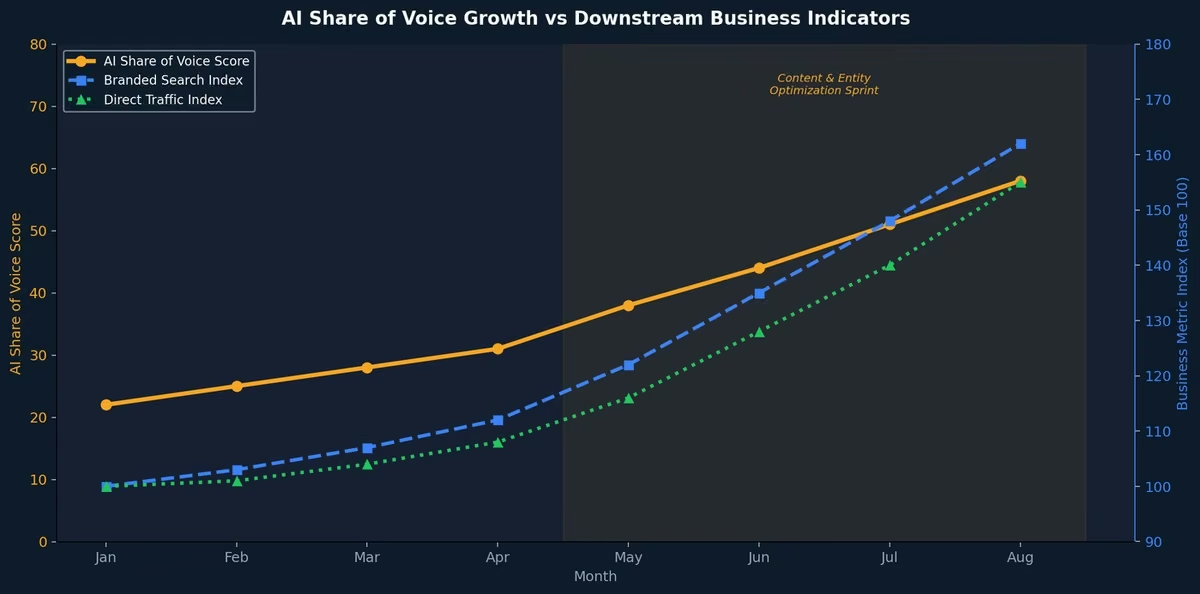
Connecting AI Share of Voice growth to downstream business indicators like branded search volume and direct traffic is essential for executive reporting.
As AI Share of Voice increases following a content and entity optimization sprint, correlated lifts in branded search and direct traffic confirm business impact.
The ultimate goal is to prove that increasing AI Share of Voice drives business value. Look for correlations between your AI visibility metrics and downstream indicators. As your brand is mentioned more frequently in AI answers, you should see an increase in users searching for your brand name directly on traditional search engines. Users who discover you via an AI recommendation may bypass search entirely and navigate directly to your domain. Track whether increases in AI SoV for specific product categories correlate with an uptick in relevant leads or sales pipeline velocity. Our guide on how to measure AI visibility provides a full framework for connecting these metrics into a cohesive reporting structure.
Treat AI SEO as an iterative process. Design controlled experiments: update a specific cluster of content, implement new schema, and observe the changes in your AI SoV for related prompts over the following weeks. Always utilize confidence intervals or variance bands when reporting. AI models fluctuate naturally, so do not overreact to a minor week-over-week dip; focus on the sustained, long-term impact of your AI search optimization efforts. The brands that treat this as a continuous measurement and improvement cycle will compound their advantage over time.
Conclusion
The transition from traditional search to AI-mediated discovery is not a future possibility; it is the current reality. Visibility is no longer defined by page position, but by inclusion within synthesized, AI-generated answers.
To succeed in this new environment, brands must adopt a measurement model that values accuracy, context, and entity clarity over raw frequency. By establishing a representative prompt universe, measuring visibility consistently across multiple engines, and systematically closing citation gaps through structured, entity-first content, you can ensure your brand remains a trusted and recommended authority. The brands that master AI Share of Voice today will control the narrative and capture the demand of tomorrow. To get started, explore the Gryffin AI visibility platform and see how automated tracking can accelerate every step of this process.
Frequently Asked Questions
What is AI Share of Voice and how is it different from traditional SoV?
AI Share of Voice measures how frequently and favorably your brand is included in AI-generated answers across a set of target prompts. Unlike traditional SoV, which tracks advertising spend or organic ranking positions on a SERP, AI SoV evaluates your actual presence and context inside the synthesized responses provided by tools like ChatGPT or Gemini.
How often should AI Share of Voice be measured?
Because AI models update frequently and search behaviors shift, AI Share of Voice should be measured regularly. We recommend tracking core category prompts weekly to catch sudden shifts, while rotating secondary feature or long-tail prompts on a bi-weekly or monthly basis.
How do I account for inaccuracies or hallucinations in AI answers?
Your measurement framework must include an accuracy validation step. When calculating your AI visibility score, apply point deductions or penalties when the AI hallucinates features, misquotes pricing, or presents outdated information about your brand. This ensures your metric reflects only positive, accurate visibility.
Which types of questions should be included in a prompt universe?
A robust prompt universe should mirror the entire buyer journey. It must include category definitions, comparative queries (Brand A vs Brand B), feature-specific questions, use-case scenarios, and implementation/budget inquiries to capture intent across all stages of research.
How can I connect AI SoV to tangible business metrics?
Correlate your AI Share of Voice trendlines with downstream indicators such as increases in branded search volume, direct traffic, demo inquiries, and assisted conversions. As your brand is recommended more often by AI, you should see a corresponding lift in these pipeline metrics.
Does sentiment or framing in AI answers affect outcomes?
Absolutely. Being mentioned as a "cheap, low-quality alternative" is very different from being recommended as the "industry-leading enterprise solution." Tracking sentiment and narrative framing is essential to ensure the AI's perception aligns with your actual brand positioning.
How do I manage multilingual or regional variations when measuring AI SoV?
AI outputs can vary significantly based on the language and location of the prompt. If you operate globally, you must segment your prompt universe and test queries in the specific languages and regional contexts relevant to your target markets to get an accurate picture of your international AI visibility.
At first, we weren’t even thinking about AI visibility. We were focused on rankings and traffic like everyone else. But once we started testing our brand in ChatGPT and other AI tools, we realized we were barely showing up — even for topics we ‘ranked’ for. Gryffin gave us a clear picture of where we stood, how competitors were being cited instead, and what that actually meant for our pipeline. It shifted how we think about search entirely.











.webp)