AI Search Visibility Metrics KPIs: How to Measure Presence in a Synthesis-First Web
Marcela De Vivo
Marcela De Vivo
June 24, 2026
12
The fundamental mechanics of search and discovery are undergoing a profound transformation. For decades, visibility was defined by securing a top position in a ranked list of blue links. The traditional search engine optimization (SEO) playbook focused on keyword density, backlink profiles, and technical site structure to win these coveted spots. Today, however, generative search results and AI overviews surface synthesized answers long before a user ever clicks a link. This shift from retrieval to synthesis means that traditional SEO metrics no longer tell the full story. In a landscape where users receive complete, conversational answers directly within the interface, brand visibility depends entirely on being cited as a source.
As discovery moves from rankings to answers, marketing and digital leaders must adopt a new framework to measure their presence. Understanding AI search visibility metrics KPIs is the key to unlocking this new era of digital discovery. These metrics move beyond clicks and impressions, focusing instead on how often and how accurately a brand is included in AI-generated responses. The implications for brand awareness, traffic, and revenue are immense. If your brand is not part of the AI's synthesis, you are invisible to a growing share of your most valuable audience. This is why AI brand visibility tracking has become a core discipline for modern marketing teams.
This comprehensive guide will explore the core metrics, measurement methods, and governance strategies necessary to operationalize AI visibility as a core component of your digital infrastructure. We will break down the layered metrics stack, define the essential KPIs, and provide a roadmap for building a content engine that consistently earns citations in the synthesis-first web.
What "AI Search Visibility" Actually Means
Defining AI search visibility requires a departure from traditional SEO paradigms. In the past, the goal was to ensure content was indexed and ranked highly on a search engine results page (SERP). Now, the objective is to ensure content is extractable, verifiable, and selected by large language models (LLMs) for synthesis. AI search visibility encompasses discoverability by AI agents, inclusion in generated answers, representation accuracy, and downstream engagement. It is not just about being found; it is about being the answer.
Discovery Versus Inclusion Versus Representation
Visibility in AI search operates on a continuum, and understanding this continuum is crucial for effective measurement. Discovery is the technical prerequisite, ensuring that AI bots and crawlers can access, parse, and understand your content. If an AI cannot read your site, it cannot cite it. Inclusion is the measure of how frequently your brand or content is cited when a relevant prompt is queried. This is the equivalent of "ranking" in the AI era, but it is measured by presence in the answer rather than a position on a page. Representation accuracy evaluates whether the AI accurately reflects your canonical facts, brand messaging, and tone.
A brand may be discovered but not included, or included but misrepresented. True visibility requires excellence across all three dimensions. You must ensure that when the AI speaks about your industry, it speaks about you, and it does so accurately. This is the foundational principle behind LLM SEO strategies: building content infrastructure that performs well at every stage of the AI's retrieval and synthesis pipeline.
How Large Language Models Source and Assemble Answers
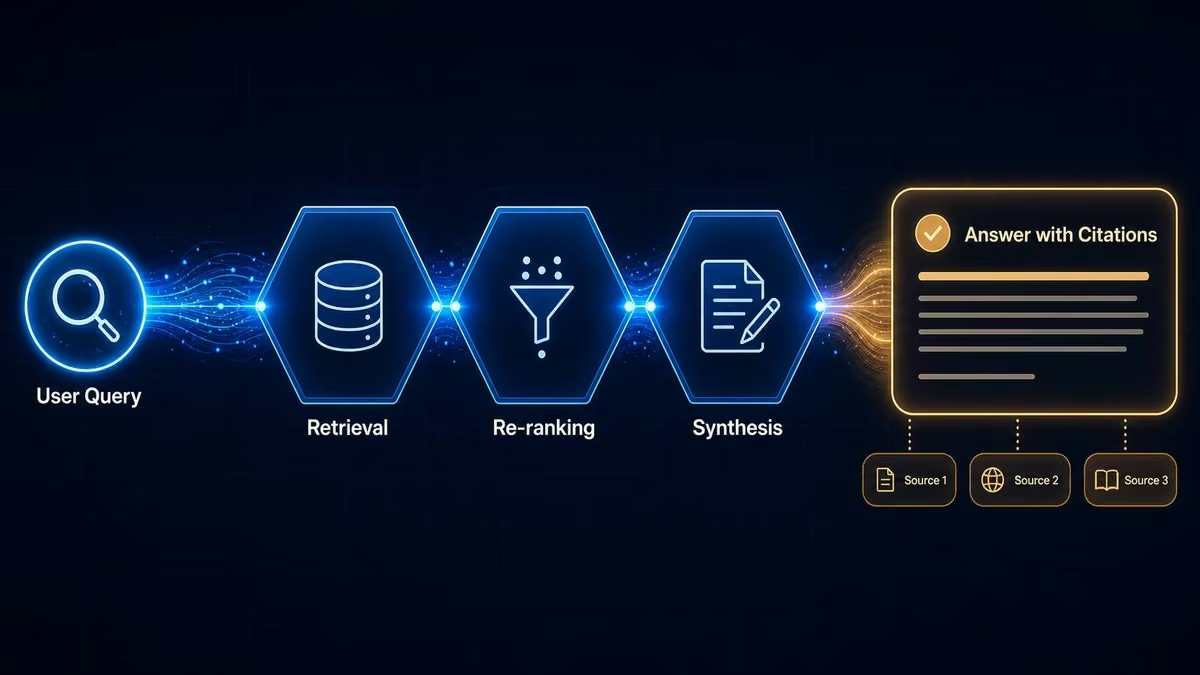
To understand how to measure visibility, one must understand how AI models construct their responses. When a user submits a prompt, the engine does not merely retrieve a page and summarize it. It runs a multi-stage process: first retrieving a broad set of potentially relevant passages from its training data or a live retrieval index, then re-ranking those passages by relevance and credibility, and finally synthesizing a coherent answer that may draw from dozens of sources simultaneously.
This entity-centric approach means that engines assemble answers from verifiable data points rather than just parsing keywords. They look for clear definitions, structured data, and authoritative signals. Consequently, your measurement strategy must track how your entities and facts are cited across the model's output, not just whether a specific URL is referenced. The Google AI search algorithm and other generative systems are increasingly rewarding content that is structured for extraction, not just optimized for ranking.
Where Visibility Shows Up in the User Journey
The impact of AI visibility extends throughout the user journey, influencing behavior long before a click occurs. Pre-click influence occurs when a brand is mentioned in an AI overview or summary. The user sees the brand name associated with a solution or concept, shaping their perception even if they do not click through to the site. This is a powerful form of brand awareness that traditional analytics often miss entirely. As users interact conversationally with AI assistants to refine their queries, the AI may guide them toward specific brands or solutions based on the context of the conversation. Finally, when the AI provides a direct link to a source, it drives highly qualified traffic to the site.
Understanding these touchpoints is critical for attributing value to AI-driven discovery and recognizing the broader impact of being cited. This is why a comprehensive AI search tracker must monitor all three stages of the user journey, not just the final click.
The Metrics Stack: A Layered Model for AI Visibility
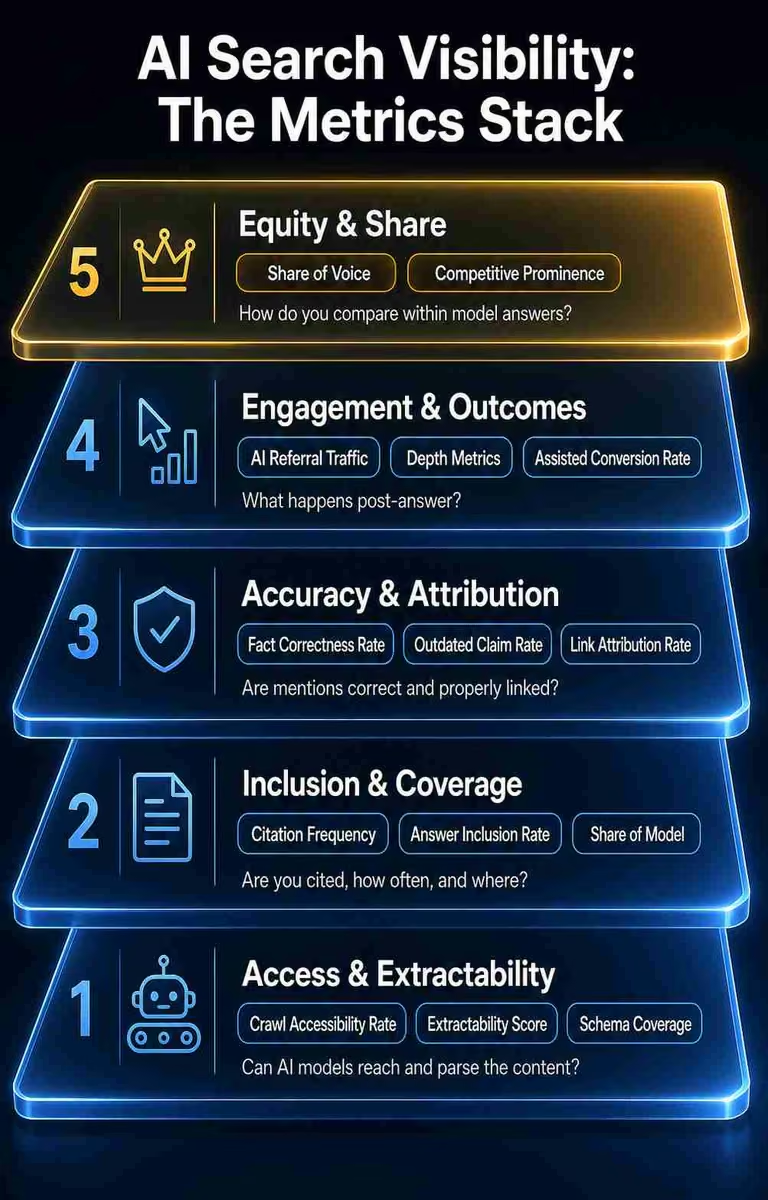
To effectively measure AI search visibility, organizations need a structured framework that connects technical exposure to business outcomes. The metrics stack provides a layered model, progressing from foundational access to commercial equity. This approach aligns stakeholders on which KPIs are leading indicators and which represent lagging business impact.
Metric LayerFocus AreaKey Performance Indicators (KPIs)Primary StakeholderAccess and ExtractabilityCan AI models reach and parse the content?Crawl accessibility rate, extractability score, schema coverageTechnical SEO, DevelopmentInclusion and CoverageAre you cited, how often, and where?Citation frequency, answer inclusion rate, share of modelContent Strategy, SEOAccuracy and AttributionAre mentions correct and linked to the source?Fact correctness rate, outdated claim rate, link attribution rateBrand Management, PREngagement and OutcomesWhat happens post-answer?AI referral traffic volume, depth metrics, assisted conversion rateAnalytics, Marketing OpsEquity and ShareHow do you compare within model answers?Share of voice relative to competitors, competitive prominenceExecutive Leadership
The foundational layer focuses on whether AI models can reach and parse your content. This involves assessing crawlability, indexation, and the coverage of structured data for extractable facts. If an AI agent cannot access or understand your content, it cannot cite it. This layer requires close collaboration between technical SEO teams and developers to ensure that the site architecture is optimized for AI crawlers. An AI SEO audit is the most effective starting point for identifying and resolving access barriers.
Once content is accessible, the inclusion and coverage layer measures how often it is utilized. This includes tracking citation frequency, the rate of answer inclusion, and the share of model at a topic level. These metrics reveal whether your content is considered authoritative enough to be included in synthesized answers. This is where content strategists must focus their efforts, ensuring that the content answers the questions users are asking AI assistants.
Being included is only valuable if the representation is accurate. The accuracy and attribution layer evaluates the correctness of core claims, context completeness, and whether expertise is properly attributed with a link to the source. Brand managers and PR teams must monitor this layer closely to protect brand integrity and ensure that the AI is not hallucinating or misrepresenting the brand's offerings.
The engagement layer tracks what happens after an answer is provided. It measures AI referral traffic, dwell time, and assisted sessions. The outcome layer connects these engagements to business value, tracking assisted conversions, pipeline influence, and the cost per assisted visit. This layer bridges the gap between visibility and revenue, demonstrating the ROI of AI search optimization efforts.
The final layer assesses how your visibility compares within the broader model answers. It provides a competitive context, showing your share of voice relative to the total citations in the answer set for a defined topic space. This is closely related to the concept of AI SEO and share of voice, where the goal is to understand your brand's dominance within the AI's knowledge base for your industry.
Core KPIs for AI Discovery and Inclusion
With the layered model established, it is essential to define the specific AI search visibility metrics KPIs that drive actionable insights. These primary KPIs provide the granular data needed to optimize content and track progress. The following table provides a quick reference for each core KPI, its formula, and its data source.
KPIFormula / CalculationData SourceReporting CadenceCrawl Accessibility RateAccessible paths / Total paths x 100Server logs, robots.txt auditMonthlyExtractability ScoreWeighted score based on schema, definitions, headingsContent auditQuarterlyAnswer Inclusion RatePrompts with brand mention / Total sampled prompts x 100Response sampling panelWeekly / MonthlyCitation FrequencyTotal brand citations in sampled responsesResponse sampling panelWeekly / MonthlyShare of ModelBrand citations / Total citations in topic space x 100Response sampling panelMonthlyFact Correctness RateAccurate claims / Total claims audited x 100Manual answer auditMonthlyLink Attribution RateCitations with source link / Total citations x 100Response sampling panelMonthlyAI Referral Traffic ShareAI-referred sessions / Total sessions x 100Analytics, server logsWeeklyAssisted Conversion RateConversions with AI touchpoint / Total conversions x 100Multi-touch attribution modelMonthly
Crawl Accessibility Rate for AI Agents
This metric measures the percentage of your site's paths and content types that are accessible to AI crawlers. It is a fundamental technical KPI that ensures no barriers prevent discovery. A low crawl accessibility rate indicates technical issues that must be resolved before any content optimization can be effective. Teams should audit their robots.txt files and server configurations to ensure that AI agents are not inadvertently blocked.
Extractability Score
The extractability score evaluates how well your content is structured for AI parsing. It looks at headline patterns, self-contained definitions, and schema coverage. A high score indicates that your facts are easily identifiable and ready for synthesis. Content that is dense, unstructured, or lacks clear definitions will score poorly on extractability. Improving this score is one of the most reliable ways to increase answer inclusion rate.
Answer Inclusion Rate
This is the percentage of sampled prompts where your brand appears in the synthesized answer. It is a direct measure of presence in AI overviews and conversational responses for specific query classes. Tracking the answer inclusion rate over time reveals whether your AI search optimization efforts are successfully increasing your visibility. A sample calculation: if your brand appears in 25 out of 100 sampled prompts, your answer inclusion rate is 25%.
Citation Frequency
Citation frequency counts the number of times your brand or content is cited across a set of sampled AI responses. It provides a volume metric for your visibility within a specific topic cluster. A high citation frequency indicates that the AI considers your brand a highly authoritative source for that topic. Unlike the answer inclusion rate, citation frequency can count multiple mentions within a single response.
Share of Model
Share of model calculates your citations divided by the total citations in the answer set for a defined topic space. This KPI is crucial for understanding your dominance or deficit within the AI's knowledge base for your industry. For example, if a sample of 100 prompts about your industry generates 200 total citations, and your brand accounts for 30 of those, your share of model is 15%. It provides a more nuanced view than citation frequency alone, as it accounts for the competitive landscape within the AI's responses.
Accuracy, Attribution, and Brand Integrity Metrics
Precision matters as much as presence. When AI models synthesize answers, there is a risk of hallucination or misrepresentation. Defining how to measure correctness and attribution quality is vital for maintaining brand integrity. This section of the metrics stack is often overlooked by teams focused solely on increasing visibility, but it is equally critical for long-term brand health.
The fact correctness rate compares the claims made in AI answers against your canonical sources. It ensures that when your brand is mentioned, the information provided is accurate and aligned with your official messaging. A low fact correctness rate indicates that the AI is misinterpreting your content or relying on outdated information. The outdated claim rate tracks mentions that conflict with your current specifications or policies, which is particularly important for products or services that undergo frequent updates.
While citations are valuable, citations that include a source link drive direct traffic. The link attribution rate measures the percentage of your citations that provide a clickable pathway back to your site. This metric is essential for connecting AI visibility to tangible website traffic. The source prominence score weights your mentions based on placement, snippet length, and the number of mentions within an answer. A prominent citation at the beginning of an answer is more valuable than a brief mention buried at the end.
Finally, hallucination and misattribution incident rates track the frequency of completely fabricated claims or instances where your content is incorrectly attributed to another source. Monitoring these incidents is critical for triggering correction workflows and ensuring that the AI is not spreading misinformation about your brand.
Engagement and Commercial Signal KPIs for AI-Driven Traffic
Moving from visibility to value requires separating and evaluating the traffic influenced by AI-generated experiences. These KPIs help quantify the commercial impact of your AI search optimization efforts and connect the work of content and SEO teams to revenue outcomes.
AI referral traffic volume and share isolates the traffic arriving from AI assistants and overviews. It helps determine the proportion of your overall traffic that is driven by generative search. As AI search continues to grow, this share is expected to increase significantly. Depth metrics, such as pages per session, time on page, and scroll depth, evaluate the quality of AI-referred traffic. They indicate whether users arriving from AI answers are finding the content relevant and engaging.
Tracking task completion proxies, such as document downloads, demo video views, or specification interactions, provides insight into the intent and value of the AI-driven audience. These proxies serve as intermediate steps toward a final conversion, indicating that the user is actively evaluating your offerings. The assisted conversion rate takes a multi-touch view, measuring how often an AI-influenced path leads to a conversion. It acknowledges that AI visibility often plays a role early in the buyer's journey, even if the final conversion occurs through a different channel.
Methodology: How to Measure AI Search Visibility Metrics KPIs Reliably
Instrumenting these metrics requires a combination of practical methods and data sources. A reproducible sampling and longitudinal tracking methodology is essential for reliable measurement. The following five-step process provides a practical framework for getting started.
Step 1: Build Your Prompt Panel. Curate a set of prompts that represent the queries your target audience is asking AI assistants. Organize these by topic cluster, intent, and lifecycle stage. A well-designed prompt panel is the foundation of all AI visibility measurement.
Step 2: Run Response Sampling. Test your prompt panel across major AI interfaces and capture the responses. Document which brands are cited, how they are described, and whether source links are provided. This is the core data collection activity.
Step 3: Analyze Server and CDN Logs. Identify AI agent patterns in your server logs to understand which crawlers are accessing your site and which pages they are visiting. This data informs your crawl accessibility rate and helps you identify technical barriers.
Step 4: Conduct a Structured Content Audit. Assess your content for schema coverage, extractability, and accuracy. Identify pages that are likely to be cited and ensure they are optimized for AI parsing.
Step 5: Stitch the Data Together. Reconcile your sampled visibility data with your web analytics, server logs, and CRM data to build a comprehensive picture of AI-driven impact. Implement confidence scoring and variance monitoring to account for the dynamic nature of AI responses.
Server and CDN logs are critical for identifying AI agent patterns and separating them from traditional bot traffic. Structured content audits help assess schema coverage and extractability. Additionally, manual and scripted answer snapshots for key queries provide direct observation of inclusion and accuracy. Using an AI visibility platform can significantly streamline this process by automating prompt sampling and response analysis across multiple AI interfaces.
Benchmarks and Targets: Setting Goals That Reflect Your Category
Setting realistic targets for AI visibility requires understanding that benchmarks vary by market, document type, and competition density. It is important to establish baselines before defining operational goals. The maturity model below provides a framework for setting category-normalized targets.
Maturity TierFocusTarget MetricKey ActionsEmergingEnsuring content is accessible to AI crawlersCrawl accessibility rate greater than 95%Technical audit, robots.txt review, schema implementationDevelopingStructuring content for extractionExtractability score improvement quarter over quarterAnswer-first content, definition blocks, FAQ schemaAdvancedEarning citations in synthesized answersAnswer inclusion rate greater than 30%Authority building, entity signals, topical depthLeadingDominating share of voice and driving trafficShare of model leadership, high link attribution rateFreshness cadence, governance workflows, competitive monitoring
Use leading indicators to anticipate shifts. Drops in inclusion often precede traffic changes, serving as an early warning system. Similarly, monitor for accuracy drift after major content updates or model releases to ensure your representation remains intact. Aligning your targets to revenue-critical content is essential for securing executive buy-in and demonstrating the business value of AI visibility efforts.
Operational Foundation: Content Engineering and Governance for AI Inclusion
Translating metrics into actions requires robust content engineering and governance practices. This operational foundation ensures that your content is consistently optimized for AI extraction and synthesis. The metrics stack tells you where you stand; the operational foundation tells you what to do about it.
Adopt answer-first sections and unambiguous definitions. Use fact tables, specifications, and references with timestamps to enhance verifiability. Implement comprehensive schema for FAQs, how-to guides, and product specifications to provide structured data that models can easily parse. This is the core of generative engine optimization (GEO), the practice of engineering content specifically for inclusion in AI-generated answers.
Establish update cadences for time-sensitive facts to minimize outdated claims. Maintain source-of-truth repositories and clear review workflows to ensure accuracy. Implement access policies for AI agents, using robots directives to selectively expose content based on value exchange. For teams looking to build a comprehensive ChatGPT visibility playbook, these governance practices are the foundation for sustained, long-term presence in AI-generated answers.
Conclusion: Measure What Models Cite, Not Just What Pages Rank
In a synthesis-first landscape, being cited accurately is the new visibility. The shift from traditional rankings to AI-generated answers requires a fundamental change in how we measure success. The metrics and frameworks outlined in this guide provide a practical path forward for marketing and digital leaders who are ready to operationalize AI search measurement as a core business discipline.
The key insight is this: AI visibility is not a single metric. It is a layered system that spans technical access, content inclusion, representation accuracy, and commercial engagement. Each layer builds on the last, and weakness at any level undermines the entire program. By operationalizing a repeatable measurement program that links AI search visibility metrics KPIs to content engineering and governance, organizations can secure their presence in the future of discovery. Audit your current inclusion and accuracy, establish your layered KPIs, and manage to those targets as core digital infrastructure. The brands that build this capability now will have a significant and compounding advantage as AI search continues to grow. Explore Gryffin's AI visibility features to see how you can start measuring and improving your presence in AI-generated answers today.
Frequently Asked Questions
What Are AI Search Visibility Metrics KPIs, and How Do They Differ from Traditional SEO Metrics?
AI search visibility metrics KPIs measure how often and how accurately a brand is cited within AI-generated answers, rather than tracking keyword rankings or click-through rates on traditional search engine results pages. Traditional SEO measures positions on a page, while AI visibility measures presence in a synthesized response. The shift requires a new measurement stack that spans technical access, content inclusion, representation accuracy, and commercial engagement.
How Do I Calculate Share of Model for a Topic Cluster?
Share of model is calculated by taking the number of times your brand is cited and dividing it by the total number of citations provided in the AI's answer set for a specific group of related prompts or topics. For example, if a sample of 100 prompts generates 200 total citations and your brand accounts for 30, your share of model is 15%. This provides a clear picture of your dominance within the AI's knowledge base for that topic.
How Often Should We Sample AI-Generated Answers to Track Changes?
It is recommended to run response sampling panels weekly for operational checks and monthly for broader trend analysis, ensuring you capture shifts after model updates or content changes. Regular sampling is crucial because AI models update frequently, and your visibility can change significantly after a model release or a major content update on your site.
What Is a Reasonable Target for Answer Inclusion Rate?
Targets vary by industry and topic density, but a strong baseline is to aim for inclusion in 30% to 40% of highly relevant, bottom-of-funnel prompts, scaling up as your content engineering matures. Teams that are just starting out should focus first on improving their extractability score and crawl accessibility rate before setting aggressive inclusion targets.
How Can I Attribute Traffic and Conversions to AI Assistants and Overviews?
Attribution requires a combination of server log analysis to identify AI agent patterns, UTM conventions for shared links, and multi-touch modeling to track assisted conversions from AI-referred sessions. This multi-faceted approach ensures that all touchpoints are accounted for and that the full commercial impact of AI visibility is captured in your reporting.
What Should I Do When a Model Misrepresents Our Product or Claims?
When misrepresentation occurs, you should update your canonical content for clarity, ensure schema markup is accurate, and utilize any available escalation paths or feedback mechanisms provided by the AI platform. Prompt correction is vital for maintaining brand integrity, and you should re-run your response sampling panel after making corrections to verify that the misrepresentation has been resolved.
Which Content Changes Most Reliably Influence Citation Frequency?
Improving extractability through self-contained definitions, utilizing structured data like schema markup, and enhancing verifiability with expert bylines and evidence tables are the most reliable ways to increase citation frequency. Content that directly answers specific questions in a clear, structured format is significantly more likely to be cited than long-form prose that buries the key facts.
How Do I Prioritize Topic Clusters for AI Visibility Efforts?
Prioritize topic clusters based on their revenue potential, strategic importance to your brand, and the current gap between your traditional search authority and your AI answer inclusion rate. Focus on the areas that will drive the most significant business impact, and use your share of model data to identify where you are most underrepresented relative to the size of the opportunity.
At first, we weren’t even thinking about AI visibility. We were focused on rankings and traffic like everyone else. But once we started testing our brand in ChatGPT and other AI tools, we realized we were barely showing up — even for topics we ‘ranked’ for. Gryffin gave us a clear picture of where we stood, how competitors were being cited instead, and what that actually meant for our pipeline. It shifted how we think about search entirely.









.webp)