What is AI Search Optimization and How Can Brands Adapt?
Marcela De Vivo
Marcela De Vivo
May 13, 2026
The search landscape is undergoing a massive transformation. Where users once clicked through ten blue links to find answers, they now ask AI assistants and receive synthesized responses backed by citations. This shift, from keyword-driven ranking to answer-engine optimization, demands a new operational discipline.
AI search optimization is the practice of structuring content, data, and organizational identity so that AI systems reliably retrieve, cite, and surface your brand as a trusted source. Unlike traditional SEO, which optimizes for ranking algorithms, AI search optimization optimizes for retrieval, extraction, and citation within generative systems.
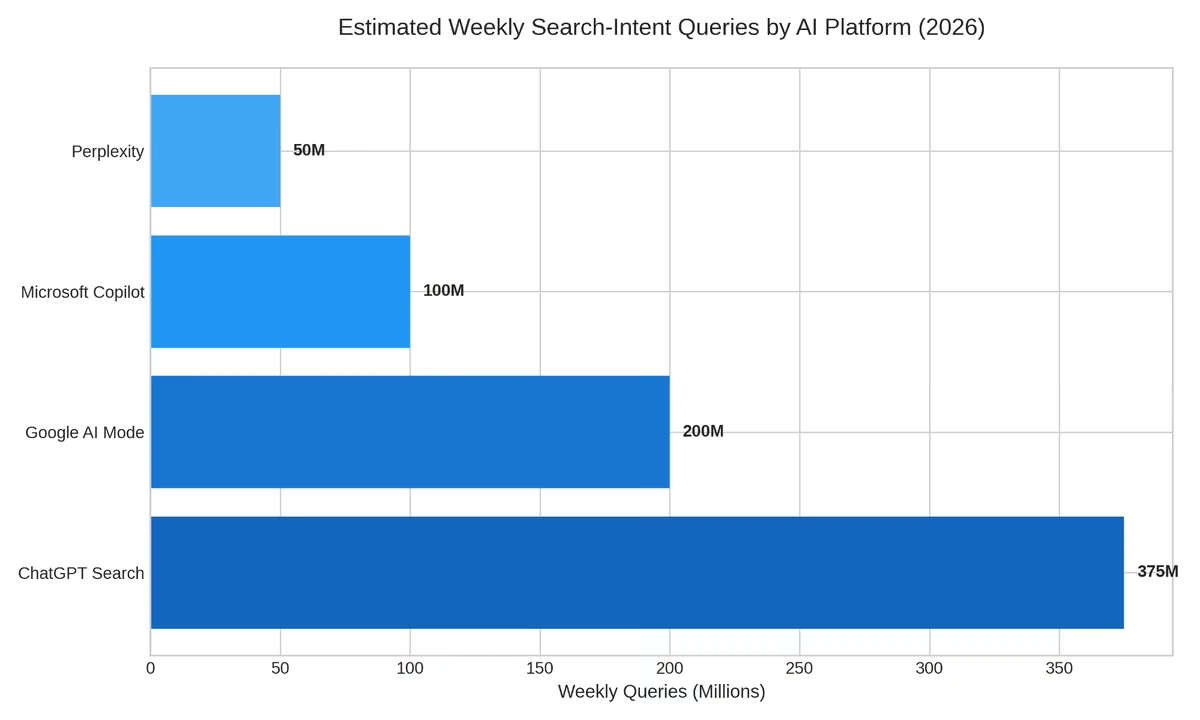
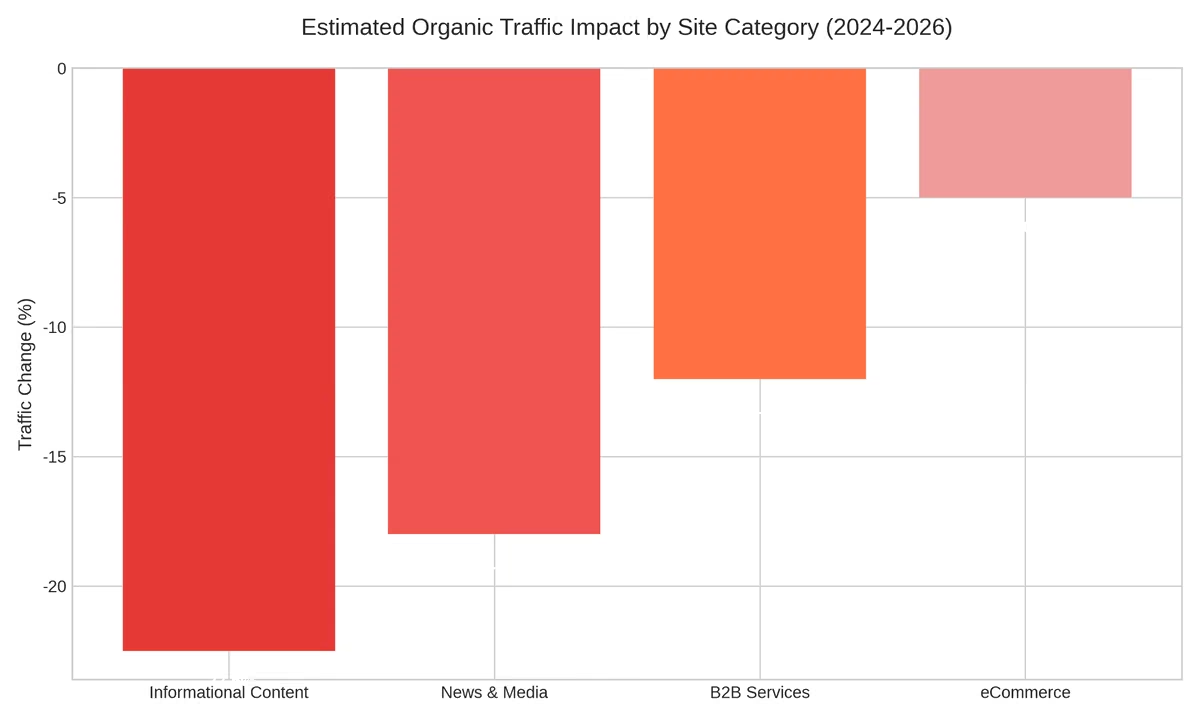
The stakes are immediate. According to 2026 market data, AI-native platforms now process hundreds of millions of search-intent queries per week. Informational query traffic to content publishers has declined significantly as citations concentrate on authoritative domains. Brands that fail to adapt will lose visibility and traffic to those that do.
This playbook covers the mechanics of AI search, the operational tactics that earn citations, the technical foundations that enable retrieval, and the measurement framework that proves impact. Whether you're an SEO leader, content strategist, or editorial team, the principles here apply: clarity, structure, and trust are the new competitive advantages.
How Do AI Search Engines Retrieve and Generate Answers?
AI search systems follow a predictable pipeline: crawl → index → vectorize → retrieve → generate → cite. Understanding this flow reveals why traditional ranking signals matter less than content clarity and structure.
When you submit a query to an AI search system, the engine does not simply rank pages by authority or keyword density. Instead, it vectorizes your query into a numerical representation that captures semantic meaning. It then retrieves candidate documents using vector similarity search across millions of embeddings, ranks those candidates, and generates a synthesis by extracting claims and evidence. Finally, it cites the sources it used.
This process relies on knowledge graphs (structured representations of entities and relationships), retrieval-augmented generation patterns that fetch external documents to ground answers, and consensus-seeking algorithms that weight sources by agreement and authority.
The critical insight: AI systems prefer content that is unambiguous, fact-rich, and easily extractable. A lengthy essay with buried answers loses to a concise page with a clear definition, structured data, and direct evidence. Vague prose is systematically deprioritized because it requires more inference and introduces hallucination risk.
With generative AI, the cost of hallucination for platforms is incredibly high. Therefore, systems are engineered to favor explicit statements over implicit ones. If your brand publishes a 5,000-word thought leadership piece that circles around a topic without ever directly defining it, the AI system will likely bypass your content in favor of a competitor who provided a clear, structured definition in a 500-word glossary entry. The mechanics of retrieval dictate that semantic clarity wins over sheer volume.
Furthermore, the deduplication process within AI search engines means that if multiple sources make the exact same claim using similar language, the engine will typically cite the source with the strongest entity authority and clearest provenance. This makes original data, unique methodologies, and strong author credentials more valuable than ever.
What Does Entity-First Visibility Mean for Brands?
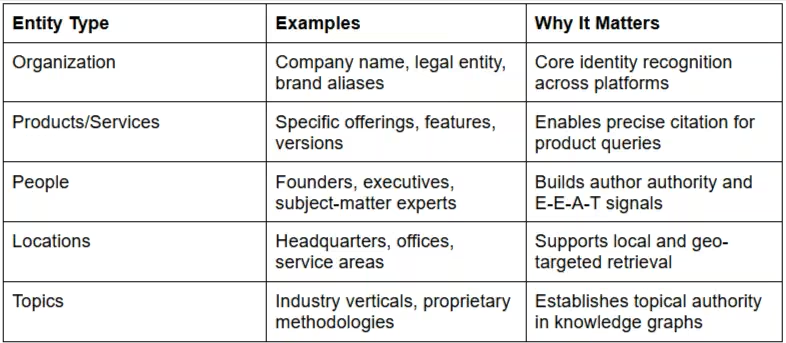
An entity is a distinct, recognizable concept: your organization, its products, key people, locations, and topics. AI systems use entities as anchors for retrieval and citation.
Start by auditing your entity landscape. AI systems must recognize you consistently across the web. If your brand is known by multiple names, acronyms, or aliases, you risk fragmenting your entity authority.
Knowledge graphs are AI systems' internal maps of entities and relationships. Strengthening your footprint means using consistent naming across your website, implementing schema markup that formally declares your entities, cross-linking related entities, and claiming authoritative profiles.
When your organization, products, and people are consistently named and formally marked up, AI systems recognize you as a coherent entity rather than scattered mentions. This dramatically increases citation likelihood. For instance, if an AI is asked "Who makes the best enterprise workflow software?", it queries its knowledge graph for entities associated with "enterprise workflow software" and evaluates the strength of those associations.
To build entity-first visibility, you must move beyond optimizing individual pages and start optimizing the relationships between your assets. An author bio page should link to the organization page using the worksFor schema property. Product pages should link to the parent organization using the brand or manufacturer property. These explicit, machine-readable connections fortify your position within the AI's knowledge graph.
Which Content Patterns Do AI Answer Engines Prefer?
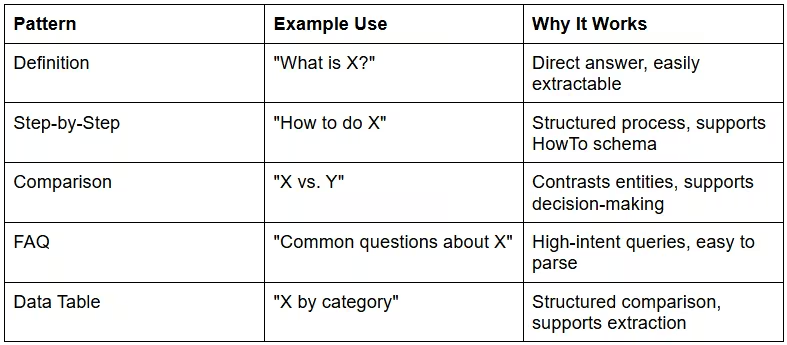
AI systems are trained on patterns. Content that matches high-value patterns gets retrieved and cited more often. The most effective patterns are those that align with how the AI intends to format its output.
Editorial standards for AI search optimization require directness. Lead with the answer, putting the key claim in the first sentence. Use precise language and avoid hedging. Date everything, cite sources, and include methodology for claims.
For example, the "Claim → Evidence → Source" block is a highly effective pattern. AI systems are designed to synthesize information by making a statement and backing it up. If you structure your content to provide the claim, the supporting data, and the citation in a single, cohesive block, you significantly reduce the computational effort required by the AI to parse your page.
Consider the difference between a traditional blog post and an AI-optimized article. A traditional post might spend three paragraphs setting the scene before delivering the core insight. An AI-optimized piece places the core insight immediately after the header, followed by bulleted evidence and a structured table. This doesn't mean the content must be dry or robotic, but it must be structurally accessible to a machine reader.
Furthermore, the use of lists (both ordered and unordered) is highly recommended. When an AI generates a response to a "how-to" or "best practices" query, it frequently outputs a list. If your content is already formatted as a clean, logical list, the AI can lift it directly, increasing the chances of your brand being cited as the primary source.
How Can Structured Data Improve Technical Clarity?
Structured data (JSON-LD schema markup) tells AI systems exactly what your content means. Implement core schemas like Organization, Product, Article, FAQPage, HowTo, and Author.
Schema markup increases retrieval likelihood because it eliminates ambiguity. AI systems can parse structured data faster and more accurately than inferring meaning from prose. While natural language processing has advanced tremendously, explicit schema markup provides a deterministic signal that the AI doesn't have to guess at.
Technical foundations also matter. Submit XML sitemaps, use canonical tags, ensure fast page speed, and provide clean HTML. AI systems struggle with content trapped in images, PDFs, or JavaScript, so provide alt text, captions, and downloadable data where relevant.
When implementing schema at scale, consistency is key. Ensure that your Organization schema matches across all pages, and that your Article schema correctly identifies the author and publication date. The FAQPage schema is particularly powerful for capturing high-intent conversational queries. By marking up your frequently asked questions, you provide the AI with pre-packaged Q&A pairs that are ready for extraction.
It is also crucial to avoid "schema spam." Only markup content that is visible to the user on the page. Marking up hidden content is a violation of guidelines and can result in penalties from both traditional search engines and AI systems.
Why Are Trust, Provenance, and E-E-A-T Critical?
AI systems weight Experience, Expertise, Authoritativeness, and Trustworthiness (E-E-A-T) heavily. Demonstrate these signals through first-hand processes, real outcomes, author credentials, and visual proof.
Source transparency and editorial governance are rewarded. Cite primary sources, publish correction logs, disclose conflicts of interest, and use clear bylines. Consistency across channels signals trustworthiness and factual alignment.
In an environment where AI can generate infinite amounts of synthetic text, human experience and verified data become the premium currency. AI search engines are increasingly sophisticated at identifying original reporting versus derivative content. To establish E-E-A-T, your brand must produce content that demonstrates actual experience. This means publishing original research, detailed case studies, and insights that cannot be easily scraped from other websites.
Author identity is a major component of this. An article authored by "Admin" carries far less weight than an article authored by a named expert with a detailed bio, verified credentials, and a robust digital footprint across the industry. Ensure that your authors have dedicated profile pages that detail their expertise and link to their published works.
Furthermore, the integrity of your content over time matters. Maintaining a correction log shows editorial responsibility. Regularly updating statistics and reviewing old content for accuracy signals to AI crawlers that your site is a maintained, reliable source of truth.
How Do We Model Queries and Architect Information for AI?
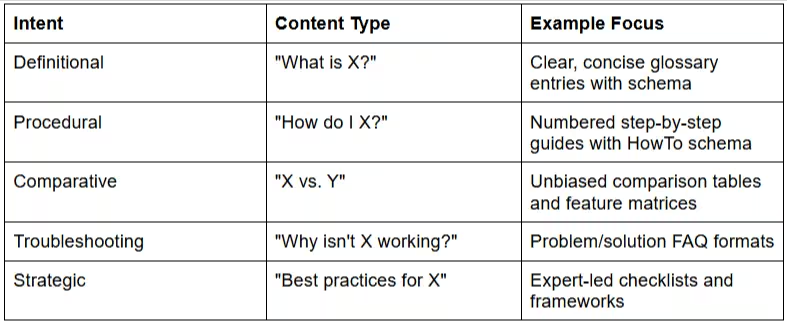
To succeed in AI search optimization, you must map user intents to specific content modules and architect your site so that assistants can find exactly what they need. This involves building topic hubs organized by intent.
Creating a comprehensive Q/A inventory for your domain is essential. Identify the core questions your audience asks and create dedicated pages or sections for each, using standardized heading structures.
Internal linking provides the necessary context. Link child pages to topic hubs to reinforce entity relationships. Use descriptive anchor text that mirrors user questions. This architecture helps AI systems understand your topical authority and navigate the semantic relationships between your content pieces.
A well-structured hub-and-spoke model is highly effective here. The central hub covers the broad topic and links out to detailed spoke pages that answer specific, granular questions. This signals comprehensive coverage to the AI, increasing the likelihood that it will view your domain as the definitive source on the subject.
How Should We Measure AI Search Optimization Success?
Measurement in the AI search era requires a shift from traditional ranking metrics to visibility and citation metrics. Track these core metrics to measure AI search optimization impact:
Share of Answer: The percentage of sampled queries where your pages are cited. This is the new equivalent of "Share of Voice."
Citation Count: The total number of times your pages appear in AI answers across different platforms.
Citation Quality: The position and prominence of your citations (e.g., inline citation vs. footer link).
Entity Visibility: Your brand's presence and associations within major knowledge graphs.
Assisted Traffic: Referral traffic specifically originating from AI systems and assistants.
Collection methods are still evolving, but practical approaches include manual SERP sampling, conversational query testing, schema validation logs, and referral pattern analysis.
A repeatable monthly audit is crucial. This should involve sampling high-intent queries, logging citations, validating schema markup on top pages, and reviewing fact-sensitive content. Distinguishing between leading indicators (like schema coverage and content refresh velocity) and lagging outcomes (like assisted conversions) helps in proving the ROI of your optimization efforts.
Deep Dive: Operationalizing AI Search Optimization Across Teams
To truly succeed in AI search optimization, it cannot be siloed within the SEO department. It requires cross-functional collaboration between editorial, engineering, product, and leadership teams. Here is a breakdown of how to operationalize this strategy across your organization.
The Role of Editorial Teams
Editorial teams must shift their mindset from "writing for humans and sprinkling keywords" to "writing for humans and structuring for machines." This means adopting the answer-first writing style discussed earlier. Editors should enforce strict guidelines on claim verification and source citation. Every piece of content should pass a quality gate that asks: "If an AI were to summarize this page, would it extract the correct conclusion?"
Furthermore, editorial teams must own the entity definition process. They are responsible for ensuring that the brand voice is consistent and that key terms are used uniformly across all publications. If the product team calls a feature "Automated Routing" but the marketing team calls it "Smart Workflows," the AI system will struggle to connect the entities. The editorial team must serve as the arbiter of terminology.
The Role of Engineering and Technical SEO
Engineering teams are the custodians of the technical foundation. Their primary responsibility is ensuring that the schema markup designed by the SEO team is implemented correctly and scales across the site. This often involves updating the Content Management System to automatically generate valid JSON-LD based on the content entered by editors.
Engineers must also ensure that the site's architecture supports rapid crawling and indexing. As AI systems increasingly rely on real-time data retrieval (especially for news or rapidly changing topics), a site that is slow or difficult to crawl will be left behind. Monitoring server logs for crawl errors from known AI bots (like OpenAI's crawler or Perplexity's bot) should become a standard part of the technical SEO workflow.
The Role of Product and Marketing Leadership
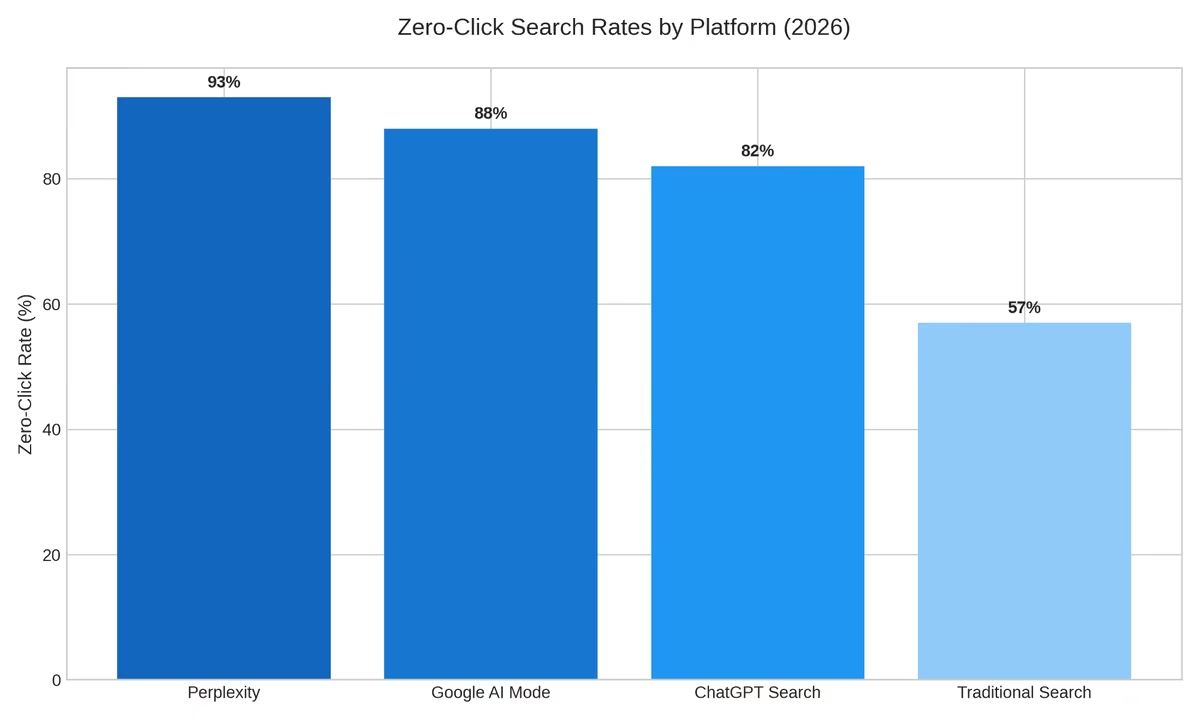
Leadership must understand that AI search optimization is a long-term play. The metrics of success are changing. While traditional organic traffic might decline as zero-click searches rise, the quality of the traffic that does arrive, and the brand authority built through citations, is highly valuable.
Leaders must resource the creation of high-quality, original data. Commissioning surveys, publishing proprietary research, and developing unique methodologies are the most effective ways to build the E-E-A-T signals that AI systems crave. This requires budget and commitment beyond standard content marketing.
Managing Risk and Hallucinations
A significant concern for brands in the AI era is the risk of hallucinations, when an AI system confidently presents false information about the brand. While you cannot control the AI's output directly, you can heavily influence it through optimization.
The best defense against hallucinations is an overwhelming abundance of clear, structured, and consistent facts on your own domain. If an AI system finds conflicting information about your pricing across different pages of your site, it is more likely to hallucinate an incorrect price. By maintaining a single source of truth and marking it up with clear schema, you minimize the ambiguity that leads to errors.
For YMYL (Your Money or Your Life) topics, such as finance, healthcare, or legal advice, the bar is even higher. AI systems are programmed to be extremely cautious in these areas. To earn citations here, your content must be backed by undeniable expertise. This means rigorous fact-checking, clear disclaimers, and authorship by recognized professionals.
The Future of AI Search Optimization
As we look beyond 2026, the integration of AI assistants into everyday workflows will only deepen. We are moving towards a future of "agentic search," where AI systems don't just answer questions, but take actions on behalf of the user.
In this future, optimizing for AI means ensuring your brand's digital assets are interoperable with these agents. Can an AI assistant seamlessly extract your product catalog, compare it to a competitor, and execute a purchase for a user? The brands that structure their data today are laying the groundwork for this agentic future.
The principles of clarity, structure, and trust will remain constant, but the technical execution will continue to evolve. By adopting the strategies outlined in this playbook, your brand can navigate the transition from traditional search to AI-powered answer engines, securing your visibility and authority for the years to come.
Continuous Iteration is the Key to Success
Ultimately, AI search optimization is not a project with a defined end date. It is a continuous process of iteration, measurement, and refinement. The algorithms powering answer engines are constantly being updated, and the competitive landscape is always shifting. Brands must remain vigilant, regularly auditing their entity footprint, testing new content patterns, and adapting to the latest technical standards. By committing to this ongoing discipline, your organization will not only survive the disruption of AI search but thrive within it, establishing an unassailable position as a trusted authority in your industry.
What Is the Recommended Roadmap for Implementation?
A phased implementation respects resourcing constraints while building a durable foundation for AI search visibility.
Phase 1: Foundation (30–60 days) Focus on the basics. Audit all entities (organization, products, people, locations) to ensure consistent naming. Fix foundational crawlability issues including robots.txt, sitemaps, and canonical tags. Implement core Organization and Article schema on your most important pages. Publish 10–20 high-intent FAQ pages with proper FAQPage schema. Establish detailed author bios with credentials.
Phase 2: Authority (60–120 days) Expand your footprint. Build comprehensive hub pages for core topics. Expand the use of HowTo and FAQ schemas across relevant sections of the site. Enhance author pages with detailed credentials and content attribution. Introduce your measurement framework, including SERP sampling and referral tracking. Refresh your top 50 pages with updated data and citations.
Phase 3: Scale (120+ days) Operationalize the strategy. Develop standardized content templates for answer-first writing. Run A/B tests on different content patterns (e.g., definitions vs. step-by-step guides vs. comparison tables). Formalize refresh SLAs to dictate how often each content type gets reviewed. Deepen your data-backed thought leadership to build unassailable E-E-A-T.
The organizations that treat AI search optimization as a core strategic discipline, rather than a one-off campaign, will secure their visibility in 2026 and beyond.
Frequently Asked Questions (FAQ): What Is AI Search Optimization
What is AI search optimization and how does it work?
AI search optimization is the process of structuring your content, data, and digital presence so that AI-powered answer engines can easily retrieve, extract, and cite your brand as a trusted source. It focuses on entity clarity, structured data, and direct answers rather than traditional keyword density.
How do AI assistants decide which sources to cite?
AI systems retrieve candidate documents using vector search, rank them by relevance and authority, and then extract the necessary claims and evidence. They prefer sources that provide clear definitions, structured data, verifiable facts, and strong E-E-A-T (Experience, Expertise, Authoritativeness, Trustworthiness) signals.
What content formats rank best in AI search engines?
AI engines strongly prefer highly structured, scannable formats. Definitions, step-by-step guides, FAQs, comparison tables, and claim-evidence-source blocks are the most frequently extracted and cited patterns.
How can I measure my brand's visibility in AI search?
You can measure visibility by tracking your "Share of Answer" (the percentage of relevant queries where your brand is cited), monitoring total citation counts, auditing your entity visibility in knowledge graphs, and analyzing referral traffic from AI platforms.
Does schema markup really matter for AI search optimization?
Yes, schema markup is critical. Implementing JSON-LD structured data (like Organization, FAQPage, and Article schema) eliminates ambiguity, allowing AI systems to parse and understand your content much faster and more accurately than relying on text alone.
How often should I update my content for AI search?
Fact-sensitive pages should be reviewed monthly, evergreen content quarterly, and news weekly. AI systems prioritize fresh, accurate information, so maintaining a visible changelog and updating statistics regularly signals that your content is a reliable source.
At first, we weren’t even thinking about AI visibility. We were focused on rankings and traffic like everyone else. But once we started testing our brand in ChatGPT and other AI tools, we realized we were barely showing up — even for topics we ‘ranked’ for. Gryffin gave us a clear picture of where we stood, how competitors were being cited instead, and what that actually meant for our pipeline. It shifted how we think about search entirely.









.webp)