How Do You Measure AI Sales Funnel Visibility by Stage
Marcela De Vivo
Marcela De Vivo
May 13, 2026
To build a high-performing AI sales funnel, teams must shift their thinking. Visibility is not a static measurement; it is a dynamic indicator that evolves from broad reach at the top of the funnel to verified commitment at the bottom. When organizations apply decision-stage metrics to awareness-stage content, they create false negatives, prematurely abandoning strategies that are actually working to build trust. Conversely, applying awareness metrics to decision-stage content leads to a false sense of security, where high impressions mask a lack of actual buyer intent.
This article provides a practical framework for setting stage-specific visibility expectations inside an AI sales funnel. By understanding how to engineer prompts and measure outcomes across the awareness, consideration, and decision stages, revenue leaders can build a predictable, scalable system that aligns with how modern buyers actually make decisions.
What Does Visibility Mean at Each Stage of the AI Sales Funnel?
To effectively measure an AI sales funnel, we must first clarify what "visibility" means at each distinct stage of the buyer's journey. The transition from initial discovery to final purchase requires a shift in how we define and track success.
In the awareness stage, visibility equates to reach and recall. The goal is to capture attention and introduce a problem or concept to a broad but relevant audience. Here, visibility is about breadth. In the consideration stage, visibility transitions to engaged attention and trust signals. The audience shrinks, but their interaction with the content deepens. Finally, in the decision stage, visibility means intent and commitment. It is no longer about how many people see the content, but rather who is seeing it and what actions they are taking as a result.
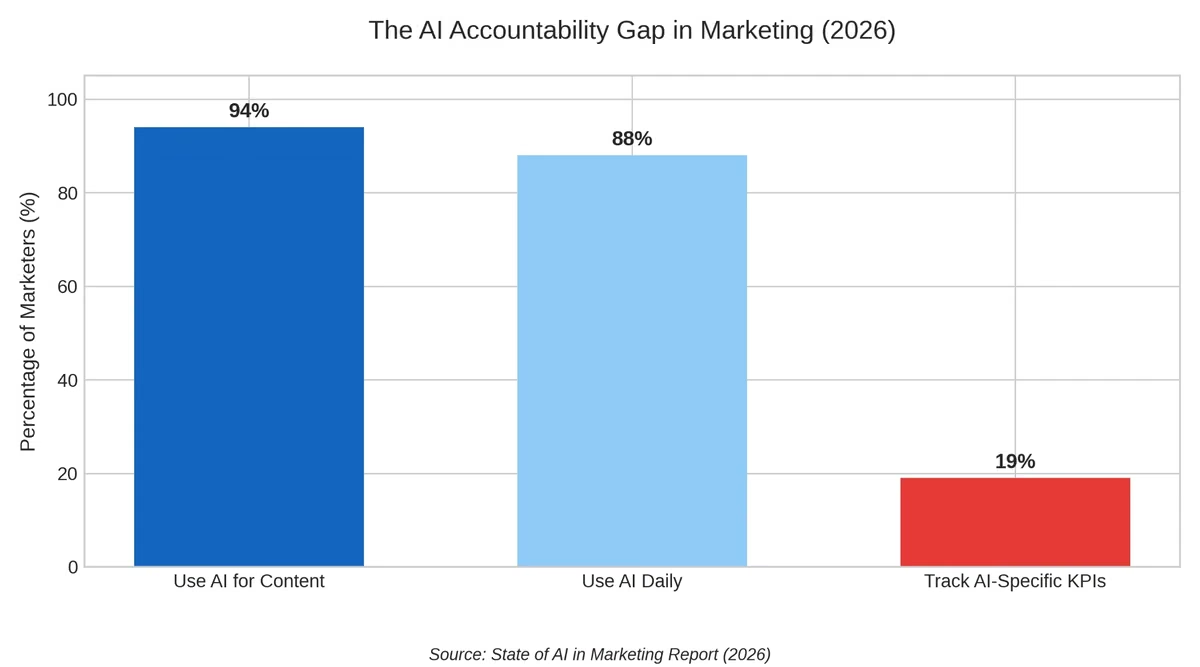
The core problem in many organizations is that they grade all AI-generated prompts and content on impressions alone. According to a 2026 State of AI in Marketing report, while 94% of marketers plan to use AI for content creation, only 19% track AI-specific KPIs. This massive accountability gap means teams are producing more content without understanding its specific role in the funnel
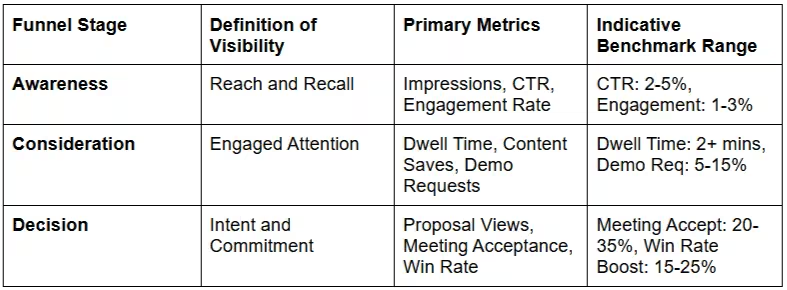
With these definitions in place, we can now set realistic expectations for prompts at each stage. The following table maps the stages of the funnel to their primary metrics and indicative benchmark ranges.
By aligning metrics with the specific stage of the funnel, teams can accurately assess the performance of their AI-driven content and ensure that each piece is doing its intended job.
How Do You Engineer Awareness-Stage Prompts for Reach and Relevance?
At the top of the funnel, the objective is to cast a wide net while maintaining relevance to the target audience. Awareness-stage prompts should instruct the AI to produce content that generates breadth and curiosity. This is not the time to push for a sale or demand readiness from the buyer. Instead, the focus should be on problem-framing, timely hooks, light social proof, and learning-forward content.
When engineering prompts for the awareness stage, it is crucial to set the right expectations. High impressions and low immediate conversion rates are entirely normal. Success at this stage looks like steady growth in qualified traffic and engagement precursors. For instance, a prompt might instruct the AI to generate a contrarian take on an industry trend, followed by a three-point explainer designed for LinkedIn or top-of-funnel SEO. The goal is to spark a conversation and make the brand visible to those who are just beginning to recognize their pain points.
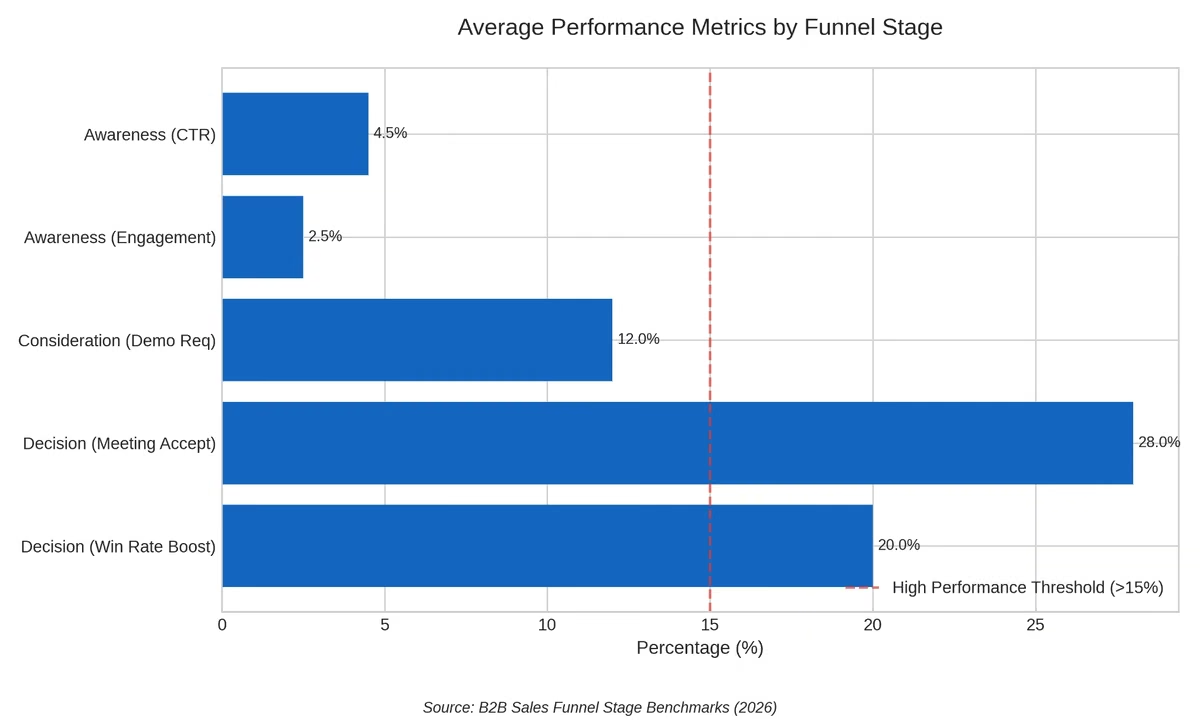
Consider the typical performance of awareness content in an AI sales funnel. While the click-through rate might hover around 2% to 5%, the real value lies in assisted conversions, the measure of how this initial touchpoint contributes to later, more decisive actions. If teams judge awareness prompts by direct, last-click revenue, they will inevitably deem them failures. However, when measured by reach and the steady accumulation of an audience, these prompts are the vital first step in the sales process.
Furthermore, the volume of content matters at this stage. Data indicates that companies publishing 16 or more posts monthly generate 3.5 times more inbound traffic than those publishing fewer than four times per month. AI enables this velocity, allowing teams to maintain a consistent presence and capture early-stage visibility.
How Should Consideration-Stage Prompts Deepen Trust and Attention?
As buyers move from awareness to consideration, their needs change dramatically. They are no longer just looking for information; they are evaluating potential solutions. Consequently, consideration-stage prompts must shift from generating broad reach to designing for depth and qualified attention. The objective is to narrow the audience while deepening trust.
Prompts at this stage should instruct the AI to create detailed, analytical content. This includes side-by-side comparisons, analyst-style breakdowns, ROI narratives, case vignettes, and content that surfaces and addresses objections early in the process. For example, a prompt might ask the AI to produce an industry-specific buyer’s guide that includes checklists mapped directly to common pain points and desired outcomes.
The expectations for visibility metrics must adjust accordingly. Teams should expect lower overall reach compared to the awareness stage, but significantly higher dwell time, more content saves, and an increase in demo micro-conversions. According to industry benchmarks, content saves at the consideration stage are typically three to five times higher than at the awareness stage, and time on page often exceeds two minutes.
This is where the quality and depth of the AI-generated content become paramount. Research shows that posts between 2,000 and 3,000 words are four times more likely to rank well and drive deep engagement. By providing comprehensive, well-structured information, consideration-stage content helps buyers evaluate their options and builds the necessary trust to move them toward a decision. After depth comes decision clarity, where visibility shifts entirely from volume to verifiable intent.
How Do Decision-Stage Prompts Drive Commitment and Clarity?
At the bottom of the funnel, the buyer is ready to make a choice. Decision-stage prompts must be highly targeted, or "narrowcast," aiming directly at readiness and commitment. The content generated here should remove friction, answer final questions, and provide the ultimate justification for the purchase.
Prompts should instruct the AI to create specific, actionable assets such as pricing FAQs, implementation timelines, risk-reversal policies, and tailored ROI calculators. For instance, a prompt might direct the AI to draft a personalized email sequence that addresses the three most common legal or security objections for a specific buyer persona, complete with links to authoritative proof sources.
The visibility expectations at the decision stage are the inverse of the awareness stage. Here, you have the smallest audience but the highest signal density. Metrics shift to proposal views, meeting acceptance rates, procurement readiness, and actual movement in the win rate. A successful decision-stage prompt might not get thousands of impressions, but it could achieve a 20% to 35% meeting acceptance rate among qualified leads.
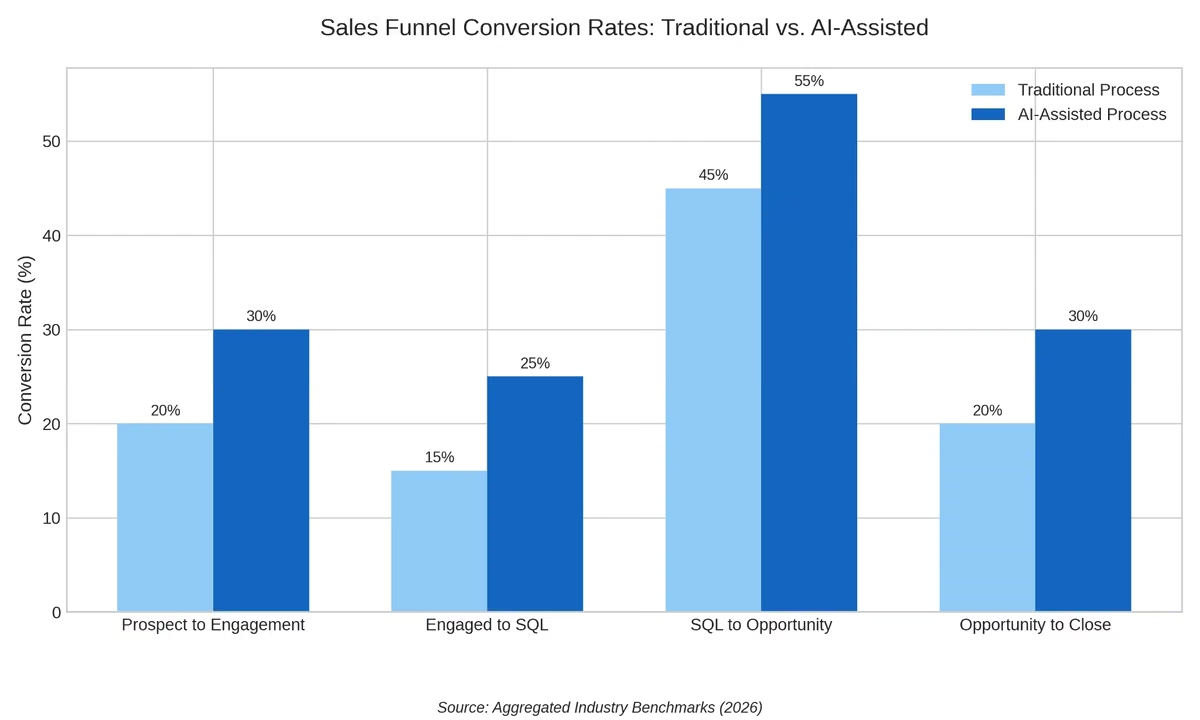
Data illustrates a stark difference in outcomes when decision content is properly executed. Organizations leveraging AI-assisted processes at the bottom of the funnel see significant improvements. For example, while traditional processes might see a 20% conversion rate from opportunity to close, AI-assisted processes can boost this to 30%. Furthermore, effective decision content can accelerate the time-to-close by 30% to 40%, proving that when visibility is measured by intent, the impact on revenue is profound.
What Are the Common Pitfalls of Misaligned Visibility Goals?
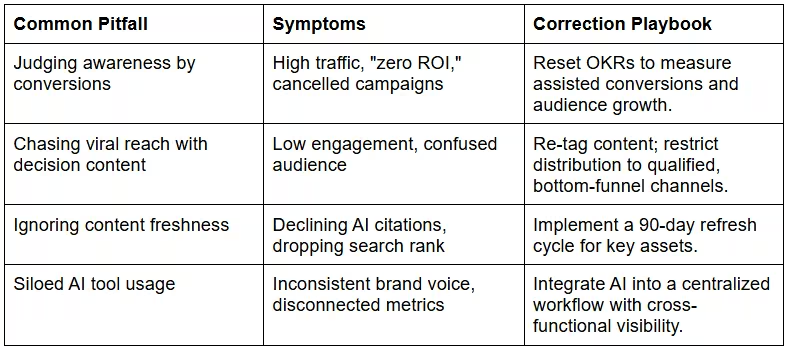
Even with a clear understanding of the funnel stages, many organizations fall into common traps when measuring visibility. The most frequent error is judging awareness prompts by last-click conversions or chasing viral reach with decision-stage content. When goals are misaligned with the content's purpose, the entire AI sales funnel suffers.
For example, if a marketing team creates a highly technical, decision-stage ROI calculator but promotes it on a broad social channel expecting viral engagement, the campaign will likely fail. The content is too dense for casual scrolling, and the audience is not ready for that level of commitment. Conversely, if an educational, top-of-funnel blog post is deemed unsuccessful because it didn't immediately generate sales qualified leads, the team might stop producing the very content that feeds the top of their pipeline.
To fix these issues, organizations need a correction playbook. The first step is to reset Objectives and Key Results by stage. Next, all content must be clearly tagged and categorized so that prompts are graded against the right metrics. Finally, distribution channels must be re-routed to match the intent of the content.
Consider a scenario where a company reclassifies its content and updates its KPIs. By simply measuring an educational guide by dwell time and newsletter signups rather than direct sales, the perceived performance of the asset improves dramatically without changing a single word of the creative. Once expectations are aligned, the focus must shift to distribution mechanics to ensure the right audience actually sees the content.
How Do You Align Prompts to Platform Signals at Each Stage?
Creating the right content is only half the battle; it must also be distributed effectively. Different platforms surface content in unique ways, and prompts must be engineered to cue the appropriate format, structure, and intent for each channel. Understanding channel mechanics is essential for maximizing visibility at every stage of the AI sales funnel.
In the awareness stage, social feed dynamics and search intent are paramount. Prompts should encode channel-specific requirements, such as concise hook styles for LinkedIn or comprehensive, keyword-optimized structures for organic search. For example, LinkedIn awareness content typically sees an 8% to 12% engagement rate when properly formatted.
As buyers move to the consideration stage, email deliverability and sender reputation become critical. Prompts should focus on creating detailed, valuable content that earns its place in the inbox. Email campaigns at this stage should aim for a 25% to 40% open rate and a 5% to 8% CTR. The content must be structured to encourage deep reading and saving for future reference.
In the decision stage, community norms, marketplace dynamics, and direct sales outreach take precedence. Prompts must generate highly personalized, compliant, and persuasive messaging. Direct sales outreach using AI-assisted, decision-stage content can achieve a 15% to 25% reply rate.
Furthermore, the structure of the content itself impacts its visibility, particularly in AI-driven search environments. Recent data shows that AI Overviews now appear on 48% of all queries. To optimize for this, prompts should instruct the AI to include FAQ sections, as these are cited three times more often than other content sections. Additionally, maintaining a 90-day freshness window is crucial; content under three months old is three times more likely to be cited by AI search engines.
How Do You Set and Calibrate Stage-Appropriate Targets?
To truly understand visibility across the AI sales funnel, organizations must establish a robust measurement and attribution spine. This requires moving beyond vanity metrics and implementing a system that connects prompt generation directly to pipeline outcomes.
The foundation of this system involves stage tagging in URLs and Content Management Systems, rigorous UTM conventions, and clear content taxonomies. CRM fields must be configured to tie specific prompts and content pieces to pipeline stages. This infrastructure allows teams to track the journey of a buyer from the first interaction to the final signature.
Organizations should leverage AI-assisted scoring, predictive models, and dashboards to calibrate targets against historical baselines, cohorts, and confidence intervals. For example, a well-designed dashboard should separate awareness-assisted revenue from decision-sourced revenue. This distinction is vital to avoid over-crediting the bottom of the funnel while starving the top.
By implementing stage-appropriate targets, revenue leaders can answer critical questions: Are we converting 25% to 35% of prospects into meaningful engagement at the intake stage? Are 50% to 62% of our SQLs turning into opportunities? When the analytics spine is properly aligned, visibility becomes a quantifiable, actionable metric rather than a vague concept.
How Do You Operationalize Stage-Specific Prompts?
The final step in mastering AI sales funnel visibility is operationalizing the process. Ad hoc prompt engineering is inefficient and difficult to measure. Instead, organizations need a working system characterized by libraries, governance, and continuous iteration.
A centralized prompt library is essential. This library should be meticulously tagged by funnel stage, target persona, distribution channel, and specific objective. It must also incorporate brand and compliance guardrails to ensure that all AI-generated content adheres to corporate standards. Furthermore, the library should include inputs for product updates and validated proof points, ensuring the AI always draws from the most current and accurate information.
Governance is a critical component of this operational model. As AI scales content production, the risks associated with off-brand or non-compliant messaging scale equally fast. A robust governance framework should include approved prompt libraries, structured content taxonomies, and clear review tiers based on the risk level of the content.
Finally, teams must define an experimentation cadence with pre-set win criteria for each stage. This creates a vital feedback loop between marketing, sales, and customer success. By connecting the prompt library to the CRM and content tools, stage context persists from creation to reporting. This operational maturity is what separates organizations that merely use AI from those that use AI to drive systemic revenue growth. Research indicates that revenue organizations adopting systemic AI enablement report 29% higher growth rates than those that do not.
Conclusion
Visibility in an AI sales funnel is not a single score. It is a dynamic metric that changes meaning as buyers advance from initial awareness to final commitment. When organizations judge all prompts and content by the same standard, they misalign their efforts, misinterpret their data, and ultimately leak revenue.
To succeed, teams must engineer prompts and measure outcomes according to the specific stage of the funnel. Awareness requires reach and relevance; consideration demands depth and engaged attention; and decision necessitates clarity and verifiable intent. Treat visibility like a ladder, each rung supports the next, and skipping rungs creates false negatives and missed opportunities.
The transition to an AI-driven sales model requires more than just new tools; it requires a new operating model. By auditing your top ten prompts per stage, re-tagging them by intent, and resetting KPIs, you can ensure that your AI sales funnel reflects how buyers actually make decisions today.
Frequently Asked Questions (FAQ): How Do You Measure AI Sales Funnel Visibility by Stage
How to measure AI sales funnel visibility by stage?
Measure visibility by aligning metrics with the buyer's journey: use impressions and CTR for awareness, dwell time and demo requests for consideration, and meeting acceptance and win rates for the decision stage.
What are the best metrics for awareness stage content?
The best metrics for the awareness stage are impressions, click-through rates (CTR typically 2-5%), engagement rates (1-3%), and assisted conversions that track audience growth rather than direct sales.
Why is my decision stage content getting low impressions?
Decision-stage content is designed for a narrow, highly qualified audience ready to buy, so low impressions are normal and expected. Success should be measured by intent signals like proposal views and meeting acceptance rates, not broad reach.
How does AI content affect sales funnel conversion rates?
When properly aligned by stage, AI-assisted content can significantly boost conversion rates, such as improving the opportunity-to-close rate from a traditional 20% up to 30%, and accelerating sales velocity.
What is the biggest mistake in AI sales funnel tracking?
The biggest mistake is judging all content by the same metrics, such as evaluating top-of-funnel educational prompts based on last-click revenue, or expecting bottom-funnel pricing guides to achieve viral social media reach.
At first, we weren’t even thinking about AI visibility. We were focused on rankings and traffic like everyone else. But once we started testing our brand in ChatGPT and other AI tools, we realized we were barely showing up — even for topics we ‘ranked’ for. Gryffin gave us a clear picture of where we stood, how competitors were being cited instead, and what that actually meant for our pipeline. It shifted how we think about search entirely.









.webp)