AI for SEO: How Can You Build an Experimentation Model for AI Search?
Marcela De Vivo
Marcela De Vivo
April 22, 2026
AI-driven search rewards pages that are clear, attributable, technically accessible, and rich in entity context. Google explains that AI Overviews and AI Mode may use a query fan-out approach to gather supporting pages and surface a wider range of links, which means optimization is no longer limited to a single blue-link ranking event 1. In that environment, ai for seo becomes a discipline of making content easier to retrieve, parse, cite, and trust.
Many teams still treat AI-search visibility as a publishing problem instead of an experimentation problem. They change titles, add FAQs, expand citations, or rewrite sections without isolating variables or defining success. Google’s structured-data guidance recommends a before-and-after test on a subset of pages using stable observation windows and Search Console data where possible 2. That logic should guide every content test designed for AI search.
The most useful operating model combines editorial governance, technical instrumentation, prompt coverage analysis, and entity reinforcement. The objective is not to chase every feature. It is to learn which changes reliably increase inclusion in AI answers, improve citation frequency, strengthen answer fidelity, and produce better post-click engagement.
Seo Experiments: How Should You Design Reliable Tests for AI Search?
Disciplined seo experiments help teams separate correlation from causation in AI-driven search. A strong test starts with one hypothesis, one primary variable, one stable page set, and one agreed success metric. If the team cannot say what changed, why it changed, and how success will be measured before launch, the test is too loose.
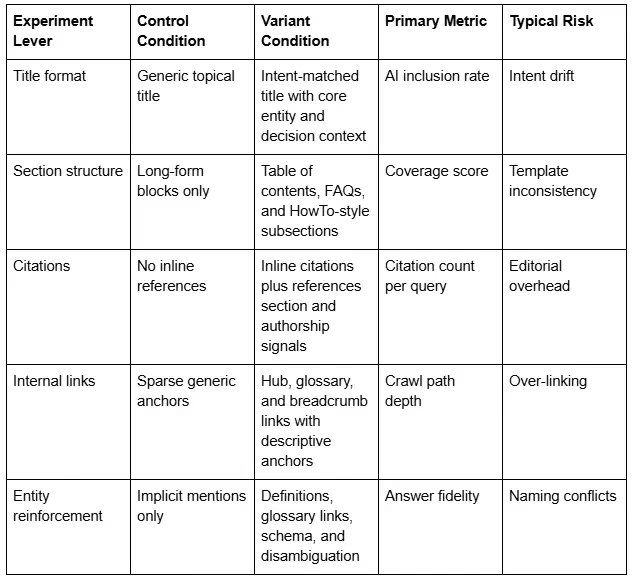
The right governance model starts with a pre-registered experiment brief. That brief should define the hypothesis, control and variant conditions, page cluster, sample size, owners, timeline, and rollback rule. This matters because titles, headings, links, citations, schema, and glossary elements can interact. Without freeze windows and version control, it becomes hard to know which change actually affected AI-search performance.
“There are no additional technical requirements” for appearing as a supporting link in Google AI features beyond being indexed and eligible to show with a snippet in Google Search 1.
That guidance is important because it redirects attention toward durable fundamentals: useful content, strong information architecture, crawlability, and trust signals. In practice, the highest-impact variables are usually title framing, section structure, citation density, internal-link precision, and explicit entity reinforcement.
A sensible rollout sequence is to test titles first, then structure, then citations, then internal links, and finally schema and entity reinforcement. Titles and headings tend to affect retrieval alignment quickly, while citations and entity work often influence attribution and answer quality more gradually. Over time, these tests should be logged in a shared registry so the organization builds institutional knowledge instead of repeating guesswork.
AI Search Testing: How Do You Measure Inclusion, Citations, and Answer Quality?
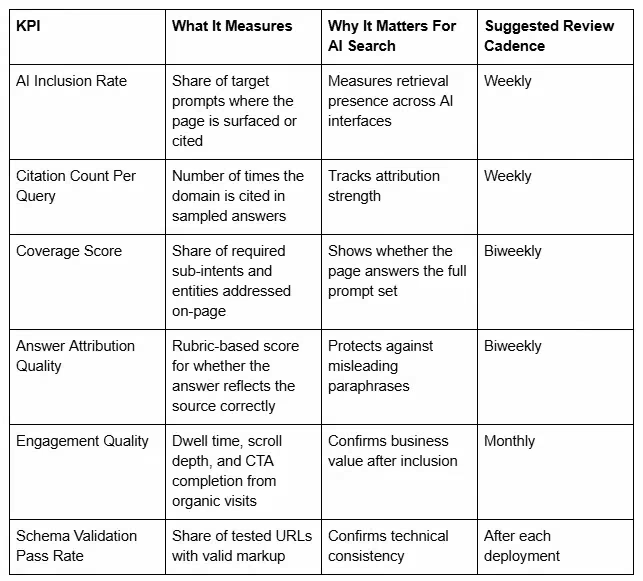
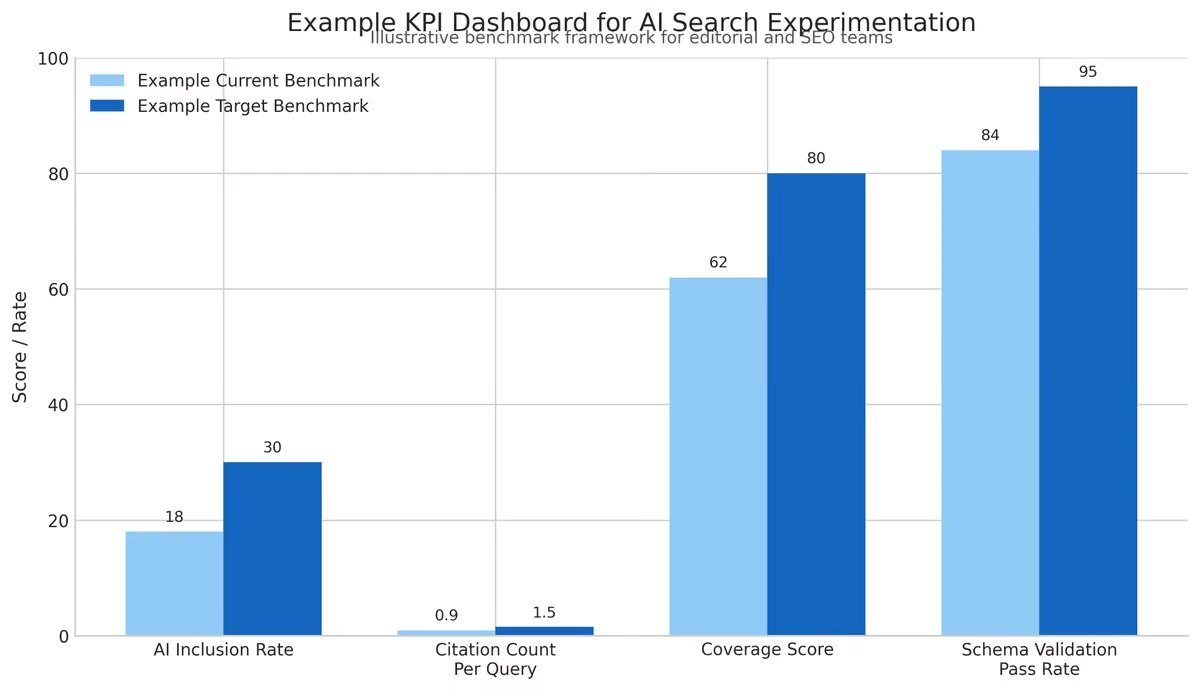
Effective ai search testing asks three questions at once: does the page appear, is it cited, and is it represented accurately? Ranking alone cannot answer that. A modern measurement model needs to capture presence in AI summaries, citation frequency, entity coverage, and the fidelity of the answer relative to the source page.
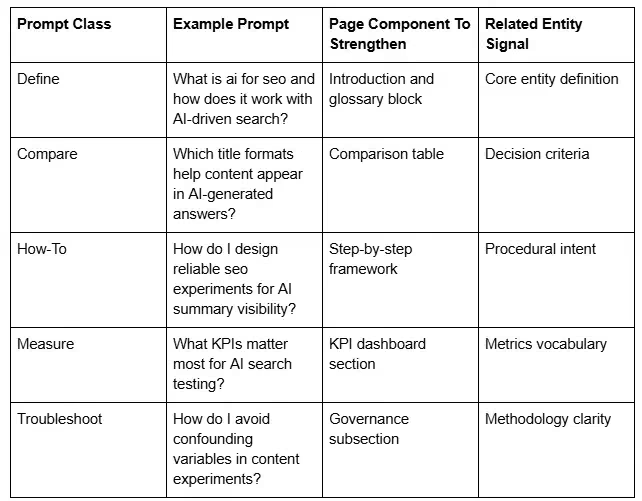
Google documents that AI Overviews and AI Mode traffic is included in the Search Console Performance report under Web search 1. That provides a useful baseline, but experimentation needs more detail. A stable query set should be versioned by intent class, such as definitional, comparative, how-to, troubleshooting, and decision-stage prompts. Each sampled answer can then be scored for inclusion, number of citations, attribution quality, and factual accuracy.
A scoring rubric also prevents soft interpretation. For example, answer fidelity can be scored from one to five, where one means the AI response omits or distorts the page’s main answer and five means the response accurately reflects the page’s definitions, evidence, and caveats. This is where analytics and editorial QA meet.
Content Updates for AI Visibility: Which Page Changes Usually Lift Performance First?
Targeted content updates for ai visibility should focus on the page elements that make retrieval easier and attribution safer. For most teams, that means rewriting titles for intent clarity, improving heading structure, adding transparent sourcing, tightening internal links, and defining entities more explicitly. Google’s guidance on AI features says that classic SEO fundamentals still matter, including internal links, textual clarity, media support, and structured data that matches visible content 1.
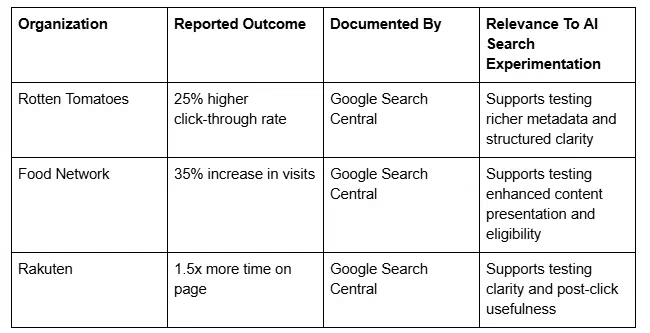
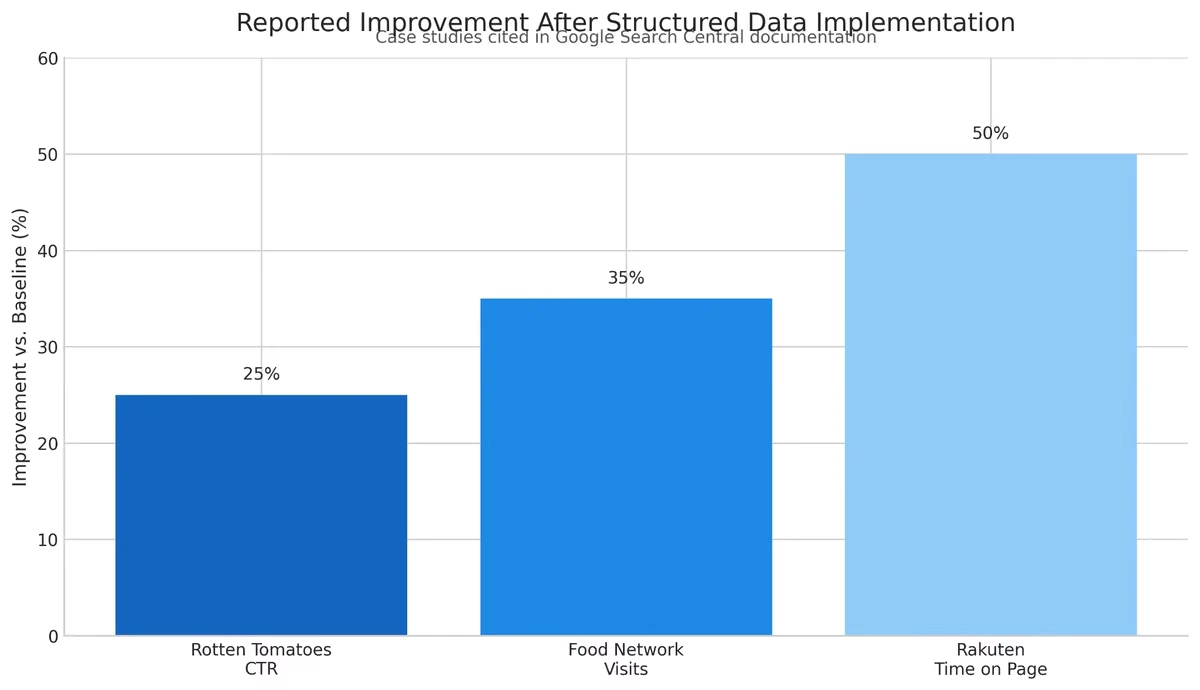
The evidence for structured clarity is not only conceptual. Google’s structured-data documentation highlights case studies where Rotten Tomatoes reported a 25% higher click-through rate on pages enhanced with structured data, Food Network reported a 35% increase in visits after enabling search features on most of its pages, and Rakuten reported users spending 1.5 times more time on pages that implemented structured data 2. Although these are different outcome types, they collectively support testing machine-readable clarity as part of an AI-search program.
Titles should describe the task, topic, and decision context with as little ambiguity as possible. Headings should mirror prompt patterns people use in AI tools while still reading like editorial prose. This is why prompt-shaped, title-case headings are useful: they preserve readability while improving alignment with conversational search behavior.
Sources and citations matter just as much as structure. Google states that structured data should describe visible page content and that complete, accurate markup matters more than bloated implementations 2. Editorially, the same rule applies. A concise references section built on primary documentation, standards bodies, and institutional research is usually stronger than a long list of weak sources. Add clear authorship, an updated date, and an editorial policy link so both users and retrieval systems can understand who produced the page and under what standards.
Schema and internal architecture reinforce that clarity. Schema.org defines a BreadcrumbList as a chain of linked web pages and describes the breadcrumb property as a set of links that helps users understand website hierarchy 4. Schema.org also defines a FAQPage as a web page presenting one or more frequently asked questions 3. In practice, that means linking the article to the AI-search hub, glossary entries, editorial guidelines, and related case studies, while using FAQ sections to create concise and attributable answer units.
Prompt Coverage Experiments: How Do You Map Prompts, Entities, and Pages Together?
Robust prompt coverage experiments measure whether a page answers the real prompts an AI system is likely to decompose, reformulate, or compare. The useful unit of analysis is not just the keyword. It is the combination of prompt intent, entity set, and page section. Prompt coverage therefore turns content strategy into a measurable retrieval model.
A practical method starts with a canonical entity list. For this topic, that includes experiment design, hypothesis, variables, sample size, confidence, titles, headings, FAQs, citations, authorship, internal links, breadcrumbs, schema markup, knowledge graphs, and answer quality. The page should then be evaluated against prompts that ask for definitions, implementation steps, comparisons, troubleshooting advice, and measurement logic. If a comparison prompt has no dedicated section or a core entity is only mentioned in passing, the page will likely underperform on coverage.
Academic research supports this entity-centered perspective. Reinanda, Meij, and de Rijke describe knowledge graphs as an important part of information retrieval research, which helps explain why entity clarity, relationship mapping, and disambiguation remain strategically useful in AI-search content design 5. The practical conclusion is straightforward: pages that define entities clearly, connect related concepts coherently, and maintain naming consistency are easier to retrieve and easier to cite.
Prompt coverage becomes most valuable when it feeds the backlog. If misses cluster around citation-related prompts, the next sprint should strengthen sources, authorship, and transparency. If misses cluster around entity definitions, the answer may be glossary pages, better disambiguation, or more precise hub-and-spoke internal linking. The experiment is complete only when the feedback loop informs the next revision cycle.
What Should Your Team Do Next With AI For Seo?
An experimentation model for ai for seo replaces guesswork with measurable learning. The best starting point is a limited page set, a stable query sample, and a narrow list of variables: titles, structure, citations, internal links, and entities. From there, the team can establish baselines, launch controlled variants, review answer fidelity, and document every result in a shared registry.
The larger lesson is that AI-search performance is not won by one tactic. It is won by combining editorial clarity, technical consistency, trustworthy sourcing, and entity-rich information architecture.
Frequently Asked Questions: AI for SEO
What Is Ai for Seo and How Does It Work With AI-Driven Search?
AI for SEO is the practice of improving content so modern search systems can retrieve, interpret, and attribute it more effectively. In AI-driven search, that means optimizing for inclusion in summaries, citations, and answer-style experiences, not only rankings.
How Do I Design Reliable Seo Experiments for AI Summary Visibility?
Start with a clear hypothesis, isolate one main variable, select comparable pages, and define the primary metric before launch. Then hold other page changes constant and review both inclusion and answer quality over a fixed time window.
Which Title Formats Help Content Appear in AI-Generated Answers?
Formats that combine the topic, user task, and decision context tend to perform better than vague headlines. Prompt-shaped titles often work well because they align with conversational query patterns while remaining readable.
How Should I Structure Content So AI Systems Extract Accurate Answers?
Use a clean hierarchy with descriptive headings, a table of contents, concise answer blocks, and FAQ or HowTo sections where they genuinely help. Short paragraphs and explicit definitions reduce ambiguity during extraction.
What Types of Sources Increase Trust and Citations in AI Summaries?
Primary documentation, standards bodies, academic research, and institutional datasets are usually the strongest sources. Inline citations, a references section, authorship details, and an editorial policy link further improve trust.
What Is Entity Reinforcement and Why Does It Matter for AI Search?
Entity reinforcement means making the page’s main concepts explicit through definitions, consistent naming, schema, glossary links, and disambiguation. It matters because retrieval systems work better when concepts are clearly connected rather than implied.
How Do I Measure AI Inclusion Rate and Citation Frequency?
Build a versioned query set, sample AI answers on a regular schedule, and record whether your page appears, how often it is cited, and whether the answer reflects your content accurately. Pair that review with Search Console, engagement metrics, and schema validation.
What Schema Types Help With AI-Driven Discovery and Attribution?
Article, Author, Organization, BreadcrumbList, FAQPage, and sometimes HowTo are the best starting points for editorial pages. The key rule is that the markup must match visible content and remain valid after deployment 234.
At first, we weren’t even thinking about AI visibility. We were focused on rankings and traffic like everyone else. But once we started testing our brand in ChatGPT and other AI tools, we realized we were barely showing up — even for topics we ‘ranked’ for. Gryffin gave us a clear picture of where we stood, how competitors were being cited instead, and what that actually meant for our pipeline. It shifted how we think about search entirely.










.webp)