AI Marketing Agency: How to Choose, Build, and Operate
Marcela De Vivo
Marcela De Vivo
March 11, 2026
Consumer behavior changes by the hour and attention spans dissolve in milliseconds. By the time a traditional agency scrambles to adjust its strategy, the trend has already passed, the audience has moved on, and the opportunity is gone.
Clients aren’t looking for agencies that respond after the fact. They’re looking for partners who can see what’s coming—and act before anyone else does.
This new breed of agency doesn’t guess or wait. It predicts. It analyzes. It automates. And it delivers insights, content, and performance optimization before the client even knows what’s needed. It’s not science fiction—it’s happening now, and the agencies that fail to adopt this predictive model are being left behind.
In this article, we’ll unpack the difference between reactive and predictive marketing, explore how AI marketing agencies are transforming client results, and show you how to future-proof your strategy in a world where speed, precision, and proactivity rule the game.
Reactive vs Predictive Marketing: How an AI Marketing Agency Operates
For decades, marketing agencies thrived on reacting. A campaign launches. Results roll in. Teams gather around dashboards to tweak, revise, and repeat. This cycle—waiting on performance data to dictate next moves—was the norm.
But in today’s fragmented attention economy, lagging indicators aren’t just slow—they’re liabilities.
A reactive agency waits for dips in performance, client feedback, or market shifts to justify action. By then, the damage is already done: leads are lost, competitors have seized the moment, and your client is asking why results are flatlining.
A predictive agency, on the other hand, sees the signals before they spike. It monitors intent patterns, customer behavior shifts, and audience sentiment in real-time—and translates that data into preemptive action. Instead of waiting for instructions, it delivers strategic moves clients didn’t even know they needed yet.
This isn’t guesswork. It’s precision—powered by automation, data modeling, and machine learning.
The best AI-driven marketing agencies don’t spend time reacting to what happened last week. They’re too busy engineering what happens next.
And that’s the defining difference: predictive agencies lead the conversation. They don’t chase trends—they launch them. They don’t just respond to the market—they shape it.
This is where AI begins to truly redefine the agency model—turning insights into foresight and replacing post-mortem reports with preemptive wins.
Let’s break down exactly how this transformation happens.
How AI Powers a Predictive AI Marketing Agency
The shift from reactive to predictive doesn’t happen with mindset alone. It takes infrastructure—powered by artificial intelligence. From behavior tracking to real-time optimizations, the right AI stack turns traditional agencies into precision engines.
Here’s how the most advanced AI digital marketing services are driving this transformation from the inside out.
How an AI Marketing Agency Uses Behavioral Data to Predict Intent
Every click, scroll, and pause tells a story—and AI reads it in real time.
Predictive agencies use behavioral data analysis to surface patterns that aren’t obvious to the human eye. By monitoring how users interact across touchpoints—email, social, search, and beyond—AI identifies not only what people are doing, but what they’re about to do.
This means agencies can preempt churn, time promotions to match buying intent, and segment audiences based on future potential—not just past performance.
For any AI for marketing agency, this is the cornerstone of predictive strategy: knowing what matters before it becomes a metric.
How to Run Predictive Content Generation at an AI Marketing Agency
Predictive content isn’t just fast—it’s forward-thinking.
AI doesn’t wait for a brief to be written or a trend to go viral. It scans emerging topics, identifies rising search patterns, and generates content calibrated for what audiences will be searching next week—not last month.
These insights fuel automated ideation, helping agencies fill content calendars with assets designed to meet tomorrow’s demand.
Whether it’s SEO blog posts, social ads, or campaign copy, predictive content gives AI digital marketing agencies a competitive edge: relevance on autopilot.
How to Set Up Automated Trend Tracking for an AI Marketing Agency
Most agencies catch trends when they’re already headline news. Predictive agencies are already executing when others are still reacting.
With AI-driven trend tracking, your agency doesn’t just monitor hashtags or trending topics—it connects social signals, search fluctuations, and competitor moves to spot meaningful patterns.
Real-time alerts feed directly into content workflows, creative briefs, and strategy dashboards, so your team can pivot instantly.
This is how AI for marketing agencies stay culturally relevant without spinning their wheels—by turning real-time signals into automated action.
How AI Marketing Agencies Run Real-Time Optimization
What good is a campaign that waits until the end to tell you it’s broken?
AI-powered optimization engines analyze performance data the moment it rolls in—click-through rates, conversions, bounce rates, engagement metrics—and adjust campaigns mid-flight to improve results instantly.
No more waiting for reports. No more postmortem meetings. Just smart, autonomous tuning happening in the background.
With these engines in place, AI digital marketing services transform static campaigns into adaptive ecosystems—ones that continuously learn, improve, and outperform.
What a Predictive AI Marketing Agency Looks Like in Practice
The difference between a traditional agency and a predictive AI marketing agency is like the difference between reacting to the weather and controlling the climate. One adapts. The other anticipates—and thrives.
Here’s what a next-generation predictive agency actually looks like in practice.
How to Run Always-On Campaign Intelligence at an AI Marketing Agency
Campaigns used to follow a launch-and-wait model. Today’s predictive agencies operate in real time.
With AI running in the background, performance is tracked minute-by-minute. Audience behavior, keyword shifts, conversion triggers—everything is monitored by intelligent systems that never sleep. Strategy doesn’t wait for the next weekly check-in; it evolves as the data flows.
This level of always-on intelligence is what defines a truly modern AI digital marketing agency. Clients aren’t getting a monthly report—they’re getting constant performance enhancement.
How to Use Predictive Models to Replace Guesswork in Strategy
Remember when strategy meetings were built on instinct and post-campaign debriefs? That’s over.
Now, strategy is driven by predictive models that surface the highest-performing opportunities before you even sit down to brainstorm. AI tools highlight what’s likely to convert, which audiences are warming up, and what content formats are gaining momentum.
This removes the guesswork—and the time wasted debating outdated data.
As a result, AI marketing agencies come to the table not with ideas, but with verified pathways forward.
How to Deliver Proactive, Actionable Reporting as an AI Marketing Agency
Predictive agencies don’t wait for clients to ask “how’s it going?”
They deliver real-time dashboards with clear next steps: test this headline variation, increase spend on this channel, pause that underperforming segment. Reporting doesn’t just inform—it directs.
This is where AI bridges the gap between performance analysis and tactical execution. Your agency doesn’t just observe outcomes—it triggers them.
For brands working with an AI advertising agency, this is the value: insight, instantly paired with action.
How to Automate Ideation from Live Market Signals
Predictive agencies don’t brainstorm in isolation. They generate content ideas based on live data and client-specific KPIs.
Imagine this: a brand selling eco-friendly skincare sees a sudden spike in interest around "zero-waste beauty routines." Before the client even notices, your agency has already:
Generated a list of blog titles
Prepped ad copy variants
Identified influencer partners aligned with the trend
That’s not just speed—it’s foresight.
With automated ideation powered by real-time market signals, AI digital marketing agencies don’t just stay relevant. They define what’s next.
Step-by-Step: Turning Trend Signals into Deployed Campaigns
Let’s say a health and wellness brand works with a predictive AI agency. Here’s what happens behind the scenes:
Signal: AI detects a 25% increase in TikTok engagement around “adaptogenic drinks.”
Insight: Behavioral analysis shows the brand’s current audience overlaps with this growing trend.
Action: Gryffin generates a content package—two blog articles, a social ad set, and a landing page—tailored to “adaptogen benefits.”
Deployment: Content is launched within 24 hours, campaign performance is tracked in real-time, and adjustments are made on the fly.
The client sees results, not requests. That’s the power of a predictive agency model in motion.
How to Choose the Right AI Marketing Agency
The right AI marketing partner isn’t just a vendor—they’re your strategic infrastructure.
But here’s the catch: not every agency that claims to use AI is truly built to support predictive, data-driven growth. Many still rely on outdated workflows, shallow automations, and generic content tools that barely scratch the surface.
That’s why understanding AI marketing agency selection criteria isn’t just helpful—it’s essential.
Here’s what to look for when evaluating potential partners:
How to Assess an Agency’s CRM and Analytics Integrations
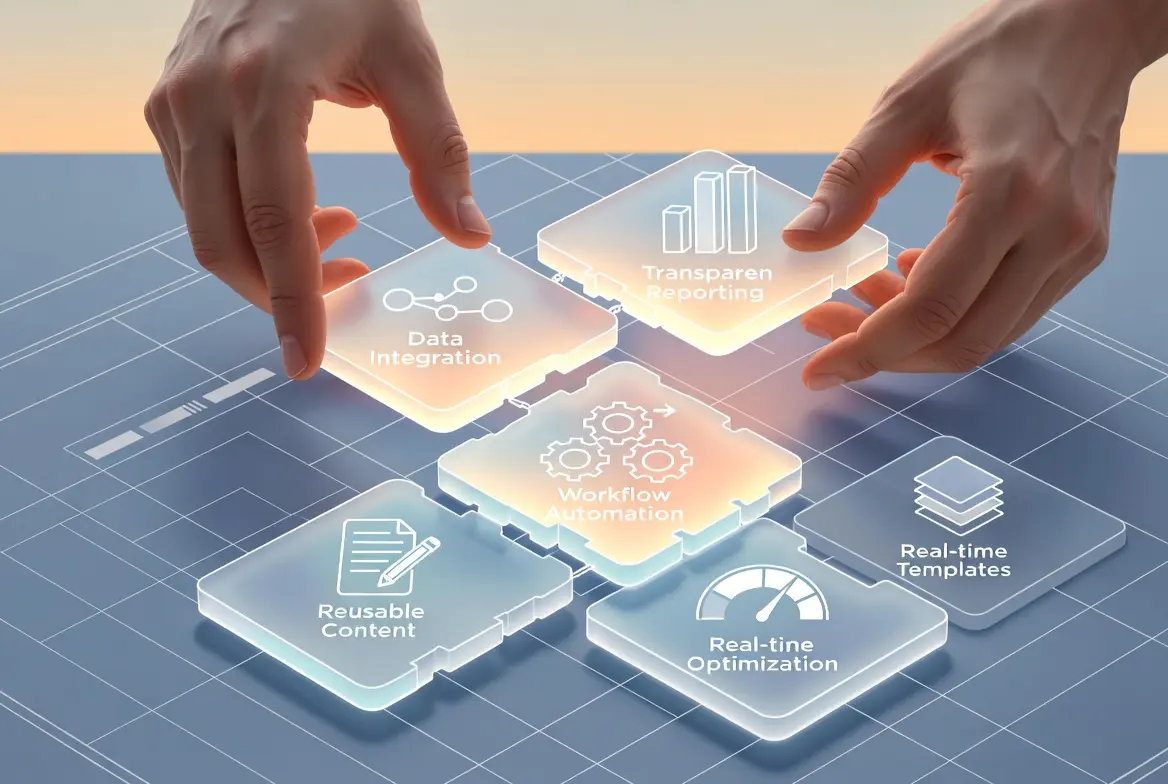
Your AI agency should connect directly with your existing tools—CRM, analytics platforms, ad dashboards, ecommerce systems—pulling in first-party data to drive smarter decisions.
If they can’t integrate seamlessly into your stack, they can’t predict anything. Disconnected data = disconnected strategy.
How to Evaluate Workflow Automation in an AI Marketing Agency
Predictive marketing depends on more than insights. It requires execution without delay.
The agency you choose should automate repetitive tasks across the campaign lifecycle—things like scheduling posts, distributing assets, routing approvals, and responding to performance signals.
If their process still requires manual follow-ups and spreadsheet updates, they’re not built for scale.
How to Vet Content Templates and AI Generation Capabilities
Scalability starts with reusable assets—but generic templates won’t cut it.
Your partner should offer:
Customizable templates for blogs, emails, social ads, and more
AI-generated content aligned with your brand voice and tone
Smart recommendations that adapt to campaign data in real time
This level of content agility is what separates a predictive agency from a production shop.
How to Validate Real-Time Optimization in an AI Marketing Agency
A predictive agency doesn’t wait for the end of a campaign to optimize—it adjusts while it runs.
Look for real-time dashboards, performance alerts, and AI that can:
Pause or scale ad sets
Swap underperforming content
Adjust spend based on live KPIs
If reporting is delayed or static, you’re not getting predictive value—you’re getting a recap.
How to Ensure Transparency in AI Decision-Making and Reporting
Trust matters. If the agency can’t clearly explain how its AI makes decisions, that’s a problem.
You should expect:
Clarity on what data powers the AI
Visibility into how decisions are made
Regular reports that show what actions were taken and why
If it feels like a black box, it’s not a partner—it’s a risk.
Key Takeaways: Choosing and Working with an AI Marketing Agency
Choosing an AI marketing agency means choosing how your brand will compete in a world where speed, personalization, and foresight are the new currency.
Look for an agency that:
Connects your data, not silos it
Automates workflows, not just tasks
Personalizes content at scale
Optimizes campaigns while they’re live
Provides clear, accountable reporting
When all five boxes are checked, you’re not just hiring a service—you’re gaining a predictive growth engine.
And in this new era of AI-powered marketing, that’s exactly what it takes to win.
How to Start an AI Marketing Agency with a Predictive Model
The opportunity to build the next generation of marketing services isn’t coming—it’s already here.
If you're wondering how to start an AI marketing agency, the answer isn’t just “use AI.” The agencies that will thrive aren’t adding AI to traditional systems. They’re building predictive engines from day one.
Here’s how to launch smarter, faster, and with scalable precision baked into your foundation.
How to Choose the Right Tools to Start an AI Marketing Agency
Before you think about hiring, branding, or outreach, get your infrastructure in place. You need workflows that don’t rely on manual effort. You need templates that adapt, not just repeat. You need data flows that update in real time—not weekly.
Gryffin was built exactly for this.
Use Gryffin’s:
Modular content templates to scale blog posts, ads, and emails
Workflow automation to reduce manual approvals and asset routing
CSV import features to launch multi-client campaigns without duplication
With the right system, you won’t start small—you’ll start scalable.
How to Position Your AI Marketing Agency Around Outcomes
Don’t build a content shop. Build a results engine.
Clients don’t care how much content you generate—they care what it achieves. From day one, position your agency around outcomes: more qualified leads, lower acquisition costs, faster testing cycles.
Use AI to track behavior, personalize campaigns, and optimize automatically. Let the tech do the heavy lifting while your team guides the strategy.
Outcomes earn trust. And trust keeps clients coming back.
How to Pick a Niche and Scale It with AI
Trying to serve everyone at once is a fast track to mediocrity.
Start with a niche: healthcare practices, local ecomm brands, SaaS startups, sustainable beauty—whatever your expertise or network aligns with. Build a specialized service stack around that audience. Use predictive insights to dominate the space.
Then, when it’s time to scale? Let AI handle the replication. Gryffin’s workflows and templates let you multiply your output without multiplying your workload.
Growth doesn’t have to be linear. With the right AI foundation, it’s exponential.
How to Anticipate Client Needs and Deliver Results Faster
Predictive marketing isn’t a trend—it’s the new standard.
In a landscape where attention is fleeting and competition is fierce, waiting to react is a luxury you can’t afford. The agencies that are thriving in 2025 are those that anticipate, automate, and act with precision.
Going predictive means:
Serving insights before clients even ask the question
Deploying campaigns that adapt in real-time
Focusing on outcomes, not just outputs
Building trust through proactive strategy—not reactive fixes
Whether you're running a fast-scaling agency or just getting started, the message is clear: clients don’t want a marketing partner who keeps up. They want one who sees what’s next—and delivers before the window closes.
This is your challenge: Stop reacting. Start leading.
The tools are here. The data is live. The opportunity is yours.
Q: What’s the difference between a reactive marketing agency and a predictive AI marketing agency?
A: A reactive agency waits for performance dips or post-campaign data before making changes. A predictive AI agency monitors intent, behavior, and sentiment in real time and takes preemptive action using automation, data modeling, and machine learning. The result is strategy that anticipates shifts, launches timely content, and optimizes before issues surface.
Q: How can AI help my marketing team anticipate customer behavior and act before performance drops?
A: AI analyzes behavioral signals across channels (clicks, scrolls, searches, sentiment) to flag patterns and predict next actions. It segments by future potential, times promotions to intent, and triggers alerts when trends or risks emerge. Real-time optimization then adjusts creative, spend, and targeting mid-flight to prevent churn and capture demand.
Q: What tech stack and workflows do I need to run a predictive, always-on marketing operation?
A: You need end-to-end data integration (CRM, analytics, ad platforms, ecommerce) feeding real-time dashboards and alerts. Layer in workflow automation for asset routing, approvals, and scheduling, plus predictive content templates aligned to brand voice. Add optimization engines that adjust budgets, targeting, and creatives while campaigns run; systems like Gryffin also support modular templates and CSV imports for multi-client scale.
Q: Give me a checklist of criteria to evaluate and choose an AI marketing agency partner.
A: Look for five things: deep data integration with your CRM/analytics/ad/ecommerce stack; workflow automation across production and approvals; custom templates and AI content aligned to your voice; real-time optimization with live controls; transparent AI logic, with reports that explain what actions were taken and why. If reporting is static or the system is a black box, keep looking.
Q: What steps should a traditional agency take to transition from reactive to predictive marketing?
A: First, integrate first-party and platform data into a single source of truth with real-time visibility. Next, automate workflows for content production, distribution, and approvals, and deploy models for trend tracking and behavioral prediction. Shift planning to outcome-based KPIs and always-on monitoring, and deliver proactive reporting with recommended next actions. Standardize with reusable templates to scale consistently.
Q: Show me an example of turning an emerging trend signal into content and campaigns within 24 hours.
A: Example: AI detects a 25% rise in TikTok engagement around “adaptogenic drinks,” with clear overlap to a wellness brand’s audience. The team auto-generates two blog drafts, a landing page, and social ad variants targeting “adaptogen benefits,” then launches within 24 hours. Performance is tracked live and creatives, audiences, and budgets are adjusted immediately based on results.
Q: What features should real-time optimization engines include, and how do they adjust campaigns while they run?
A: Core features include minute-by-minute analysis of CTR, conversions, bounce, and engagement; automated creative rotation and audience tests; and budget controls that scale or pause segments. They should swap underperforming assets, refine targeting, and shift spend based on live KPIs, with alerts and audit trails showing what changed and why. This turns static campaigns into adaptive systems that continuously learn.
Q: How do predictive content generation and automated ideation work across SEO, ads, and social?
A: AI scans rising searches, social signals, and competitor moves to spot emerging topics, then proposes SEO outlines, headlines, and briefs calibrated for near-term demand. For ads, it drafts copy variants, audiences, and landing page angles tied to intent signals. For social, it generates posts, hooks, and creative prompts aligned to trend velocity and brand voice—feeding a continuous ideation pipeline.
Q: If I’m launching an AI marketing agency in 2025, where should I start and how do I scale effectively?
A: Start with infrastructure, not headcount: real-time data flows, workflow automation, and modular content templates (tools like Gryffin cover these). Position services around outcomes—qualified leads, lower acquisition costs, faster test cycles—and let AI handle personalization and optimization. Niche down to a clear segment, win with predictive insights, then replicate with templates and CSV-driven workflows to scale without adding complexity.
Q: What questions should I ask an AI agency to confirm data integration, workflow automation, and transparent AI decision-making?
A: Ask: Which CRM, analytics, ad, and ecommerce systems do you integrate with, and how is first-party data used? Which tasks are automated end-to-end (asset routing, approvals, publishing, optimization), and what still requires manual work? How do your models make decisions—what data powers them, what rules or thresholds apply, and can we see logs of actions taken and their impact?
At first, we weren’t even thinking about AI visibility. We were focused on rankings and traffic like everyone else. But once we started testing our brand in ChatGPT and other AI tools, we realized we were barely showing up — even for topics we ‘ranked’ for. Gryffin gave us a clear picture of where we stood, how competitors were being cited instead, and what that actually meant for our pipeline. It shifted how we think about search entirely.









.webp)