How Do You Perform a Competitor Analysis for AI Search Engine Visibility?
Marcela De Vivo
Marcela De Vivo
May 18, 2026
The landscape of search is fundamentally shifting. Buyers are no longer just scrolling through ten blue links on Google; instead, they are starting their journeys with AI. More than half of consumers now use AI to find the best prices before making a purchase, and visitors arriving from AI search have a 4X higher conversion likelihood. If your brand isn’t mentioned in those initial AI responses, your competitors are capturing the business instead.
This paradigm shift necessitates a new approach to understanding your market position. The goal of an AI competitor analysis is to understand precisely who appears in AI-generated answers, why those specific entities are cited, and how you can earn inclusion for your own brand. Unlike classic blue-link Search Engine Results Pages where ranking position was paramount, AI search visibility is about citation presence, entity authority, and format fit.
What Is an AI Competitor Analysis and How Does It Differ from Traditional SEO?
An AI competitor analysis is the systematic process of evaluating how frequently and prominently your brand and your competitors are cited within AI-generated responses across major platforms like ChatGPT, Gemini, Perplexity, and Google AI Overviews. The primary output is a clear understanding of your Share of AI Voice, a detailed gap map, and a prioritized roadmap for improving your visibility.
Traditional SEO tools focus on tracking keyword rankings on Google. However, AI search operates on a different layer of discovery. The focus shifts entirely from securing a top ranking to earning mentions and citations within synthesized answers.
The key differences lie in the metrics of success. In traditional SEO, position is everything. In AI search, citation presence is the critical metric. AI models prioritize entity prominence, meaning they look for clear, established organizations and authors. They also favor format fit; if a user asks for a step-by-step guide, the AI prefers citing content already structured as a step-by-step guide. Furthermore, AI systems value evidence density, rewarding content backed by original research, data points, and expert quotes.
When conducting an AI SEO competitor analysis, you must consider the specific surfaces where these answers appear. This includes AI overviews at the top of traditional search results, dedicated chat-style assistants, and embedded Q&A modules within platforms. The deliverables of this analysis will equip you with a defined competitor universe, a clear picture of your Share of AI Voice, and actionable steps to fix the gaps where your competitors are currently winning.
How Do You Map the AI Search Landscape and Build a Reproducible Query Set?
To accurately measure your AI visibility, you must first build a representative, intent-led keyword sample. This query set should mirror the actual questions your buyers are asking that are likely to trigger AI answers.
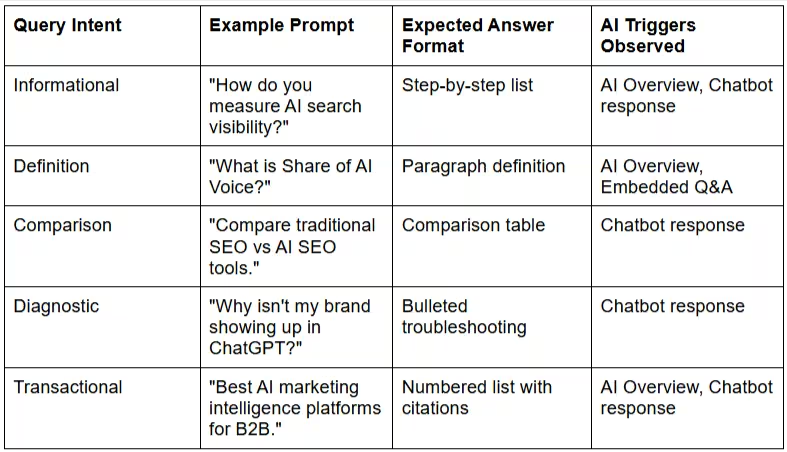
Start by clustering your queries by user intent. You need to capture a wide spectrum of the buyer's journey. Include informational "how-to" queries, definition requests, direct comparisons between solutions, problem diagnostic questions, and transactional research prompts.
It is crucial to include a mix of head, mid, and long-tail questions. Furthermore, because users interact with AI assistants more conversationally than traditional search engines, you must add conversational phrasings to your query set.
To ensure your data is reliable, you must establish a strict sampling protocol. AI results can be highly variable. Therefore, you must control for consistency by standardizing the device, location, signed-out state, cadence, and time-of-day for your test runs.
Query Sampling Worksheet Template
How Can You Define the Competitor Universe at the Entity and Topic Level?
In the realm of AI search, your competitors are not just the direct business rivals you face in the market. You must broaden your scope to include topic authorities that AI systems frequently cite.
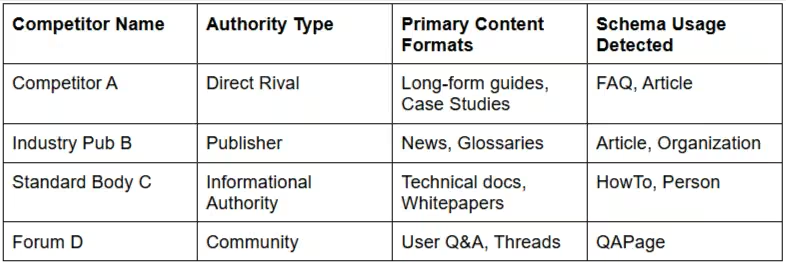
When mapping your competitor universe, categorize them into several types. You have your direct competitors, of course. But you also have informational authorities, industry forums, major publishers, standards bodies, and primary data sources. If an AI model consistently cites a specific industry glossary or a prominent research firm for definitions in your space, that entity is a competitor for AI visibility.
You must engage in entity modeling. Map out the organizations, specific authors, and key entities that are repeatedly cited around your core topics. Understanding who the AI considers an authority is the first step to becoming one yourself.
Competitor Taxonomy Matrix Template
What Is the Best Data Collection Workflow to Capture AI Answers and Citations?
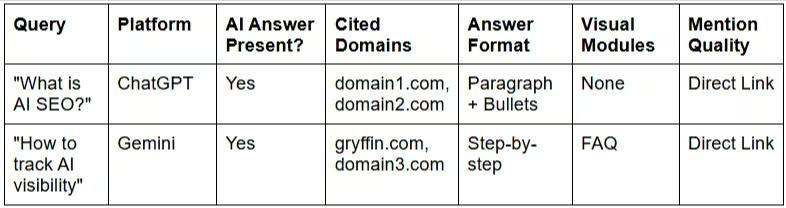
Gathering structured observations from AI results requires a consistent and ethical data collection workflow. For every query in your reproducible set, you must log specific data points.
First, note whether an AI answer appears at all. If it does, capture the cited domains and specific URLs. Pay close attention to the snippet types and answer formats. Note the presence of visual modules, such as FAQs, step lists, comparison tables, calculators, and product schemas. AI models tend to surface these structured formats frequently.
Develop a scoring rubric to evaluate the mentions. Track the presence of a citation, its order in the response, and its frequency across multiple runs. Evaluate the mention quality, is it a direct, clickable link, or just an implied reference?
Furthermore, analyze the evidence fields within the cited content. Identify the original source type (e.g., an original study, a comprehensive guide, a glossary). Note the publication date for freshness signals and look for strong author signals that contribute to E-E-A-T (Experience, Expertise, Authoritativeness, and Trustworthiness).
AI Answer Citation Logging Template
How Do You Quantify Visibility with AI-Specific Metrics?
To truly understand your performance, you must move beyond traditional ranking metrics and adopt metrics suited to AI-generated results.
Share of AI Voice is the foundational metric. This represents the percentage of queries where your domain is cited, ideally weighted by the citation order (being the first citation carries more weight than being the fifth).
Query Coverage measures the number and percentage of intents where your domain appears, broken down by your query clusters. This shows you where your topical authority is strong and where it is lacking.
Citation Quality Index adds depth to your analysis by weighting citations based on the evidence depth of the cited page, its freshness, and the presence of structured data.
Format Fit Score evaluates the alignment between your page format and the preferred answer module of the AI. If the AI prefers checklists for a specific query intent, and your page provides a checklist, your format fit score is high.
The output of this measurement should be a comprehensive dashboard showing trends, cluster rollups, and your top opportunities for improvement.
The bar chart above illustrates how Share of AI Voice can be visualized across different query clusters, allowing you to instantly identify areas where competitors are outperforming your brand.
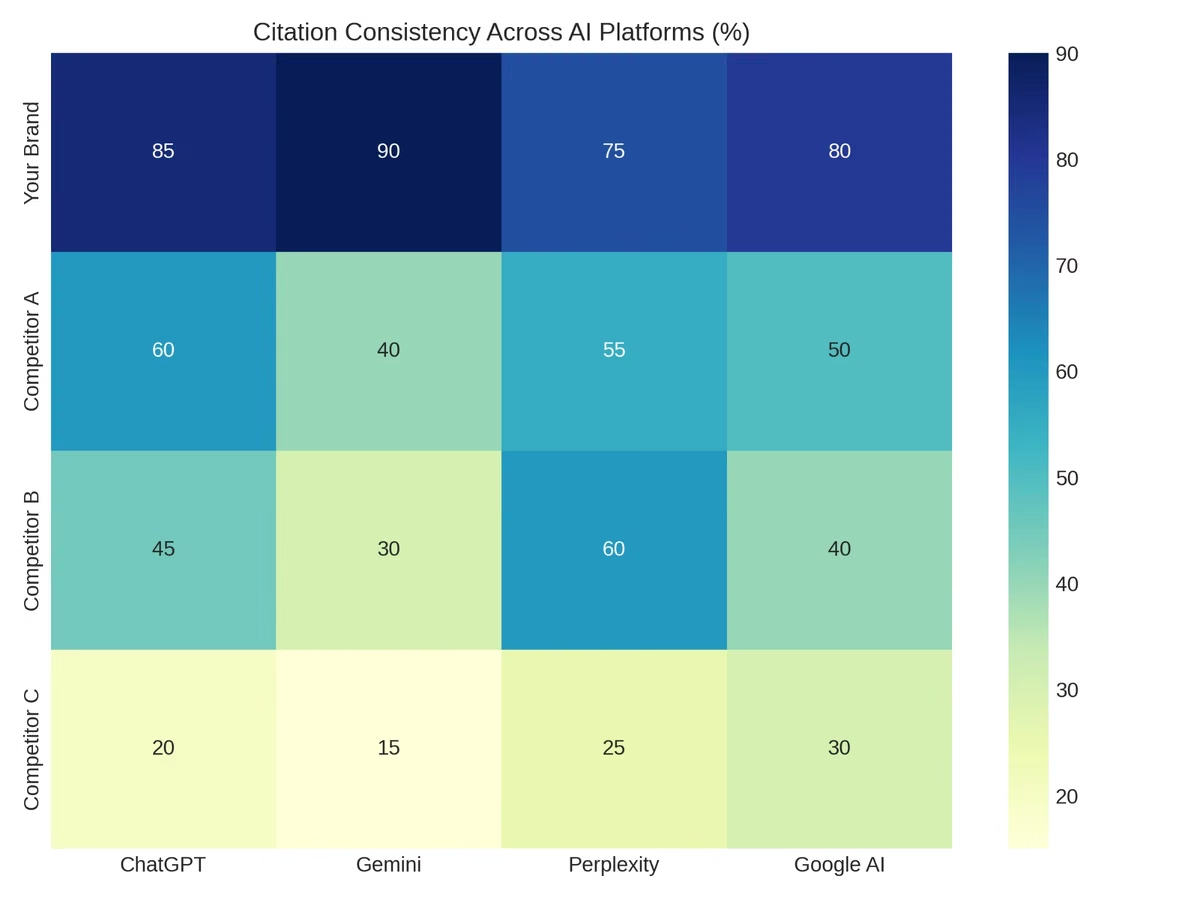
This heatmap demonstrates citation consistency across major AI platforms. A high percentage indicates reliable visibility, while lower percentages highlight platforms requiring targeted optimization.
How Can You Diagnose Content, Entity, and Evidence Gaps in AI Search?
Once you have quantified your visibility, you must translate that data into actionable insights. You need to diagnose why others are being cited and where you can earn inclusion. Gryffin helps you identify these gaps and provides clear, ready-to-use actions to fix them instantly.
Content Gaps: Look for missing topics in your content library. Are your existing pages lacking sufficient depth? Do you fail to provide clear instructions where AI models prefer them? Are you missing definitions or supporting data that competitors provide?
Entity Gaps: AI models rely on clear entity recognition. Do you have an unclear organizational entity? Are your author profiles weak or lacking credentials? Thin "About," "Contact," or "Editorial Policy" pages can harm your entity authority.
Evidence Gaps: AI models favor substantiated claims. Are you missing original research, statistical data, in-depth case studies, or quotes from recognized subject matter experts?
Technical Gaps: Ensure your technical foundation supports AI discovery. This includes comprehensive schema coverage (such as FAQ, HowTo, Article, Organization, and Person schema), strong internal linking structures, and crawlable Q&A sections.
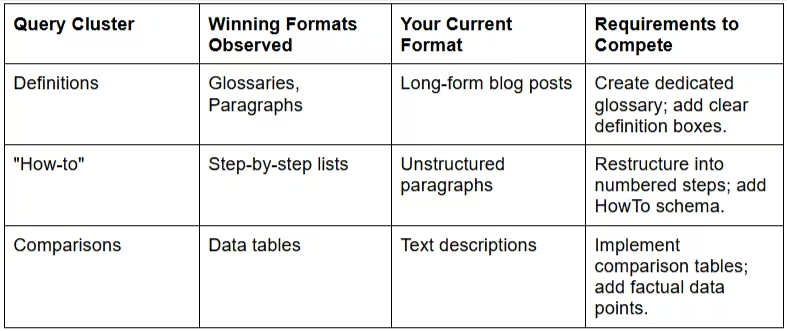
AI Competitor Analysis Gap Mapping Matrix
How Do You Prioritize Actions and Build a Roadmap for AI Search Visibility?
With your gaps identified, you must convert these findings into a sequenced plan using effort-versus-impact logic. Every action should tie directly to improving your presence in AI answers.
Start with Quick Wins. These are low-effort, high-impact changes. Add FAQ sections to existing high-traffic pages. Strengthen your definitions to make them easily extractable by AI. Update publication dates to signal freshness. Surface expert biographies prominently, and enrich your existing pages with relevant schema markup.
Next, focus on Net-New Assets. Create authoritative primers on core topics. Build comprehensive glossaries. Develop clear process explainers and interactive calculators. Most importantly, produce evidence-led guides backed by original data.
Finally, tackle Content Refactors. Take your existing long-form pages and restructure them into scannable steps, data tables, and clear questions and answers, the formats that AI modules prefer to cite.
When creating new content or refactoring old pages, use an editorial brief optimized for answer-first formats. This brief should clearly define the user intent, the target answer format (e.g., list, table, paragraph), the required evidence sources, the schema plan, and specific internal link targets.
How Should You Monitor, Experiment, and Report on AI SEO Competitor Analysis?
Achieving AI search visibility is not a one-time project; it requires an ongoing operating cadence to validate your changes against AI results. Gryffin allows you to track results so you know exactly what moved the needle after you take action.
Establish a rigorous experiment design. Define clear hypotheses for your optimizations, select specific page sets to test, and determine your success metrics upfront. Log all changes and their timelines meticulously.
Re-run your query set on a regular schedule. Compare your presence, citation quality, and cluster coverage deltas over time.
Implement strong governance practices. Maintain a changelog of all optimizations. Develop a style guide specifically for evidence standards to ensure all new content meets AI requirements. Create a schema QA checklist, and ensure author policies are consistently updated.
Your reporting should focus on monthly trends and quarterly strategy resets. Document both your insights and any anomalies you observe, as AI platforms shift daily. Teams that systematize citation earning through entity clarity, structured evidence, and answer-first formats will compound their visibility as these models continue to evolve.
Building a Reliable AI Search Query Sampling Framework
To truly master AI visibility, the foundation of your strategy must be built on a robust and reliable query sampling framework. As we discussed earlier, variability is the enemy of accurate measurement in AI search. Without a standardized approach to sampling, your data will be noisy, and your insights will be flawed.
When building this framework, start by categorizing your target keywords not just by search volume, but by the likelihood of triggering an AI response. Informational queries ("how to," "what is") and complex comparison queries ("difference between X and Y") have a significantly higher probability of generating comprehensive AI answers than simple navigational queries.
Once you have identified these high-probability queries, you need to establish a consistent testing environment. This means utilizing clean browser profiles or incognito modes, ensuring that location settings are standardized (e.g., always testing from a specific city or region if local relevance is a factor), and clearing cache and cookies between sessions. For enterprise-level tracking, utilizing automated tools like Gryffin is essential, as manual tracking quickly becomes unscalable and prone to human error.
Furthermore, your sampling framework must account for the different "personalities" and training data of various AI models. A query that triggers a detailed, cited response in Perplexity might only generate a brief summary in Google AI Overviews. Your framework must log these discrepancies to provide a holistic view of your Share of AI Voice across the entire ecosystem.
Writing Editorial Briefs Optimized for Answer-First Formats
The traditional SEO content brief, focused heavily on keyword density, word count, and LSI keywords, is no longer sufficient for the AI era. To win citations in AI answers, you must transition to writing editorial briefs optimized for "answer-first" formats.
An answer-first brief prioritizes clarity, structure, and directness. When crafting these briefs, explicitly state the primary question the content must answer in the very first paragraph. Do not bury the lede. AI models are designed to extract the most direct and relevant information quickly.
Your briefs should mandate the use of specific structural elements that AI models favor. Require the inclusion of a "TL;DR" or summary section at the top of the article. Specify where bulleted lists, numbered step-by-step instructions, and comparison tables should be used.
Moreover, an answer-first brief must emphasize entity clarity. Instruct writers to clearly define any industry jargon or complex concepts using simple, unambiguous language. Ensure that the relationships between different entities (e.g., how your product integrates with another platform) are explicitly stated, as AI models rely on these connections to build their knowledge graphs.
Entity SEO Fundamentals: Organization, Author, and Topical Entities
Understanding and optimizing for entities is the cornerstone of AI search visibility. An entity is a distinct, well-defined concept, it can be a person, an organization, a place, or an abstract idea. AI models use entities, rather than just keywords, to understand the context and meaning of content.
Organization Entities: Your brand is an entity. To strengthen your organization entity, ensure that your brand name, address, phone number, and core business offerings are consistent across your website, social media profiles, and industry directories. Utilize Organization schema markup on your homepage and "About Us" page to explicitly define your corporate identity to search engines and AI crawlers.
Author Entities: The individuals writing your content are also entities. AI models evaluate the expertise and authority of these authors to determine the trustworthiness of the content. Strengthen author entities by creating detailed author bio pages that highlight their credentials, experience, and links to their other published works. Implement Person schema markup to connect the author to the content they produce.
Topical Entities: These are the core subjects your brand focuses on. To build authority around topical entities, create comprehensive pillar pages that cover a subject in depth, and link out to related sub-topics. Ensure that your content clearly defines the relationships between different topical entities within your industry.
Evidence-Led Content: How to Integrate Data, Studies, and Citations
In an environment where AI models are increasingly scrutinized for "hallucinations" (providing incorrect or fabricated information), evidence-led content is your strongest asset. AI models are programmed to prefer content that is substantiated by credible sources.
To create evidence-led content, you must move beyond simply stating opinions or industry platitudes. Every significant claim should be backed by data. Integrate original research, survey results, or proprietary data points into your articles. If you do not have original data, cite reputable third-party studies, industry reports, or academic papers.
When integrating evidence, do so clearly and explicitly. Use phrases like "According to a recent study by..." or "Data from [Source] indicates that..." Provide direct links to the original sources. This not only builds trust with human readers but also provides the clear citation signals that AI models look for when determining which sources to include in their synthesized answers.
Practical Schema Plans for FAQs, HowTo, and Article Types
Schema markup is the language you use to communicate directly with AI models and search engines. It provides explicit context about the structure and meaning of your content. A practical schema plan is essential for maximizing your AI visibility.
FAQ Schema: This is perhaps the most critical schema type for AI search. AI models frequently extract Q&A pairs to populate their answers. Implement FAQ schema on any page that contains a list of questions and answers. Ensure that the questions in your schema exactly match the questions on the page, and that the answers are concise and direct.
HowTo Schema: If your content provides step-by-step instructions, HowTo schema is mandatory. This schema breaks down the process into distinct, logical steps, making it incredibly easy for AI models to understand and extract the instructions. Include relevant images or video clips for each step within the schema markup.
Article Schema: Use Article schema (or specific subtypes like NewsArticle or TechArticle) for all your blog posts and informational content. This schema provides essential metadata, such as the headline, author, publication date, and featured image, helping AI models understand the context and freshness of the content.
Measuring Share of AI Voice Alongside Classic SEO KPIs
While Share of AI Voice is the defining metric for this new era of search, it should not be measured in isolation. To get a complete picture of your performance, you must measure Share of AI Voice alongside your classic SEO Key Performance Indicators.
Traditional metrics like organic traffic, keyword rankings, and click-through rates, still matter. However, you must now analyze how these metrics correlate with your AI visibility. For example, if you see a drop in organic traffic for a specific query cluster, check your Share of AI Voice for those same queries. It is highly likely that an AI-generated answer is now satisfying the user's intent directly on the search results page, leading to fewer clicks to your website.
By tracking both sets of metrics, you can identify which topics are driving traditional organic traffic and which are driving AI citations. This dual approach allows you to optimize your content strategy more effectively, ensuring that you are capturing visibility across the entire spectrum of search discovery.
The transition from traditional search to AI-driven discovery requires a fundamental shift in strategy. It is no longer enough to track ranking positions; you must focus on citation presence and entity authority. By embracing repeatable measurement, creating evidence-led content, and ensuring your pages have the right format fit, you can build enduring advantages in AI search. As buyers increasingly rely on AI to find answers, ensuring your brand is the one they see first is critical for driving conversions and pipeline growth.
Frequently Asked Questions: Competitor Analysis for AI Search Engine Visibility?
What is an AI competitor analysis in the context of AI-generated search answers?
An AI competitor analysis evaluates how frequently and prominently your brand and competitors are cited in AI responses (like ChatGPT or Google AI Overviews), focusing on citation presence and entity authority rather than traditional ranking positions.
How often should you re-run an AI SEO competitor analysis?
Because AI platforms shift frequently, it is recommended to re-run your query set on a regular schedule, typically monthly or quarterly, to track changes in your Share of AI Voice and identify new opportunities.
Why do some AI answers omit citations, and how should you handle that?
Some AI models synthesize answers without direct links if the information is considered general knowledge or if the model's confidence in a single source is low. To combat this, focus on providing unique, evidence-led content and strong entity signals that force the AI to cite your specific expertise.
How do E-E-A-T signals influence inclusion in AI-generated answers?
Experience, Expertise, Authoritativeness, and Trustworthiness are critical. AI models prefer to cite established entities, recognized authors, and content backed by original research and clear editorial policies.
What sample size of queries is sufficient for reliable insights?
A reliable sample size should cover your core intents (informational, transactional, etc.) across the buyer journey. While the exact number varies, a robust set of 50-150 well-clustered, intent-driven queries is typically sufficient for actionable insights.
How do you measure ROI from improved AI answer visibility?
ROI is measured by tracking the increase in your Share of AI Voice and correlating it with referral traffic from AI platforms, brand search volume increases, and the higher conversion likelihood (up to 4X) associated with AI search visitors.
How do multilingual or regional queries change the process?
Regional and multilingual queries require localized query sets and separate tracking runs, as AI models may cite different local authorities or formats depending on the user's language and location parameters.
Are AI results personalized, and how can teams control for variability?
Yes, AI results can be personalized based on user history and session data. To control for this variability, you must establish a strict sampling protocol using signed-out states, consistent locations, and standardized devices during data collection.
At first, we weren’t even thinking about AI visibility. We were focused on rankings and traffic like everyone else. But once we started testing our brand in ChatGPT and other AI tools, we realized we were barely showing up — even for topics we ‘ranked’ for. Gryffin gave us a clear picture of where we stood, how competitors were being cited instead, and what that actually meant for our pipeline. It shifted how we think about search entirely.










.webp)