How to Track AI Brand Sentiment in LLMs and Fix Negative Signals
Marcela De Vivo
Marcela De Vivo
May 19, 2026
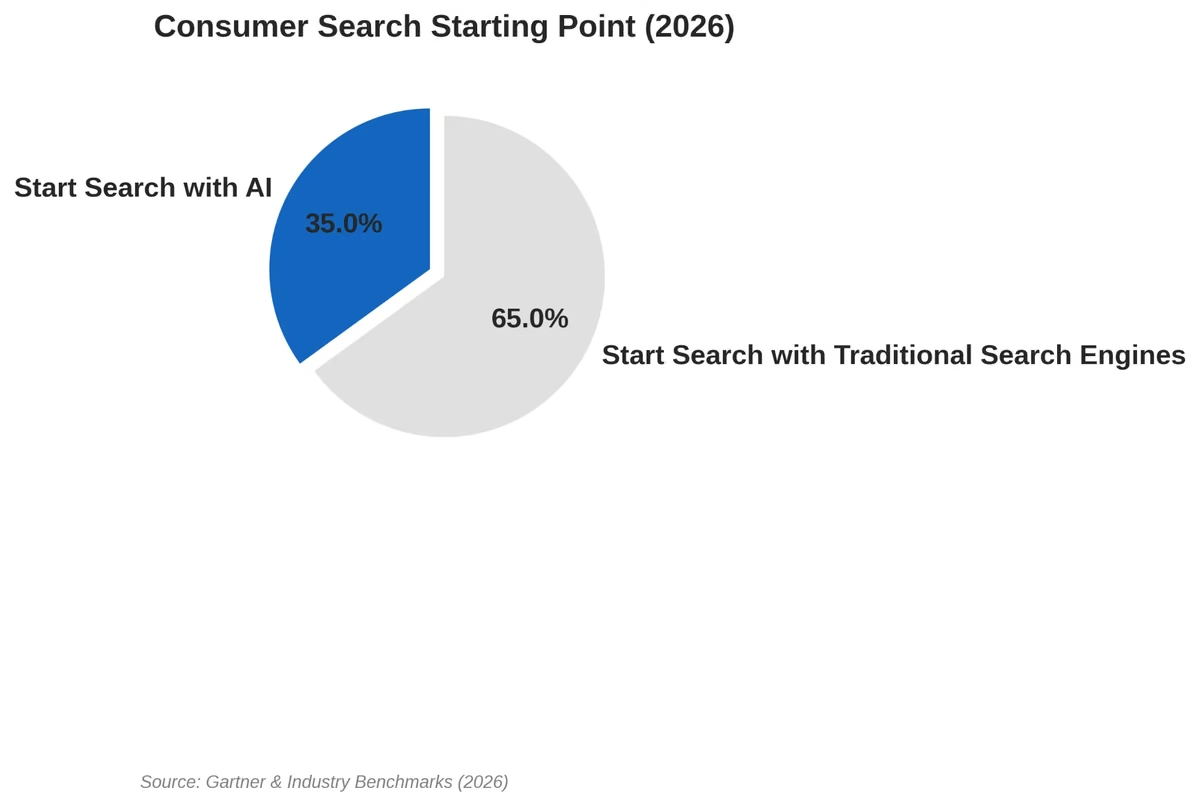
The search landscape is undergoing its most dramatic shift in two decades. Consumers and B2B buyers are no longer sifting through ten blue links to find the best software, financial services, or enterprise solutions. Instead, they are asking ChatGPT, Claude, and Perplexity direct questions, and expecting direct, authoritative answers. This rise of AI-mediated discovery means that Large Language Models now actively shape the perception of your brand.
But what happens when an AI assistant hallucinates a negative review about your product? What if it confidently states that your competitor is the "industry standard" while omitting your brand entirely? When AI outputs reflect or amplify negative brand sentiment, it directly impacts user trust and conversion rates. Data shows that buyers who arrive via AI search have a 4X higher conversion likelihood, making visibility in these platforms more valuable than ever.
For marketing, SEO, PR, and product leaders, managing your reputation now requires understanding the mechanics of AI search. This article will explore how AI brand sentiment forms, where you can find it, how to measure it rigorously using a structured framework, and how to remediate and monitor it over time using platforms like Gryffin.
What is AI Brand Sentiment and Why Does it Matter?
AI brand sentiment is the aggregate favorability, trust, and suitability signals that LLMs and AI search experiences associate with a specific brand entity. It is the qualitative layer of your AI visibility. While traditional SEO focuses on whether you rank for a keyword, AI brand sentiment determines how you are described when you are recommended.
It is crucial to contrast this with traditional social listening sentiment. Social sentiment tracks what human users are saying about your brand on Twitter or Reddit in real-time. AI sentiment, however, is entity-centric. It is shaped by the model's training data, its retrieval-augmented generation results, and complex feedback loops. An LLM does not "feel" anything about your brand; rather, it calculates the statistical probability of associating your brand name with positive, negative, or neutral descriptors based on the vast corpus of text it has ingested.
AI Brand Sentiment (Definition): The aggregate favorability, trust, and suitability signals that Large Language Models and AI search experiences associate with a brand entity, determining how the brand is positioned, recommended, or critiqued in AI-generated answers.
Where Does AI Brand Sentiment Show Up?
The impact of AI brand sentiment is not limited to a single platform. It surfaces across the entire ecosystem of AI-driven user journeys:
Chat Assistants: ChatGPT, Claude, and Gemini conversational interfaces.
Generative Search Answers: Google's AI Overviews and Perplexity's citation-heavy responses.
Code Assistants: GitHub Copilot recommending specific APIs or SDKs.
Shopping Assistants: AI agents comparing product features and pricing.
Autocomplete and Voice Agents: Siri, Alexa, and predictive text features summarizing brand reputation.
If your brand isn't showing up positively in those first AI responses, you are essentially invisible at the moment it matters most.
How Do LLMs Learn and Express Brand Sentiment?
To fix negative AI brand sentiment, you must first understand how LLMs form these associations. The process is not magic; it is a combination of massive data ingestion and algorithmic weighting.
What Inputs Shape LLM Brand Sentiment?
An LLM's perception of your brand is built upon layers of data. The foundational layer is the pretraining corpora, the massive datasets (like Common Crawl) used to train the base model. This includes historical web snapshots, news archives, Wikipedia, and digitized books.
However, modern AI search engines do not rely solely on their pretraining. They use Retrieval-Augmented Generation. When a user asks a question, the system queries the live web, retrieves the top results, and feeds that context to the LLM to generate an answer. Therefore, the inputs that actively shape your sentiment include:
Real-time news articles and PR releases.
Third-party reviews on sites like G2, Capterra, or Trustpilot.
Knowledge bases and documentation.
Citations from authoritative industry blogs.
User feedback and community discussions (e.g., Reddit, Stack Overflow).
How Do System Factors and Safety Layers Influence Outputs?
Beyond the raw data, the architecture of the AI system plays a massive role. AI companies implement safety and classification layers to prevent their models from generating harmful or overly biased content. Furthermore, the prompt instructions (the hidden "system prompts" that guide the AI's behavior) often bias the model toward risk-averse recommendations.
If an AI system detects conflicting information about your brand's reliability, its safety layers may trigger cautionary language. It might append phrases like "Users should exercise caution" or "Some reports indicate..." to avoid appearing overly promotional or endorsing a potentially flawed product.
Why Do Entity Resolution and Knowledge Graphs Matter?
LLMs treat brands as entities, unique nodes in a massive knowledge graph. To an AI, your brand is a collection of attributes, relationships, and facts. Consistent, high-quality, referenceable information is what solidifies your entity in the knowledge graph. If your brand's Name, Address, and Phone number are inconsistent across the web, or if your product features are poorly documented, the LLM struggles with entity resolution. This confusion often results in the AI omitting your brand entirely or hallucinating incorrect details. Understanding this formation helps you target remediation at the right layers, whether that means fixing web signals or providing direct model feedback.
Where Does Negative AI Brand Sentiment Appear and How Can You Spot It?
Identifying negative AI brand sentiment requires proactive auditing. Because AI responses are dynamic and personalized, you cannot simply Google your brand name once and assume the job is done. You must actively prompt the models to see how they respond under different conditions.
What Are the Common Patterns of Negative AI Sentiment?
When an LLM holds a negative or uncertain association with your brand, it typically manifests in a few predictable patterns:
Discouraging Language: The model explicitly states that your product is "not recommended for enterprise use" or "lacks key security features."
Outdated Issues Presented as Current: The AI brings up a data breach from 2019 or a discontinued pricing model as if it happened yesterday.
One-Sided Summaries: The response heavily weighs negative reviews from a specific niche forum while ignoring your official documentation or positive case studies.
Overcautious Safety Blocks: The model refuses to answer questions about your brand, citing safety guidelines, which implies your brand is controversial or risky.
Hallucinated Claims: The AI invents a controversy or a product limitation that does not exist, simply because it confused your entity with a competitor.
Which Surfaces and Prompts Should You Audit?
To spot these red flags, you need to test specific surfaces and intents. Do not just ask, "What is [Brand Name]?" Instead, audit the following prompt categories:
Brand Queries: "Give me an overview of [Brand Name]'s reputation."
Category Comparisons: "What is the best AI visibility platform: [Competitor A], [Competitor B], or [Your Brand]?"
Troubleshooting Prompts: "What are the common complaints about [Your Brand]?"
Trust and Safety Prompts: "Is [Your Brand] safe to use for financial data?" or "Is [Your Brand] reliable?"
Location or Product-Specific Prompts: "Does [Your Brand] support European data compliance?"
How Should You Collect Evidence?
When you spot a red flag, such as repeated cautionary phrasing, the absence of recent achievements, or missing critical context, you must document it rigorously. Capture date-stamped screenshots and save the exact raw prompt-output pairs. This evidence plan is vital for reproducibility. AI models are updated constantly; if you do not record the exact phrasing and the date, you will not be able to prove whether your remediation efforts actually worked.
A Practical Measurement Framework for AI Brand Sentiment
You cannot fix what you cannot measure. To move from anecdotal observations to a strategic AI SEO program, you need a structured measurement framework.
What Are the Measurable Axes of AI Sentiment?
When evaluating LLM outputs, you should score your brand across five distinct axes:
Favorability: Is the overall tone positive, neutral, or negative? Does the AI actively recommend the brand?
Trust/Credibility: Does the model cite authoritative sources when discussing your brand? Does it acknowledge your industry expertise?
Safety/Ethics: Are there any red flags regarding data privacy, security, or ethical business practices?
Suitability/Fit: Does the AI accurately match your product to the right use cases and target audience?
Recency/Accuracy: Is the information current? Are product features, pricing, and leadership details accurate?
How Do You Score AI Visibility?
Establish a 5-point scoring rubric for each axis. For example, on the Favorability axis:
1 (Severe Risk): Explicitly discourages use; highlights severe flaws.
3 (Neutral): Provides a factual, dry summary with equal weight to pros and cons.
5 (Strong Endorsement): Actively recommends the brand as a top-tier solution; highlights unique strengths.
Include clear guidance and examples for what qualifies at each level to ensure inter-rater reliability if multiple team members are auditing the outputs.
How Should You Design Your Evaluation?
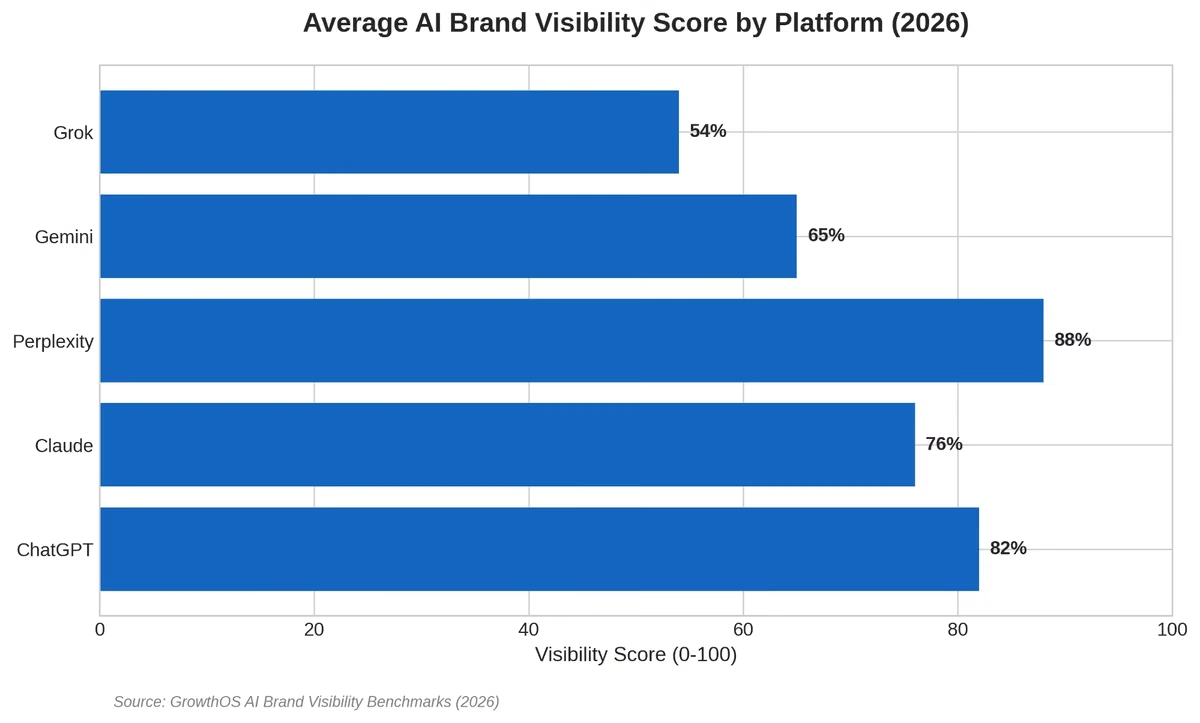
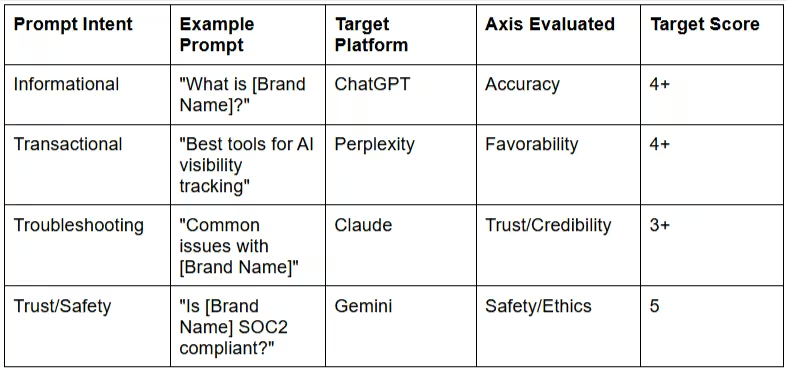
Your evaluation design should not be ad-hoc. Create prompt sets categorized by intent: informational, navigational, transactional, and troubleshooting. Test these prompts across multiple models (ChatGPT, Claude, Perplexity, Gemini) and different geographies, as localized models may yield different results. This evaluation must be conducted at a fixed cadence to establish trend lines over time for leadership reporting.
Table 1: Sample AI Brand Sentiment Evaluation Matrix
Building a Repeatable LLM Brand Sentiment Audit Workflow
A one-time check is insufficient. You must build a repeatable LLM brand sentiment audit workflow that scales with your marketing efforts.
How Do You Create a Comprehensive Test Suite?
Start by building a robust test suite. This should include:
Seed Prompts: Core questions about your brand and category.
Paraphrases: Variations of the seed prompts (e.g., "Best AI SEO tools" vs. "Top platforms for AI search optimization").
Adversarial/Edge Prompts: Prompts designed to provoke a negative response (e.g., "Why should I avoid using [Brand Name]?").
Brand-Risk Prompts: "Is [Brand Name] safe?", "Is it a scam?", "Who is responsible for [Brand Name]?"
Should You Automate the Audit Process?
Yes, where possible. While manual spot-checking is valuable for nuance, automation allows for scale. Use programmatic prompting via APIs (where allowed by the platform's terms of service) to run your test suite weekly or monthly. Log the outputs and store the judgments in a central database. However, always complement automation with human review, as AI cannot fully grasp the subtle nuances of brand reputation.
What Governance and KPIs Are Required?
Establish clear governance. Who reviews the findings? What is the escalation path if the audit uncovers a highly defamatory output? Define your documentation standards so that every issue is tracked from discovery to resolution.
Key Performance Indicators for your AI sentiment program should include:
Model Coverage: Percentage of major LLMs where your brand is accurately represented.
Issue Count by Severity: Number of critical vs. minor inaccuracies found.
Time-to-Remediation: How long it takes to correct a negative signal once identified.
Sentiment Score by Intent: Average rubric score across transactional vs. informational prompts.
Resolution Confirmation Rate: The percentage of issues successfully fixed in subsequent audits.
Remediating Negative AI Brand Sentiment via Web and Content Signals
Once you have identified negative sentiment or inaccuracies, how do you fix them? The most durable method is to improve the web signals that feed the LLMs' RAG systems.
How Can On-Site Fixes Improve AI Perception?
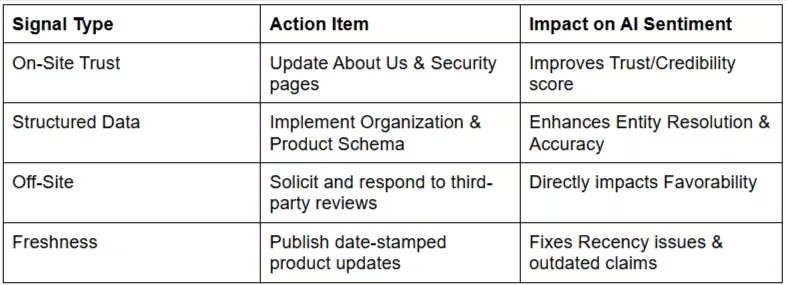
LLMs look for authoritative signals on your own domain. Ensure your site has:
Authoritative About and Trust Pages: Clearly articulate your mission, history, and leadership.
Transparent Policies: Publish clear security, privacy, and compliance pages.
Detailed Product Docs: Provide comprehensive, unambiguous documentation that models can easily parse.
Incident Retrospectives: If you had a past issue (like downtime), publish a transparent post-mortem. LLMs reward transparency and resolution.
Citations: Link to authoritative external sources to boost your own credibility.
How Does Structured Data Influence LLMs?
Entity optimization for LLMs relies heavily on structured data. Implement clear Organization and Product markup. Ensure your Name, Address, and Phone number are consistent across the web. Use sameAs links to connect your canonical profiles (LinkedIn, Crunchbase, official social channels) so the knowledge graph can accurately map your entity. Machine-readable facts are far easier for an AI to ingest than clever marketing copy.
What Off-Site Signals Matter Most?
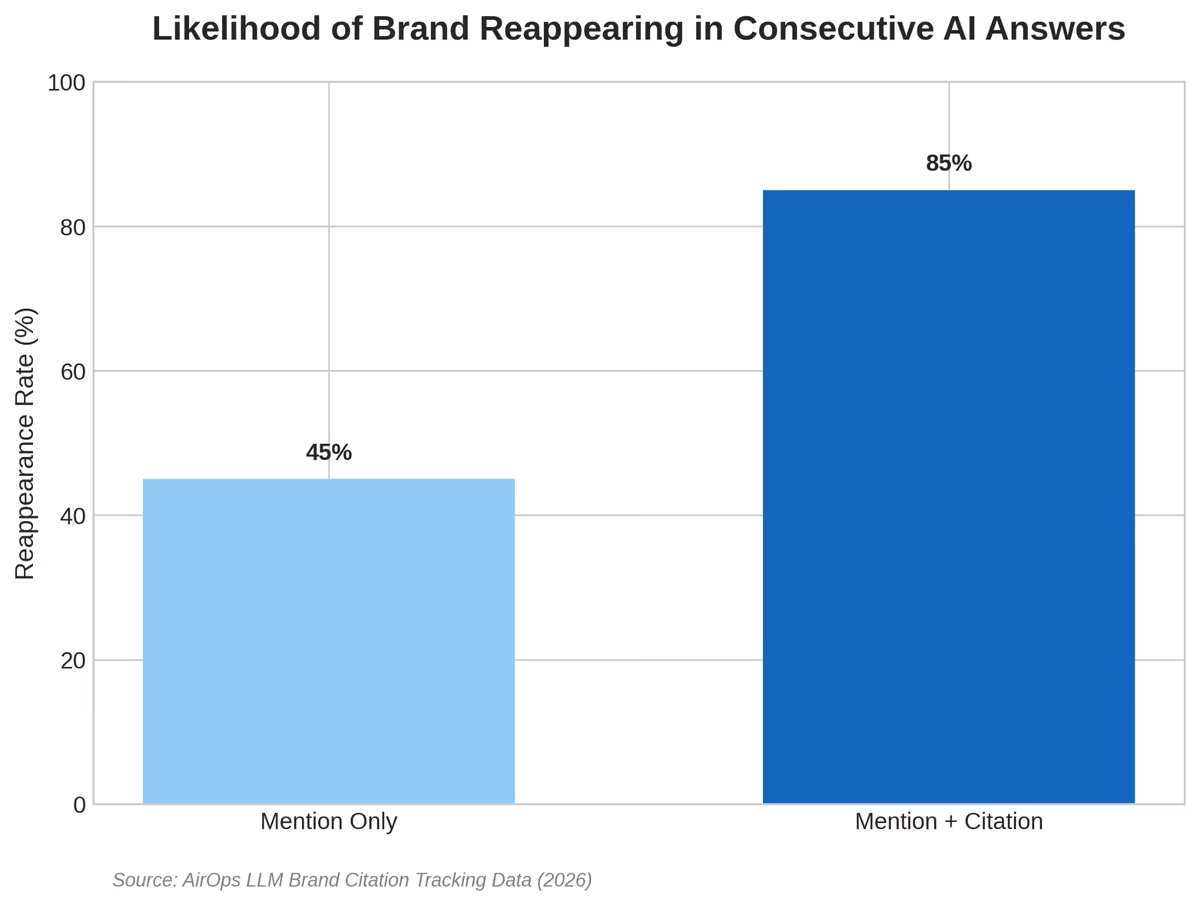
Your own website is only part of the equation. LLMs heavily weight third-party citations. Focus on generating reputable reviews on platforms like G2 and Capterra, and always respond to them, both positive and negative. Seek expert mentions in industry publications, ensure your Wikipedia or high-quality knowledge base entries are accurate, and maintain accurate directory listings.
Research indicates that brands that earn both a mention and a direct citation in an AI response are 40% more likely to reappear in consecutive answers.
Why Are Freshness and Verifiability Crucial?
AI models prioritize recent, verifiable information. If an LLM is citing an outdated pricing page from 2022, you must update the content that the AI is citing. Publish correction notes if a third-party site has incorrect information. Provide primary sources that models can easily retrieve and summarize. When your web signals are in order, you create a foundation of truth that the AI's retrieval systems cannot ignore.
Table 2: Web Signal Remediation Checklist
Direct Model Interactions, Reporting, and Risk Management
When web signals are optimized but the model still hallucinates or presents negative sentiment, you must engage with the model-level feedback channels.
How Do You Use Feedback Loops to Correct Inaccuracies?
Most AI platforms provide reporting tools or feedback prompts (like a "thumbs down" icon). Use these channels to flag inaccuracies. Do not just say "this is wrong." Provide concise, evidence-backed requests for review, including URLs to primary sources. Some platforms also offer publisher appeal forms for systemic issues.
What If the Model Misclassifies Your Content for Safety Reasons?
If a model over-blocks your brand due to safety conflicts (e.g., misclassifying a cybersecurity tool as a hacking threat), submit a formal, evidence-backed request for review to the platform provider. Clearly explain your product's legitimate use case and provide links to your compliance documentation.
How Should You Handle Legal and Reputational Safeguards?
For severe cases involving harmful or defamatory claims, you need established escalation criteria. Coordinate closely with your legal and PR teams. Maintain a detailed log of all outreach, feedback submissions, and outcomes.
After implementing web changes or submitting feedback, verification is essential. Re-test the exact same prompts and variants after a few weeks. Record the improvement deltas to prove the ROI of your AI SEO efforts.
Ongoing Monitoring and Future-Proofing Your AI Search Brand Perception
AI models are not static; they are continuously updated and retrained. Therefore, treating AI-facing reputation as a one-time project is a recipe for failure. It must be a continuous quality program.
What is the Ideal Audit Cadence?
Establish a regular cadence for monitoring:
Monthly: Light checks on core seed prompts and high-priority transactional queries.
Quarterly: Deep audits across the full prompt suite, evaluating all five axes of the measurement framework.
Immediate Triggers: Run checks immediately after major company news, product launches, PR incidents, or known core updates to major LLMs.
How Do You Prepare for Future Model Updates?
Preparedness is key. Maintain a living prompt bank that evolves as user search behavior changes. Keep a list of watchlist queries where your brand is currently underperforming. Develop an issue taxonomy to categorize the types of AI hallucinations or negative sentiments you encounter. Monitor industry news for changes in model behavior after known updates (e.g., the release of a new GPT or Claude version).
What Does AI-Ready Publishing Look Like?
To future-proof your brand, adopt AI-ready publishing patterns. This means creating structured, citation-rich, and unambiguous pages. Disambiguate your entities clearly. Use FAQs formatted as natural language prompts. Provide concise summaries at the top of long-form content that models can ingest reliably.
The outlook is clear: entity-first strategies and stronger provenance signals will matter more as AI search and assistants expand. Brands that structure their data for machines will win the recommendation engine game.
The era of ten blue links is ending, replaced by AI-mediated discovery where LLMs directly shape perceptions of your brand. AI brand sentiment is not an abstract concept; it is the aggregate result of training data, retrieval systems, and feedback loops. To succeed, marketing and SEO leaders need structured auditing, measurable rubrics, rigorous content and entity remediation, and strong governance.
Treat your AI-facing reputation like a continuous quality program. Pair durable web signals with consistent evaluation and transparent corrections. By doing so, you ensure that when a buyer asks an AI for a recommendation, your brand is not only visible but positioned as the trusted, authoritative choice.
Start today: formalize an internal AI sentiment playbook and pilot your first quarterly audit to see exactly how the machines perceive your brand.
Frequently Asked Questions (FAQ): How to Track AI Brand Sentiment
What is AI brand sentiment and why is it different from social sentiment?
AI brand sentiment refers to how Large Language Models perceive, describe, and recommend your brand based on their training data and retrieval systems. Unlike social sentiment, which tracks real-time human opinions on social media, AI sentiment is entity-centric and shapes the actual answers generated by AI search engines like ChatGPT and Perplexity.
How often should teams audit LLM outputs for brand sentiment?
Teams should perform light checks monthly on core brand queries, conduct a comprehensive deep audit quarterly using a structured scoring rubric, and run immediate ad-hoc checks following major product launches, PR incidents, or significant updates to major AI models.
Does structured data actually influence LLM outputs?
Yes, structured data (like Organization and Product schema) is critical for entity resolution. It provides machine-readable facts that help LLMs accurately map your brand in their knowledge graphs, reducing hallucinations and ensuring your product details are cited correctly in AI-generated answers.
What should I do if an AI system presents false or defamatory claims about my brand?
First, document the exact prompt and output with date-stamped screenshots. Next, update your own website's trust pages and documentation to correct the false information. Finally, use the AI platform's built-in feedback mechanisms or publisher appeal forms to flag the inaccuracy, providing direct links to your primary sources as evidence.
Can updating on-site content alone correct negative AI brand sentiment?
While updating on-site content is foundational, it is often not enough on its own. LLMs heavily weight third-party citations, so you must also focus on off-site signals like generating reputable reviews, earning expert mentions, and ensuring your brand is accurately represented in external knowledge bases and directories.
How do I measure improvement after remediation?
To measure improvement, you must re-test the exact same prompt sets used in your initial audit across the same AI models. Compare the new outputs against your 5-point scoring rubric (evaluating favorability, trust, accuracy, etc.) and record the positive deltas to demonstrate the impact of your remediation efforts.
At first, we weren’t even thinking about AI visibility. We were focused on rankings and traffic like everyone else. But once we started testing our brand in ChatGPT and other AI tools, we realized we were barely showing up — even for topics we ‘ranked’ for. Gryffin gave us a clear picture of where we stood, how competitors were being cited instead, and what that actually meant for our pipeline. It shifted how we think about search entirely.









.webp)