What Is an AI Visibility Score and Why Does It Matter in AI Search?
Marcela De Vivo
Marcela De Vivo
April 23, 2026
The simplest answer is this: an AI visibility score measures how often and how well AI systems recognize, trust, and reuse your brand's content inside generated answers. It is not a proxy for rankings, and it is not just another way to dress up traffic reporting. It is a presence metric for an answer-first environment. When a user asks a search engine, chatbot, or assistant a question and receives a synthesized response before clicking anything, the real competitive question is no longer only whether your page ranked. It is whether your brand made it into the answer at all.
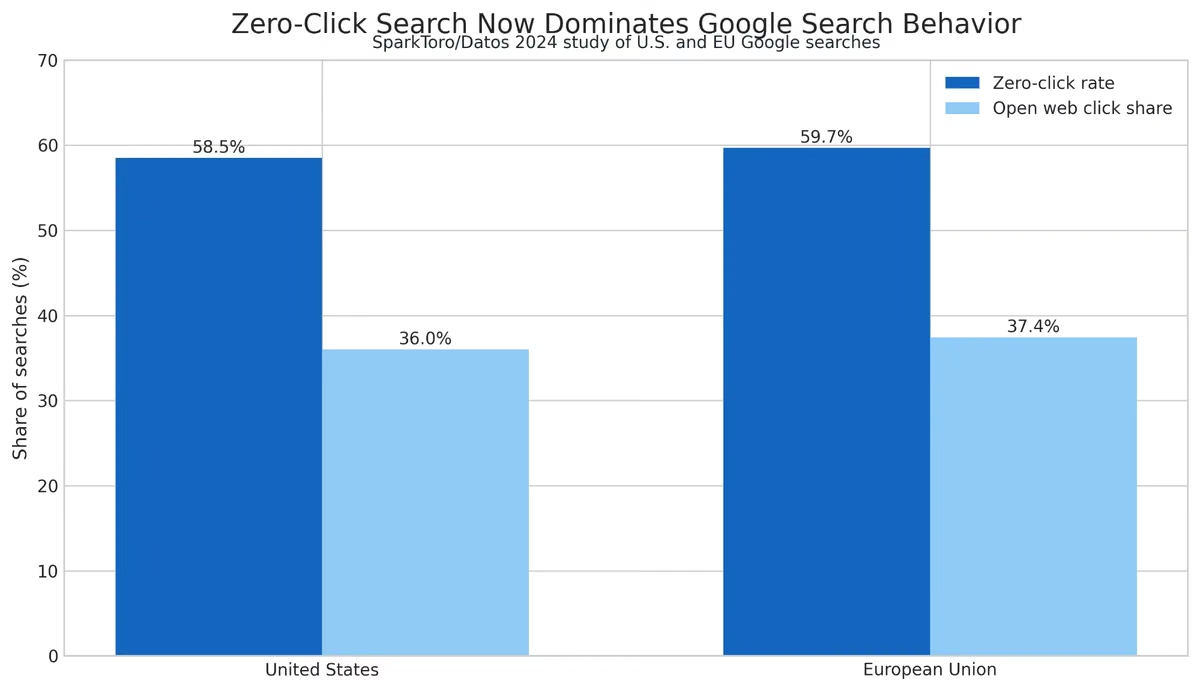
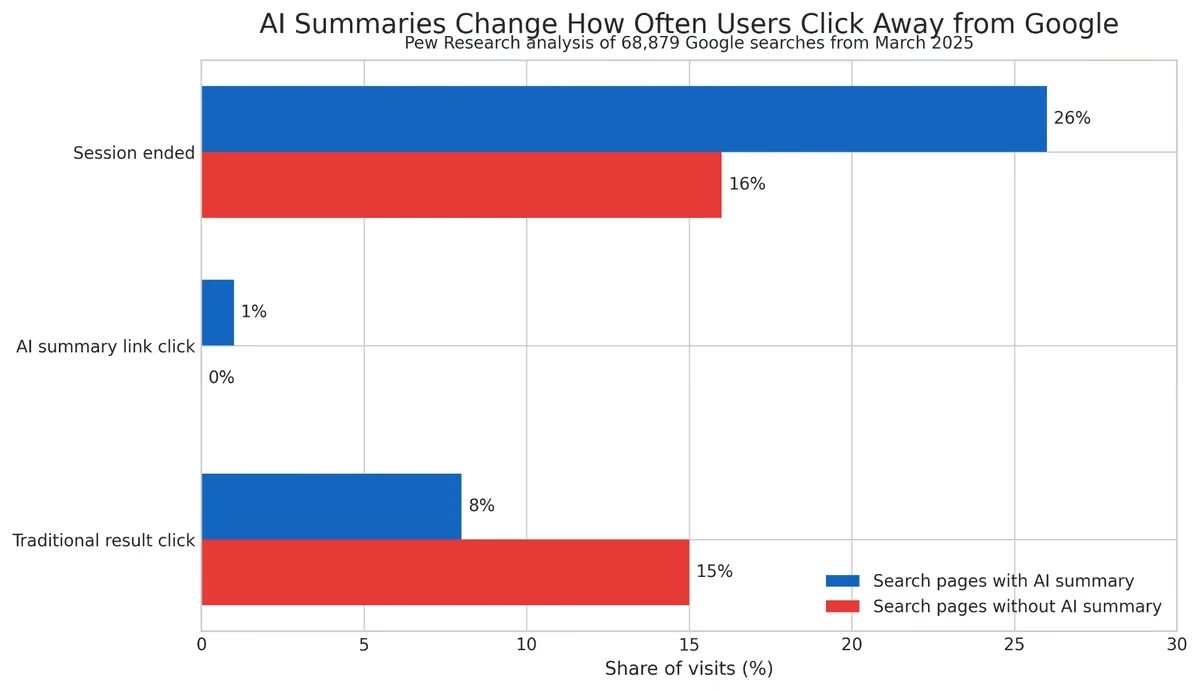
That distinction has become more important because search behavior is changing in public and measurable ways. SparkToro's 2024 zero-click study found that 58.5% of U.S. Google searches and 59.7% of EU Google searches ended without a click to the open web.1 Pew Research later found that when a Google results page included an AI summary, users clicked a traditional search result only 8% of the time, versus 15% when no AI summary appeared.2 In other words, an organization can preserve respectable rankings and still lose influence if AI systems do not treat its material as reusable, trustworthy source content.
The central argument of this article is straightforward. In AI-mediated discovery, presence beats position. Modern visibility depends on interpretation, not retrieval alone. That shift means brands need a metric that can capture entity recognition, topic association, structural extractability, and citation safety in one coherent system. The rest of this article develops that thesis in sequence: first by defining the metric precisely, then by explaining why old KPIs are no longer enough, then by breaking down the signals that shape the score, and finally by showing how teams can operationalize the metric across content, analytics, and governance.
What is an AI visibility score, exactly?
An AI visibility score is a composite measurement framework that estimates whether AI systems can identify your brand correctly, connect it to the right topics, trust the page enough to cite or paraphrase it, and surface it consistently across relevant prompts. The metric therefore sits at the intersection of content quality, information architecture, structured data, and answer behavior. It should be understood less like a single rank position and more like a health score for participation in AI-generated answers.
A useful definition must be precise enough for practitioners and simple enough for executives. In practical terms, the score answers four questions at once. First, do AI systems know who you are? Second, do they associate you with the topics that matter commercially? Third, can they extract your claims cleanly from the way the page is structured? Fourth, do they regard the content as safe and credible enough to reuse? If any one of those layers breaks, answer visibility becomes unstable even if the page remains indexed and authoritative by older SEO standards.
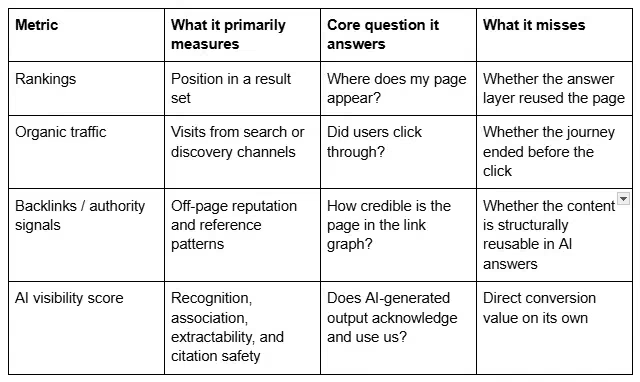
The most important thing to clarify is what the metric is not. It is not a rank tracker. It is not domain authority in a new outfit. It is not a backlink score, and it is not merely a traffic trend by another name. Those metrics still matter, but they answer different questions. Rankings tell you whether a page was competitively positioned. Traffic tells you whether a user clicked. An AI visibility score tells you whether a model or search interface judged your content usable inside the response layer itself.
This definition also explains why the score should be composite rather than singular. A brand may have strong entity recognition but weak topic association outside its core category. Another may have excellent page structure but insufficient trust cues for high-stakes claims. A credible score therefore needs subcomponents and evidence, not just a headline number. The score should tell a team where the interpretation pipeline is breaking, not merely that something is wrong.
Why are rankings no longer enough on their own?
Rankings remain necessary, but they are no longer sufficient. Traditional SEO was built around retrieval logic: crawl the page, index the page, rank the page, and earn the click. AI-enhanced search introduces an additional interpretive layer between the user and the click. That layer rewrites the economics of visibility because the answer itself can satisfy the query before a visit occurs.
The best public data makes the shift hard to ignore. SparkToro's cross-market analysis found that only 360 out of every 1,000 Google searches in the United States and 374 out of every 1,000 in the European Union sent clicks to the open web.1 Pew Research's 2025 analysis adds behavioral texture: when an AI summary appeared, users were less likely to click a result, more likely to stop browsing, and almost never clicked the cited source links inside the summary itself.2 These findings do not mean websites are obsolete. They mean that being selected into the interpretive layer has become a separate and increasingly important contest.
That change is not hypothetical from Google's side either. Google explains that AI Overviews and AI Mode may use a query fan-out technique that issues multiple related searches across subtopics and supporting sources before constructing a response.3 That matters because it reframes optimization. A page is not competing only to rank for one head term. It may be evaluated as one supporting source among many while the system assembles a multi-part answer. The content that wins in that environment is not merely discoverable; it is interpretable, quotable, and easy to connect to adjacent concepts.
This is why rankings alone can create false confidence. A page may sit on page one, pass technical audits, and still contribute nothing to the answers that shape category perception. Conversely, a page may not dominate traditional rankings but still earn mention in AI outputs because it offers clean definitions, strong supporting detail, and clear machine-readable structure. For decision-makers, the implication is strategic: if reporting stops at rank and traffic, it can miss the growing portion of search value that accumulates before the click.
The shift also changes how teams interpret traffic loss. In a pre-AI environment, a drop in visits usually suggested weaker demand capture, poorer rankings, or stronger competition. In an AI-summary environment, some of the same decline may reflect that the user's informational need was partially satisfied within the search interface. That does not make traffic unimportant. It means traffic has become an incomplete proxy for influence. A brand can be educationally influential inside the answer layer even when referral visits flatten. The challenge is proving that influence. The AI visibility score exists to do exactly that.
What signals actually shape an AI visibility score?
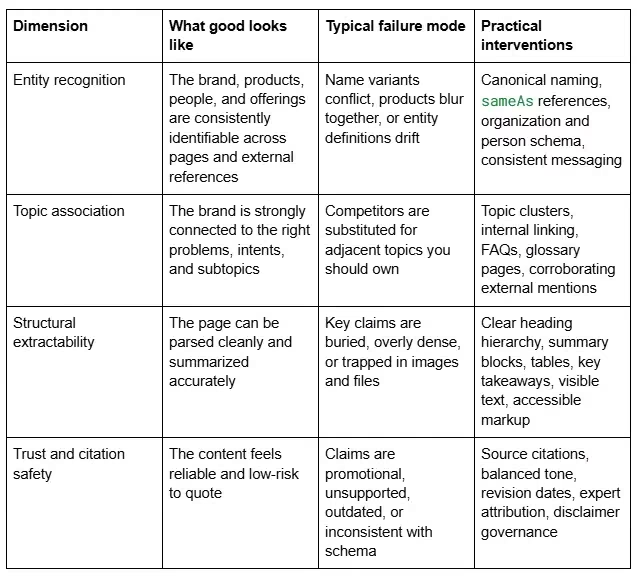
Although every platform will weight inputs differently, most useful scoring models should revolve around four dimensions: entity recognition, topic association, structural extractability, and trust or citation safety. Together, these dimensions describe whether a system can understand your content, connect it to a question, and reuse it without distorting the answer.
How does entity recognition affect AI visibility?
AI systems reason about entities more than URLs. That means they need a stable understanding of who the organization is, how its products relate to one another, and which names are canonical versus incidental. If a company uses one name in navigation, another in schema, a third in press releases, and several inconsistent abbreviations in support docs, the interpretive layer becomes fragile. Models may still retrieve the page, but they will be less confident about citing it.
Good entity recognition begins with disciplined naming. Core pages should agree on the organization's primary label, product families, leadership identities, and service taxonomy. Supporting schema can reinforce those definitions, especially when Organization, Person, Product, Service, and sameAs relationships mirror visible page text.4 Google explicitly recommends that structured data match what the user can see, which is a simple rule with major consequences for AI visibility.34
A practical way to manage this is to create an internal entity passport for every high-value brand object. The passport should record the canonical name, acceptable variants, unacceptable variants, official description, associated topics, and corroborating external URLs. That may feel like tedious governance, but it reduces the probability that AI systems will merge separate offerings or misattribute your expertise to a competitor.
Why does topic association matter as much as brand recognition?
Recognition alone is not enough. A model may know your brand exists and still fail to connect it to the exact question the user asked. Topic association captures whether your content ecosystem repeatedly and coherently links the brand to the right problems, stages of the journey, and adjacent concepts.
This is where content architecture becomes decisive. A strong pillar page can establish thematic ownership, but it rarely does the whole job alone. Supporting explainers, glossary entries, comparisons, implementation guides, case examples, and FAQ pages make the association durable. When the same topic language appears coherently across multiple formats, the system receives repeated evidence that your brand belongs in that semantic neighborhood.
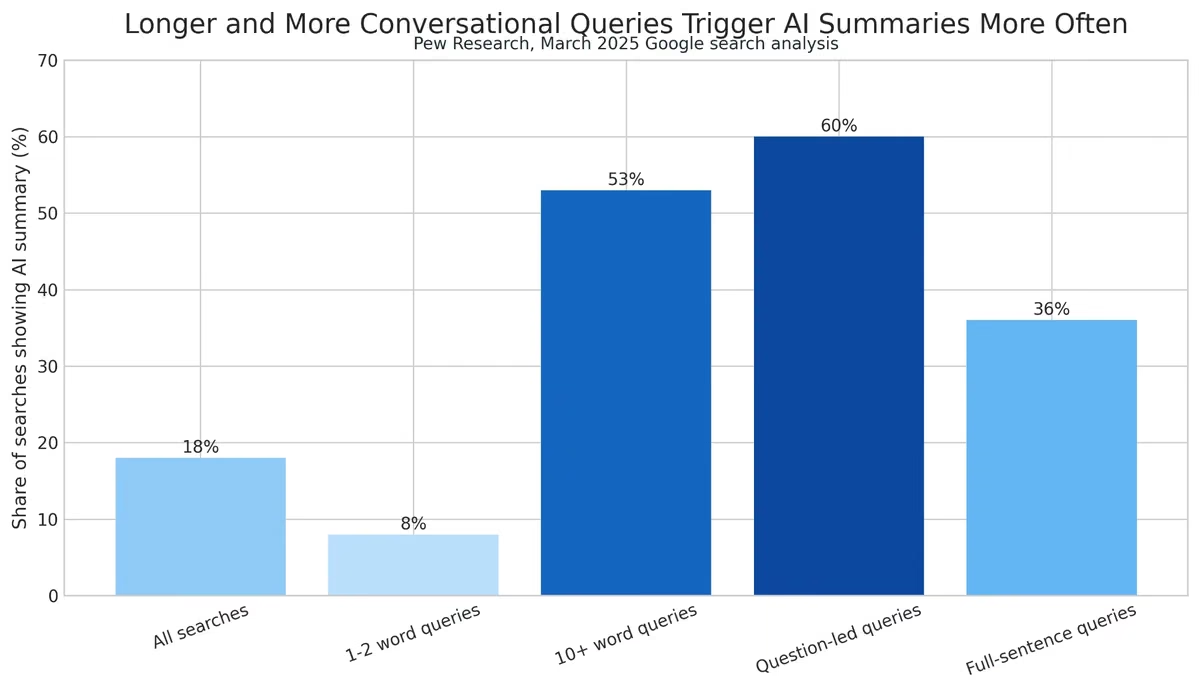
Pew's data offers a useful clue here: AI summaries are much more likely to appear on longer, more question-like queries, including searches with ten or more words and those beginning with question words.2 That means brands should map content not only to head terms, but to the kinds of conversational intents people increasingly type into AI-enhanced search. If your topic architecture is built only for terse keyword strings, you may be absent from the prompts that now trigger the answer layer most often.
Why does structural extractability influence whether content gets reused?
Even great ideas can be invisible if they are hard to extract. Structural extractability is the discipline of making critical information legible to both humans and machines. It includes obvious choices, such as meaningful headings and concise definitions, but it also includes subtler editorial habits: placing the answer early, keeping key claims in visible text rather than graphics, labeling tables clearly, and using summaries that can stand alone if quoted.
Google's own guidance aligns with this principle. In its documentation for AI features, Google advises site owners to make important content available in textual form, maintain internal discoverability, and ensure structured data matches the page's visible text.3 That is essentially a technical expression of extractability. If the critical statement lives only inside an image, a buried PDF, or a vague paragraph lacking context, the probability of accurate reuse drops.
This is why AI-visible content often resembles well-edited feature writing rather than keyword-stuffed pages. It answers the main question near the top, defines unfamiliar terms on first use, and uses tables or frameworks where they clarify choices. The goal is not to write for robots. The goal is to remove unnecessary friction so that when a system scans the page for support, the relevant sentence is easy to identify and safe to quote.
What makes content feel safe to cite?
Trust and citation safety are the most underappreciated parts of the score. Models and search systems are conservative about reusing material that looks exaggerated, unsupported, contradictory, or stale. A page may rank because it attracts links and satisfies traditional relevance tests, but still be skipped in answer generation if the claims sound too promotional or too ambiguous.
Safe-to-cite content usually shares a recognizable pattern. The writing is clear but restrained. Claims are tied to evidence. Dates, authorship, and revision context are visible. The article acknowledges nuance instead of forcing certainty where certainty does not exist. When advice is context-sensitive, the page says so. This kind of writing earns trust because it reduces the interpretive burden on the answering system.
The irony is that citation safety often looks like excellent editorial judgment rather than technical optimization. A sentence such as "structured data helps Google understand page content" is safer because it mirrors Google's own documentation closely.4 A claim like "schema guarantees AI visibility" is riskier because it overpromises beyond available evidence. The strongest visibility programs teach writers and marketers to recognize that distinction before publication, not after answers go live.
How should teams improve an AI visibility score in practice?
Improving the score requires a system, not a one-off content refresh. Because the metric depends on interpretation, the work spans editorial, technical, and operational layers. The right way to think about improvement is to sequence interventions so each one reinforces the next.
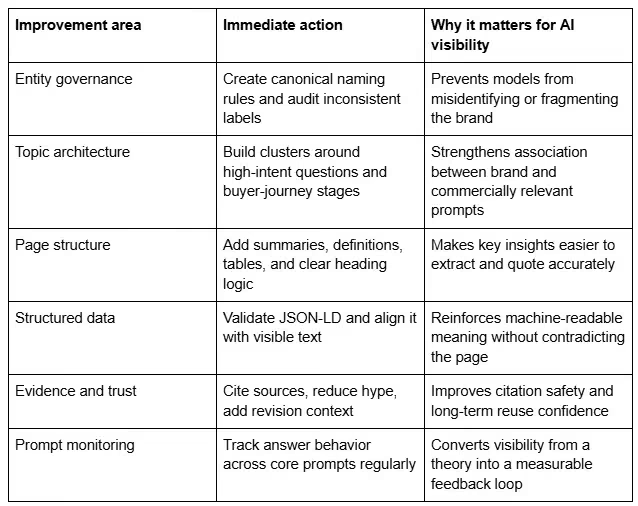
The first step is to stabilize the entity layer. Canonicalize brand names, product labels, author bios, and organizational descriptions. Audit the site for naming drift. Then align the same definitions across schema, navigation, support content, partner pages, and external profiles. This is foundational because every later improvement depends on the model correctly resolving who you are.
The second step is to rebuild topic coverage around user questions rather than isolated keywords. Start with the commercial or strategic topics the brand needs to own, then identify the awareness, evaluation, and implementation questions users ask around each one. Create or revise cornerstone guides, supporting explainers, comparisons, and FAQs so the topic cluster reflects natural-language intent. Longer, more conversational queries are especially important because they are more likely to trigger AI summaries and richer answer experiences.2
The third step is to increase extractability on high-value pages. Put the direct answer near the beginning. Use a summary block. Replace vague subheads with editorial ones that reveal the purpose of the section. Add tables when the reader needs comparison, not because templates demand them. Keep key assertions in text and ensure the structured data reinforces, rather than improvises on, what the reader can see.
The fourth step is to raise citation safety. Tighten sourcing. Replace marketing inflation with precise claims. Add update dates to high-stakes content. Distinguish definitions, expert interpretations, and opinion where necessary. If a page makes a consequential recommendation, support it with either primary documentation, data, or clearly labeled practitioner experience. AI visibility grows when systems sense the content is low-risk to summarize.
Suggested visual: a workflow diagram showing the improvement loop from entity audit -> content revision -> schema validation -> prompt testing -> executive reporting.
One of the most effective habits is to build a prompt library that mirrors how buyers, researchers, and operators actually ask questions. The library should include basic definitional prompts, consideration-stage prompts, troubleshooting questions, comparisons, and executive-summary requests. Teams should run those prompts on a recurring schedule, capture screenshots or transcripts, and annotate the results. Did the answer cite the brand? Did it preserve the positioning? Did it flatten an important distinction? Without that evidence layer, the score becomes too abstract to guide real decisions.
Another practical lesson is to focus first on the pages that sit closest to strategic outcomes. Not every page deserves the same optimization effort. A category-defining guide, a comparison page, a pricing explainer, or a methodology document often exerts more answer-layer influence than dozens of low-value blog posts. Improving the visibility score is therefore partly an exercise in editorial prioritization. Fix the assets most likely to be quoted, then scale the patterns that work.
How does AI visibility fit with SEO and analytics?
The healthiest framing is that AI visibility complements SEO rather than replacing it. Retrieval still matters. A page must remain crawlable, indexable, internally discoverable, and credible in the broader search ecosystem. Google is explicit that eligibility for its AI features starts with the same foundational SEO and technical requirements that govern Search more broadly.3 The problem is not that classic SEO has stopped mattering. The problem is that classic SEO measures only part of what now creates market influence.
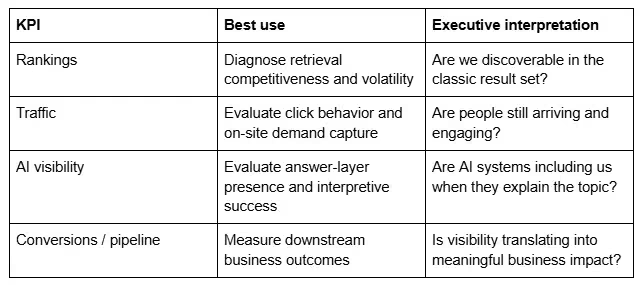
A mature reporting model therefore places rankings, traffic, and visibility side by side. Rankings reveal where pages stand in competitive retrieval. Traffic shows what users clicked and what sessions followed. AI visibility shows whether the answer layer reused the brand's expertise before, during, or instead of the click. Looking at all three together often produces more honest interpretation than any one metric alone.
This integrated view also improves storytelling around performance changes. If rankings hold steady but AI visibility falls, the likely issue is not crawlability. It may be structure, trust, freshness, or a competitor whose page is easier to cite. If visibility improves before traffic does, that may signal a leading indicator rather than a failed initiative. In a world where more user journeys finish inside search interfaces, companies need these earlier signals to avoid overreacting to lagging traffic alone.
Analytics teams should also resist the temptation to overstate precision. An AI visibility score is directional and diagnostic before it is perfectly attributable. You may not be able to map every answer mention directly to revenue. But you can correlate visibility trends with branded search lift, demo quality, deal velocity, support efficiency, or the quality of conversations arriving from the market. Over time, those relationships make the score more credible inside performance reviews.
What operating model makes the metric sustainable?
A visibility score becomes valuable only when it is tied to routine ownership. Otherwise it degrades into an interesting but unused dashboard. The operating model should start with clear accountability. One team or individual needs responsibility for the methodology, the prompt library, the evidence archive, and the reporting cadence. That owner does not perform all the work alone, but they maintain continuity and resolve ambiguity.
The next requirement is cross-functional participation. Content teams improve clarity and extractability. SEO and technical teams maintain crawlability, internal discoverability, and schema integrity. Product marketing protects positioning language and category definitions. Analytics teams monitor changes, annotate trendlines, and help leadership interpret the evidence. Legal or compliance teams may need to review high-stakes claims so that citation safety remains intact. AI visibility is therefore less a channel metric than a coordination metric.
A sustainable program also needs recurring rituals. Weekly or biweekly monitoring can capture rapid answer changes on priority prompts. Monthly reviews can evaluate movement by topic cluster. Quarterly executive updates can connect the score to commercial initiatives, product launches, or market shifts. When these rituals exist, visibility becomes a managed discipline rather than an after-the-fact audit.
Evidence management matters more than many teams expect. Store prompt outputs with timestamps. Keep notes on what changed after each major edit. Record which claims or formats were cited most often. Over time, this archive becomes a strategic asset. It reveals not just whether the score moved, but why. That is especially important because AI systems do not always expose their reasoning. The organization's own evidence trail becomes the closest thing to an experimental record.
Suggested visual: an annotated dashboard mockup that shows rankings, traffic, AI visibility, and supporting screenshot evidence on one executive-friendly page.
Executive storytelling deserves its own emphasis. Leaders rarely act because they love methodology. They act because the evidence makes the business stakes obvious. A screenshot showing a competitor cited in a category-defining answer can be more persuasive than a dense technical explanation of entity drift. The best visibility programs translate the metric into decision language: where the brand is absent, which revenue motion is affected, what fix is proposed, and how quickly the team expects to see movement.
What should brands expect from AI visibility next?
The concept will almost certainly expand. Today's discussion focuses heavily on text answers, links, and citations, but the next generation of visibility will include multimodal presence. Brands will increasingly need to know whether assistants reuse their charts, images, videos, audio explanations, and product visuals, not just their prose. The same four dimensions still apply, but they will need to be expressed across more formats.
Another likely shift is from one broad score to multiple context-specific scores. A brand may eventually monitor visibility by persona, market, funnel stage, geography, or assistant ecosystem. That is sensible because the same company can be highly visible in one context and nearly absent in another. The key is not to make the model more complex for its own sake. The key is to preserve interpretability so that each score still drives action.
Methodology will also need regular calibration. Search systems change, prompt behavior changes, and the line between retrieval and generation continues to blur. That means teams should log changes to their scoring criteria, keep examples of edge cases, and revisit the weighting of each dimension over time. A score that never evolves becomes less useful precisely because the environment does not stand still.
Still, the underlying strategic principle is unlikely to reverse. As long as search interfaces keep answering more questions directly, organizations will need a way to measure whether they are present inside those answers. That is why the AI visibility score is not a fad metric. It is an adaptation to a real change in how information gets mediated between publisher and audience.
Why AI Visibility Score belongs in the modern search dashboard
The rise of AI-generated answers has not made SEO irrelevant. It has made interpretation impossible to ignore. A brand can no longer assume that a strong rank position guarantees inclusion in the conversation users actually see. The AI visibility score matters because it tracks whether your brand survives that translation layer intact—whether you are recognized, associated with the right topics, extractable in structure, and trustworthy enough to be cited.
That is why the metric belongs beside rankings, traffic, and conversions rather than underneath them. It fills the measurement gap created by zero-click behavior and answer-first interfaces. It gives teams a way to justify work that traditional dashboards overlook: schema governance, prompt monitoring, entity consistency, editorial structure, and evidence stewardship. Most importantly, it helps organizations focus on the outcome that matters most in AI-mediated discovery: not merely being available on the web, but being present in the answer.
If there is one next step to take after reading this article, it is to choose ten high-value prompts, evaluate whether your brand appears in the answers today, and document why. That exercise will reveal whether your current search success is as durable as it looks—or whether your brand is still ranking while quietly disappearing from view.
Frequently Asked Questions: What is an AI Visibility Score
What is an AI visibility score in simple terms?
An AI visibility score is a way to measure whether AI systems mention, cite, or reuse your brand's content when they answer relevant questions. It focuses on presence inside answers, not just placement in search results.
Is an AI visibility score the same thing as SEO rankings?
No. Rankings measure where a page appears in a result set, while an AI visibility score measures whether AI systems actually include your content in the generated answer. The two metrics often overlap, but neither fully explains the other.
How do I improve my AI visibility score quickly?
The fastest gains usually come from improving high-value pages that already have authority: clarify definitions, strengthen structure, align schema with visible text, tighten evidence, and test performance across a prompt library. Quick wins are possible, but lasting improvement requires governance.
Why can a site rank well and still have poor AI visibility?
Because ranking reflects retrieval, while AI visibility reflects interpretation. A page can rank for a query but still be skipped if the content is hard to extract, weakly associated with the topic, or not safe to cite.
Does structured data directly increase AI visibility?
Structured data helps search systems understand page meaning and entities, especially when it matches the visible text accurately.4 It does not guarantee answer inclusion by itself, but it can improve the clarity and consistency that support AI visibility.
What kinds of prompts should I monitor?
Monitor the prompts that matter to the business: category-defining questions, comparisons, implementation queries, troubleshooting prompts, and executive-summary requests. The goal is to reflect how real users and buyers actually ask for information.
How often should teams measure AI visibility?
For core prompts, monthly monitoring is a practical baseline, with more frequent checks around launches, rebrands, pricing changes, or major content releases. The right cadence depends on how quickly your market narrative changes.
At first, we weren’t even thinking about AI visibility. We were focused on rankings and traffic like everyone else. But once we started testing our brand in ChatGPT and other AI tools, we realized we were barely showing up — even for topics we ‘ranked’ for. Gryffin gave us a clear picture of where we stood, how competitors were being cited instead, and what that actually meant for our pipeline. It shifted how we think about search entirely.










.webp)