Semantic SEO: How to Map Topics, Intent, And Entities with AI
Marcela De Vivo
Marcela De Vivo
March 11, 2026
Google is no longer limited to matching exact keywords. Instead, Google uses advanced natural language processing and machine learning to understand the context and intent behind queries. This evolution has given rise to Semantic SEO—a strategic approach focused on creating content that reflects the deeper meaning behind search behavior rather than simply targeting keywords.
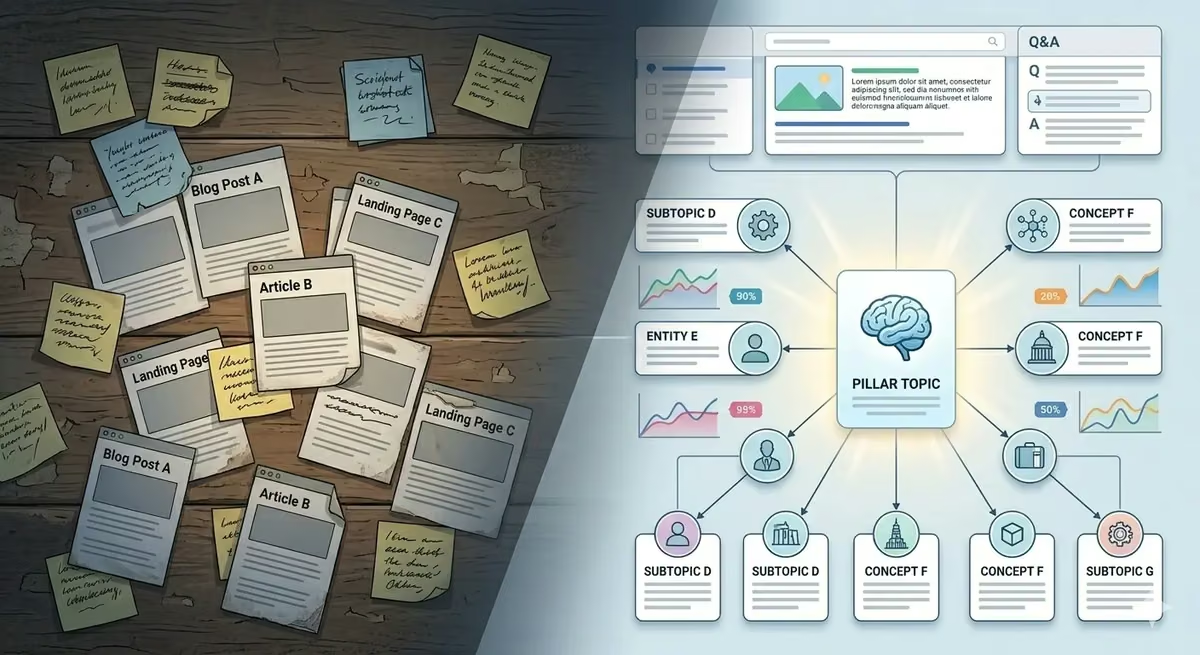
Semantic SEO emphasizes relationships between topics, entities, and search intent. It’s about answering questions comprehensively, using structured content that connects with what users actually want to know. As algorithms get better at interpreting language and user intent, brands must adapt by producing content that’s contextually rich, well-structured, and optimized for topical relevance.
But here’s the challenge: delivering a semantic SEO strategy at scale is time-consuming and complex. It requires deep keyword research, topic clustering, intent mapping, and content alignment—tasks that are difficult to manage manually, especially for growing teams or agencies managing multiple campaigns.
That’s where Gryffin steps in. Our AI-powered platform streamlines and automates semantic SEO workflows—making it easier than ever to map topics, align content with intent, and scale high-impact SEO strategies efficiently. In this article, we’ll explore how to harness the power of AI to implement semantic SEO at scale—and how Gryffin simplifies the process from start to finish.
What Is Semantic SEO? Definition, Examples, and How It Works
Semantic SEO is a modern approach to search engine optimization that goes beyond matching exact keywords to queries. Instead, it focuses on understanding the meaning behind search terms—leveraging context, user intent, and related concepts to create content that fully satisfies what users are really looking for.
Core Principles of Semantic SEO: Context, Intent, and Entities
Contextual Understanding in Semantic SEO: What It Is and How to Achieve It
Search engines now interpret content through the lens of context. This means analyzing the relationship between words, phrases, and ideas to grasp the broader topic. Effective semantic SEO ensures that your content isn't just targeting keywords—it’s telling a coherent, comprehensive story around a subject.
Aligning Content with Search Intent in Semantic SEO
Not all searches are created equal. Some users are looking for quick answers, others want in-depth information, and many are ready to make a purchase. Semantic SEO requires that your content aligns with search intent—whether informational, navigational, or transactional—to meet users at the right stage of their journey.
Entity-Based Optimization for Semantic SEO: A Practical Approach
Modern search engines rely on entities—specific people, places, brands, products, or concepts—to structure knowledge and deliver more relevant results. Optimizing for semantic SEO means structuring content around these entities and their interconnections, helping search engines understand your site’s topical authority.
Comparison: Traditional SEO vs. Semantic SEO—What’s Changed and Why
Traditional SEO relied heavily on exact-match keywords, often leading to fragmented content strategies built around individual keyword targets. While this approach could drive traffic in the past, it often missed the bigger picture: what does the user really want?
Semantic SEO shifts the focus from isolated keywords to comprehensive topic coverage. Instead of creating separate pages for "best hiking boots," "hiking boot reviews," and "top hiking footwear," a semantic strategy might combine these into a single, authoritative resource that addresses multiple facets of the topic—enhancing both user experience and search visibility.
How Semantic SEO Aligns with Google’s Latest Algorithms
Google’s evolution has been driven by one goal: to better understand the meaning behind searches. These algorithm updates prioritize topical relevance, natural language, and user satisfaction over keyword frequency.
Semantic SEO is perfectly aligned with this direction. By organizing content into structured topic clusters, answering related questions, and optimizing for entities, marketers can future-proof their SEO strategies.
With Gryffin, implementing a semantic SEO strategy becomes a repeatable, scalable process. Our AI helps you identify key topics, map related search intents, and generate optimized content that reflects the way real people search and think.
Challenges of Scaling Semantic SEO and How to Solve Them
Semantic SEO is incredibly effective—but implementing it at scale presents a series of challenges for marketers, content teams, and SEO professionals. What makes semantic SEO so valuable—its depth, structure, and alignment with search intent—also makes it difficult to execute consistently without the right systems in place.
1. Topic and Intent Mapping for Semantic SEO: Why Manual Work Slows Teams
Creating a semantic SEO strategy begins with understanding how various search queries relate to broader topics and user intent. This involves:
Analyzing hundreds (sometimes thousands) of keywords.
Grouping them into logical clusters based on shared meaning or context.
Determining the intent behind each cluster (informational, navigational, transactional).
Developing content that thoroughly addresses each cluster and subtopic.
When done manually, this process is slow, error-prone, and difficult to scale—especially for agencies managing multiple clients or businesses with expansive product catalogs. Without automation, it's easy to fall behind, missing critical content gaps or opportunities to build topical authority.
2. Maintain Cross-Channel Consistency for Semantic SEO
Semantic SEO isn't limited to blog articles. It should guide the creation of landing pages, product descriptions, FAQs, pillar pages, and even social media content. Ensuring consistency in voice, structure, and intent across all these formats becomes exponentially harder as the volume of content grows.
For example, a campaign targeting “sustainable fashion” may include:
A blog series on ethical production methods.
Product pages emphasizing eco-friendly materials.
A downloadable guide to sustainable wardrobes.
Social media posts that support and extend the narrative.
Without a centralized system or template-driven workflow, teams often produce siloed content that lacks strategic cohesion—diluting SEO impact and confusing users.
3. Stay Current: Semantic SEO for Changing Algorithms and SERPs
Search engine algorithms evolve constantly. From BERT’s contextual understanding to MUM’s multimodal insights, Google continues to redefine how it interprets search intent. On top of this, SERP features—like People Also Ask, featured snippets, and entity panels—shift how content is displayed and prioritized.
Staying on top of these changes requires:
Monitoring SERP behavior for target keywords.
Updating content to retain visibility in rich results.
Adapting strategy to match the latest best practices.
Doing this at scale—across hundreds or thousands of content pieces—is virtually impossible without real-time insights and automation.
That’s why scaling semantic SEO isn’t just about doing more—it’s about doing it smarter. With Gryffin’s AI-powered tools, you can automate topic mapping, standardize content creation across formats, and adapt dynamically to algorithm updates—all while staying aligned with your SEO strategy.
Gryffin’s AI Tools for Semantic SEO: Plan, Create, and Refine at Scale
Scaling a semantic SEO strategy requires more than keyword lists and editorial calendars—it demands intelligent systems that understand language, context, and intent at a granular level. Gryffin’s AI-powered platform is built specifically to handle this complexity, transforming the way teams plan, produce, and refine content at scale.
1. Template-Driven Content Creation for Semantic SEO
At the heart of Gryffin’s platform is an extensive library of customizable templates—each designed with SEO, content structure, and user intent in mind. These templates are engineered to support semantic SEO by ensuring every piece of content is:
Structured for topical depth.
Optimized for related keywords and entities.
Aligned with the content’s purpose and searcher’s intent.
Whether you're creating a cornerstone blog post, a product description, or a landing page, Gryffin’s templates guide the AI to generate content that fits seamlessly within a larger topic cluster. This eliminates guesswork and enables teams to produce high-quality, search-optimized content with remarkable consistency.
2. Intent-Based Optimization in Semantic SEO with Gryffin
One of the most critical—and often overlooked—factors in SEO is aligning content with user intent. Gryffin’s AI evaluates each content opportunity through the lens of intent:
Informational: Users seeking knowledge or answers. Gryffin generates content that educates and builds trust.
Navigational: Users looking for a specific brand or page. Gryffin tailors the structure to guide users clearly to their destination.
Transactional: Users ready to take action. Gryffin emphasizes persuasive language and conversion-optimized formats.
By identifying and adapting to the dominant intent behind each keyword cluster, Gryffin ensures your content not only ranks—but also resonates and converts.
3. AI-Enhanced Keyword Research for Semantic SEO Clustering
Semantic SEO isn't just about targeting keywords—it's about understanding how they relate. Gryffin uses AI to:
Discover long-tail variations and semantically related phrases.
Group keywords into meaningful topic clusters.
Identify gaps and opportunities based on emerging trends and search patterns.
Unlike traditional keyword tools that rely on volume and difficulty scores alone, Gryffin’s approach maps out keyword relationships, helping you build content that reflects the way users naturally search and think. This allows for more holistic coverage and stronger topical authority.
4. Data-Driven Refinement: Iterate Semantic SEO with Performance Insights
Creating content is only part of the equation—continuous improvement is where long-term SEO success is found. Gryffin closes the loop by integrating performance analytics directly into your workflows. The platform monitors:
Keyword rankings and SERP features.
Page-level engagement metrics (time on page, bounce rate, conversions).
Content gaps and overlapping topics.
Using this data, Gryffin’s AI provides smart recommendations—whether it’s restructuring a blog for clarity, expanding a section to cover a trending subtopic, or consolidating redundant content across clusters. These insights help you maintain relevance, improve performance, and scale your strategy with precision.
With Gryffin, semantic SEO isn’t just a best practice—it’s a built-in advantage. From content planning and creation to optimization and iteration, every feature is designed to make scalable, intent-driven SEO not only possible, but practical for teams of any size.
Semantic SEO FAQs
Q: What is semantic SEO, and how is it different from traditional keyword-focused SEO? A: Semantic SEO focuses on the meaning behind queries—context, entities, and user intent—rather than exact-match keywords. Traditional SEO often splits topics across many pages targeting single phrases, while semantic SEO builds comprehensive topic clusters that answer related questions. This approach improves topical relevance and user satisfaction.
Q: How do I build a semantic SEO strategy that aligns content with search intent? A: Research keywords and questions around a core topic, then group them into clusters by shared meaning. Map each cluster to dominant intent—informational, navigational, or transactional—and match formats accordingly (guides, brand/category pages, conversion pages). Structure pages for depth and related entities, and use AI like Gryffin to automate clustering and maintain alignment at scale.
Q: Steps to create topic clusters and map informational, navigational, and transactional intents. A: Identify a core topic, gather related queries, and use AI to cluster them by semantic similarity. Label each cluster’s intent: informational (learn), navigational (find a page/brand), or transactional (take action). Create a pillar that covers the broader subject, then produce supporting assets for each intent and interlink them to guide users through the journey.
Q: How can I structure content around entities to grow topical authority? A: Center each piece on specific entities—people, products, brands, places, or concepts—and clearly describe attributes, relationships, and use cases. Connect related entities across your cluster with consistent terms and internal links so search engines can map your topical graph. This structure signals authority and relevance across a wider set of queries.
Q: Which tools can automate topic mapping, keyword clustering, and intent analysis for semantic SEO? A: Gryffin automates these workflows with AI-enhanced research and template-driven planning. It discovers long-tail and related phrases, clusters them by meaning, and aligns formats to intent. The platform also integrates performance data to refine clusters and content over time.
Q: What’s a template-driven workflow for creating pillar pages and their supporting cluster content? A: Start with a pillar page template designed for topical depth, clear sections, and entity coverage, then add support templates for subtopics, FAQs, and related landing or product pages. Gryffin’s templates embed intent cues, recommended sections, and internal linking patterns so each asset fits the cluster. This keeps structure, messaging, and quality consistent as you scale.
Q: How do Google updates like BERT and MUM affect content planning and SERP visibility? A: BERT strengthened Google’s understanding of context and nuance, while MUM extends that to richer relationships across topics and formats. They reward content that addresses intent comprehensively, uses natural language, and connects related questions and entities. Plan clusters that can capture featured snippets, People Also Ask, and entity panels.
Q: How can I keep messaging and intent consistent across blogs, product pages, FAQs, and social posts? A: Use shared intent maps and standardized templates so each format expresses the same message for its stage in the journey. Centralize briefs, approved language, and internal linking rules to avoid siloed execution. Gryffin supports this with template-driven workflows and intent-aware content generation.
Q: How do I use AI to find long-tail, related queries and identify content gaps? A: Start with seed topics, then let AI surface long-tail variants and semantically related questions, clustering them by theme. Compare clusters against existing content and SERPs to spot thin coverage, overlap, or missing pages. Gryffin adds performance insights to flag where to expand sections, merge assets, or create new content.
Q: How does Gryffin handle intent-based optimization, templates, and performance insights for scaling semantic SEO? A: Gryffin analyzes keywords by intent and generates content tailored to informational, navigational, or transactional goals. Its template library enforces structure, entity coverage, and internal linking across pillars and clusters. Integrated analytics track rankings, SERP features, and engagement, then recommend updates or consolidation to strengthen topical authority at scale.
At first, we weren’t even thinking about AI visibility. We were focused on rankings and traffic like everyone else. But once we started testing our brand in ChatGPT and other AI tools, we realized we were barely showing up — even for topics we ‘ranked’ for. Gryffin gave us a clear picture of where we stood, how competitors were being cited instead, and what that actually meant for our pipeline. It shifted how we think about search entirely.










.webp)