AI Brand Visibility Tracking: A Practical, Research-Backed Guide
Marcela De Vivo
Marcela De Vivo
June 15, 2026
12 min read
Visibility is fragmented. The customer journey no longer begins and ends with traditional search engines. Today, buyers turn to AI, including ChatGPT, Gemini, Perplexity, and Google AI Overviews, to ask complex questions and find product recommendations. If your brand is not mentioned in those synthesized answers, you are missing out on high-intent traffic. Manual tracking misses the scale and nuance of these shifting platforms. That's why modern marketing teams are turning to AI brand visibility tracking to measure their presence, find the gaps, and close them.
This comprehensive guide breaks down what AI brand visibility tracking is, how it works, and the metrics you need to translate visibility into actionable insights. We will explore the technical underpinnings of these systems, the frameworks required for accurate measurement, and the ethical considerations that must guide your strategy.
What Is AI Brand Visibility Tracking? Scope And Definitions
AI brand visibility tracking goes beyond traditional SEO monitoring. Instead of just tracking keyword rankings on a static search engine results page (SERP), it measures how often and how accurately AI models talk about your brand inside their generated answers. This involves tracking your brand, your products, and your executives across multiple surfaces. It is a fundamental shift from tracking links to tracking citations and context within Large Language Models (LLMs). For a deeper dive into how this impacts the B2B landscape, see AI in B2B Marketing: How to Build Visibility in AI Answer Engines.
Visibility Vs. Awareness Vs. Reputation
While these terms are often used interchangeably, they represent different stages of the funnel. Awareness is whether your audience knows you exist. Reputation is how they feel about you. Visibility is whether you show up when they are actively seeking solutions. AI brand visibility tracking focuses on the latter: ensuring you are cited when a relevant prompt is asked. You might have excellent brand awareness, but if an AI model doesn't associate your brand with a specific user query, your visibility is zero.
Channels And Surfaces Tracked
To get a complete picture, you need to track across the ecosystem. This includes conversational AI interfaces like ChatGPT and Gemini, search generative experiences like Google AI Overviews, and research tools like Perplexity. It also extends to the data sources these models ingest, such as news articles, community forums, and social media platforms. The platforms you track should align with where your target audience spends their time. Learn more about adapting to these changes in What is AI Search Optimization and How Can Brands Adapt?.
Outputs: Indices, Share Of Voice, Visibility Scorecards
The outputs of AI brand visibility tracking provide clear performance indicators. A visibility scorecard shows your performance across platforms. Share of voice metrics reveal how much of the conversation you own compared to your competitors. A composite visibility index gives you a single number to track progress over time. These outputs move you away from vanity metrics and toward data that drives strategic decisions.
How AI Systems Track Visibility Across Channels
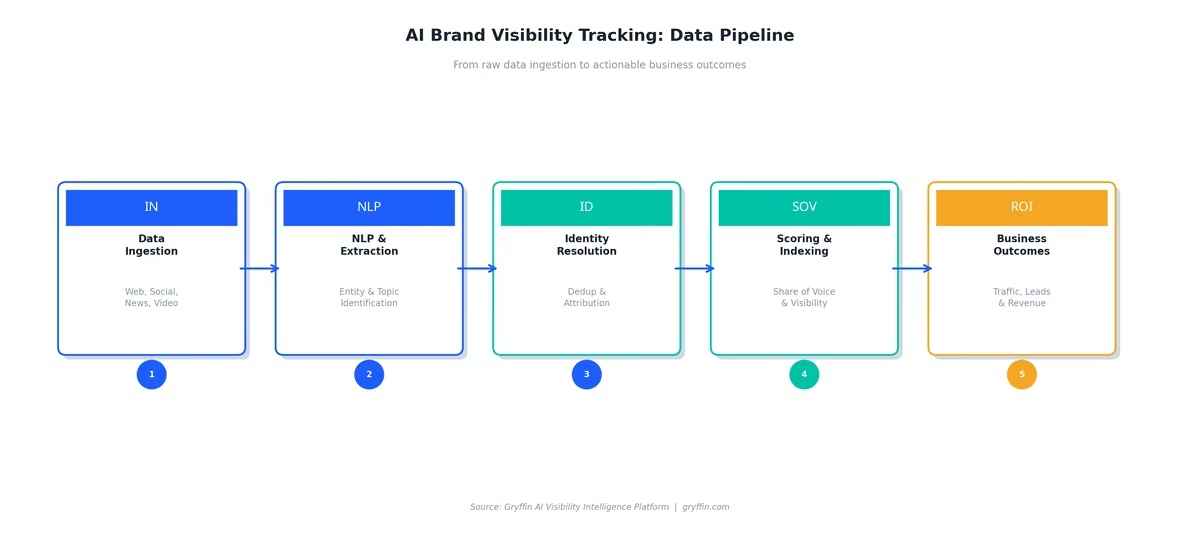
Understanding the data pipeline is crucial for trusting the metrics. AI brand visibility tracking relies on a sophisticated process to ingest, enrich, model, and report on brand mentions. This pipeline must be robust enough to handle the sheer volume and variety of data generated across the web.
Data Sources: The Foundation Of Tracking
The process starts with data ingestion. Systems crawl the web, tap into social APIs, monitor newswires, and even analyze video transcripts and SERP features. This wide net ensures that no mention is missed, whether it's a direct brand reference or a subtle contextual link. The quality of your tracking is directly proportional to the quality and breadth of your data sources.
Unstructured-To-Structured: NLP And Extraction
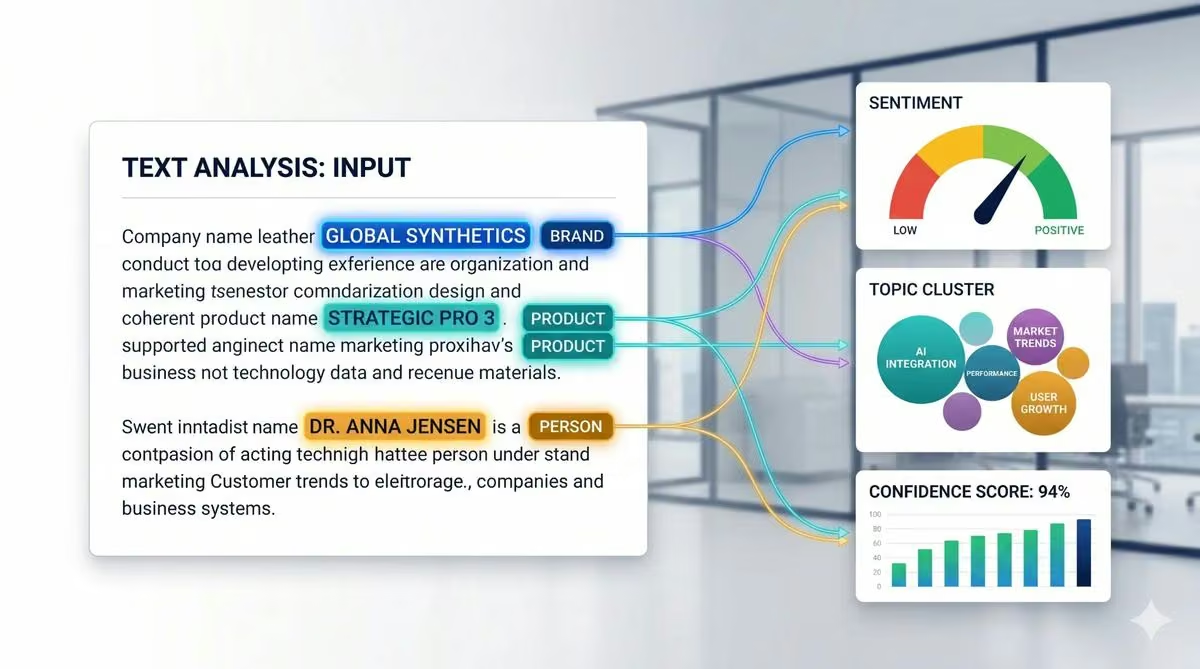
Raw data is messy. Natural Language Processing (NLP) is used to turn unstructured text into structured, analyzable data. This includes identifying entities (like your brand name) and extracting the topics surrounding the mention. This step is critical because AI models don't just look for keywords; they look for semantic meaning and context.
Figure 1: The conceptual pipeline for AI brand visibility tracking, showing the flow from raw data ingestion to business outcomes.
Identity Resolution And Deduplication
Brands often have ambiguous names or multiple variations. Identity resolution ensures that a mention of your company is accurately attributed, even if the phrasing varies. Deduplication prevents the same mention from being counted multiple times, ensuring your data remains clean and reliable. Without these steps, your visibility metrics would be skewed and unreliable.
Temporal And Geographic Tagging
Tracking mentions over time and across different regions provides deeper insights. Temporal tagging allows you to see how your visibility spikes during a product launch or dips during a crisis. Geographic tagging helps you understand regional variations in brand perception and visibility, allowing for more targeted marketing efforts.
The Metrics That Matter: Visibility KPIs And Frameworks
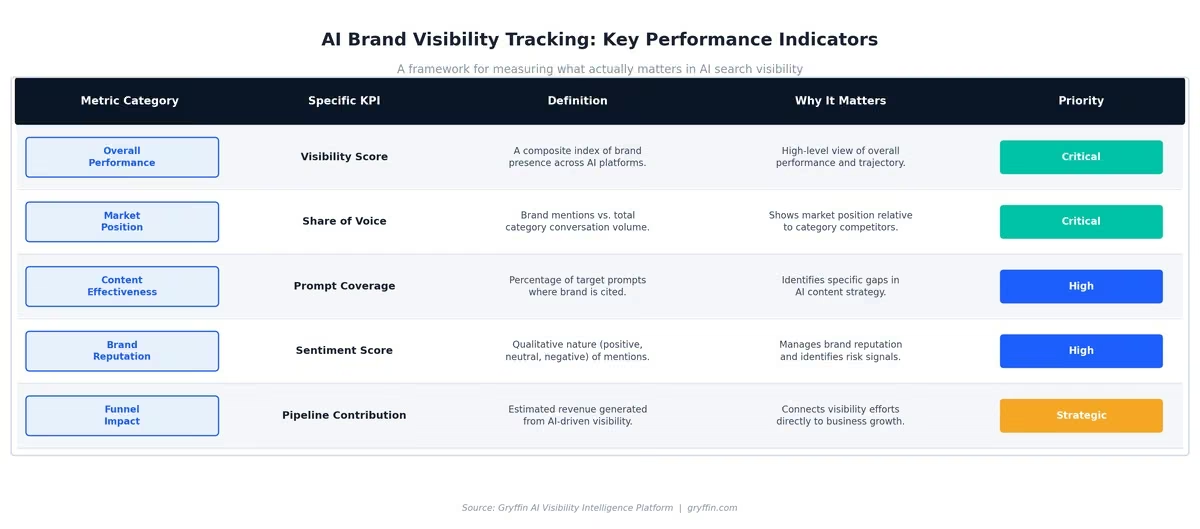
To move beyond vanity metrics, you need a durable measurement framework. These KPIs help you understand your true visibility and the impact of your marketing efforts. Establishing these metrics early is crucial for long-term success.
Share Of Voice
Share of voice is a foundational metric. It measures the volume of your brand mentions relative to the total conversation within your category. Weighting this by the reach or authority of the platform provides a more accurate picture of your influence. A high share of voice indicates that you are a dominant player in your industry's AI conversations.
SERP Presence
SERP presence evaluates your visibility in search engine features. This includes tracking your branded query share, your presence in knowledge panels, and how often you appear in AI Overviews or Top Stories. While traditional SEO focuses on blue links, AI visibility focuses on the rich, generated content that now dominates the top of the SERP.
Topic/Category Visibility
It's not just about being mentioned; it's about being mentioned in the right context. Topic visibility tracks how often your brand is tied to priority themes. If you sell marketing software, you want to be visible when users ask about "marketing automation tools." Tracking this requires a robust taxonomy that maps your brand to relevant industry topics.
Sentiment And Stance
Sentiment analysis goes beyond simple positive or negative polarity. It evaluates the stance and intent behind the mention. Is the AI recommending your product, or just listing it as an option? Understanding this nuance is critical for reputation management. For strategies on managing this, read How to Track AI Brand Sentiment in LLMs and Fix Negative Signals.
Branded Search Demand
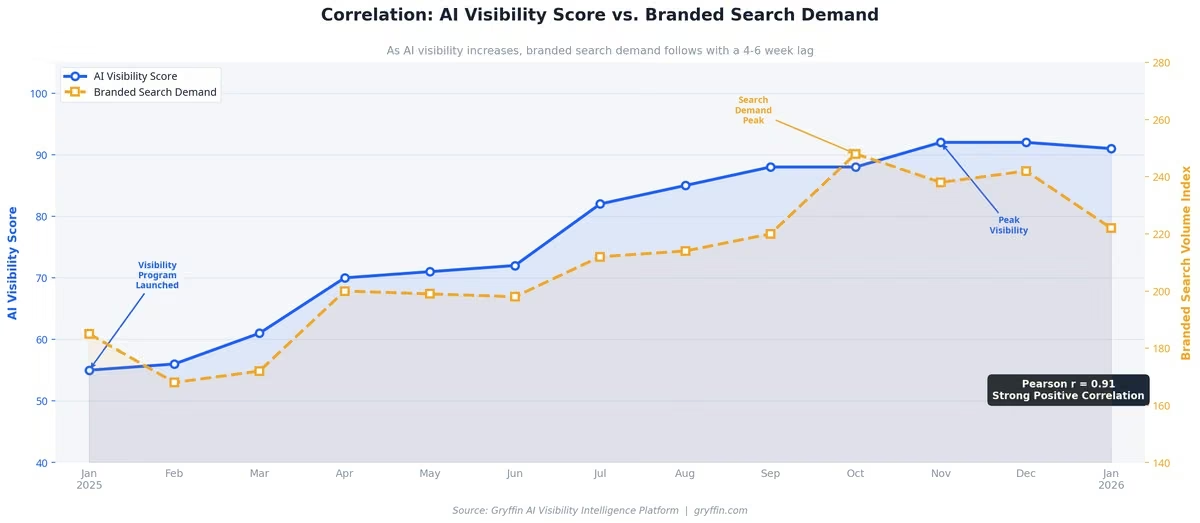
Branded search demand is a leading indicator of visibility. As your presence in AI answers increases, you should see a corresponding lift in users searching for your brand directly. This demonstrates that the AI recommendations are driving real-world interest and intent.
Under The Hood: Core AI Methods Used In Visibility Tracking
The technology powering these metrics relies on advanced machine learning techniques. Understanding these methods demystifies the scoring process and helps you interpret the data more effectively.
Named Entity Recognition And Entity Linking
Named Entity Recognition (NER) is the process of identifying specific entities within text, such as people, organizations, or locations. Entity linking connects those mentions back to a unique identifier, ensuring that variations of your brand name are all tracked accurately. This is the foundation of any reliable tracking system.
Topic Modeling And Embeddings
Topic modeling groups narratives into cohesive themes. Embeddings, which represent words as vectors in a high-dimensional space, allow the system to understand the semantic relationship between words. This helps identify when a conversation is relevant to your brand, even if specific keywords aren't used. It allows the tracking system to understand context just as the LLMs do.
Sentiment, Stance, And Intent Classification
Advanced classifiers determine the sentiment, stance, and intent of a mention. These models use calibrated probabilities to assess whether a mention is a strong recommendation, a neutral citation, or a negative review. This requires models trained specifically on the nuances of brand mentions, not just general sentiment analysis.
Visual Recognition: Logo Detection
Visibility isn't just about text. Visual recognition technology can detect your logo in images and video frames across the web. This is particularly important for consumer brands where visual presence is a key driver of awareness and visibility.
Quality Checks: Precision/Recall And Human-In-The-Loop
No AI model is perfect. Quality checks are essential. Precision measures how many of the identified mentions are actually relevant, while recall measures how many relevant mentions were successfully identified. Human-in-the-loop review provides an additional layer of validation to catch errors and refine the models. A system with high recall but low precision will overwhelm you with noise; a system with high precision but low recall will miss important signals.
Implementation Blueprint: From Questions To Dashboards
Translating these concepts into a working program requires a clear implementation blueprint. Here is how to build your AI visibility tracking strategy from the ground up.
Define Questions
Start with the business questions you need to answer. Are you tracking category share? Monitoring a product launch? Managing executive visibility? Defining these questions upfront guides the rest of the implementation. If you don't know what you're trying to measure, the data will be meaningless.
Determine your reporting cadence. Set up near-real-time alerts for crisis monitoring and risk management. Use weekly roll-ups for tactical adjustments, and monthly narrative reports for strategic planning and executive updates. The cadence should match the speed at which decisions are made in your organization.
Governance And QA
Establish clear governance protocols. Document your models, taxonomies, and data retention windows. Implement quality gates, such as sampling audits and cross-source validation, to maintain data integrity. A tracking program is only as good as the trust people place in the data.
Linking Visibility To Outcomes (Without Overclaiming)
Connecting visibility metrics to business outcomes is the ultimate goal, but it requires careful analysis to avoid confusing correlation with causation. You must be rigorous in how you attribute success.
Correlation Vs. Causation
Just because two metrics move together doesn't mean one caused the other. It's important to establish guardrails and avoid overclaiming the impact of visibility changes. For example, a spike in visibility during a major ad campaign might be correlated, but the ad campaign is the underlying cause of both the visibility and the sales increase.
Early Indicators
Look for early indicators of success. An increase in AI visibility should eventually translate into higher branded search volume, more direct traffic, and improved engagement quality. These early indicators show that your visibility strategy is moving the needle before the final sales numbers come in.
Figure 2: Tracking the correlation between AI visibility scores and branded search demand over time. As the visibility score increases, branded search demand follows.
Methods: Time-Series Analysis And MMM
Use advanced methods like time-series analysis and Marketing Mix Modeling (MMM) to measure incremental impact. These techniques help isolate the effect of visibility changes from other marketing activities and external factors. They provide a more scientifically rigorous way to prove ROI.
Communicating Uncertainty
Always communicate the uncertainty and plausible ranges in your data. Using control periods and category baselines helps provide context and ensures your reporting is credible. Transparency about what you don't know is just as important as highlighting what you do know.
Bias, Privacy, And Ethics In AI Visibility Measurement
Responsible data use is a critical component of any AI tracking program. You must address bias and privacy concerns to build a trustworthy system that respects user rights and provides fair analysis.
Sampling Bias And Weighting
Ensure your data sources are representative. Overrepresenting certain channels can skew your results. For instance, if you only track tech forums, you might miss how your brand is perceived by a broader consumer audience. Use demographic and geographic weighting to correct for sampling bias.
Privacy-By-Design
Implement privacy-by-design principles. This includes data minimization, securing consent where required, and providing opt-outs. Adhere to high-level regulations like GDPR and CCPA to protect user privacy. Never collect personally identifiable information (PII) when tracking brand visibility.
Transparency And Red-Teaming
Maintain transparency by documenting your data sources, model assumptions, and error rates. Red-team your pipeline to identify potential failure modes and adversarial content. Ensure your reporting uses inclusive language and accessible formats.
Reporting That Drives Decisions
Data is only useful if it drives decisions. Your reporting should turn analysis into actionable narratives tailored to different stakeholders. A dashboard is not a report; a report tells a story.
Executive Summaries
For leadership, focus on the big picture. Executive one-pagers should highlight trendlines, anomalies, and the "so what" insights. They need to know if visibility is improving and how it impacts the bottom line. Keep it concise and focused on strategic implications.
Use effective visualization patterns. Small multiples, rolling averages, and seasonality plots help uncover hidden trends and make complex data easy to digest. A well-designed chart can communicate more than pages of text.
Alerts And Thresholds
Set up alert thresholds for crises and misinformation spikes. Storytelling with context, connecting data to macro events, owned campaigns, and category shifts, makes your reports more compelling and actionable. When an alert triggers, it should come with context and recommended next steps.
Conclusion
AI brand visibility tracking is an ongoing research program. It requires clear definitions, a robust data pipeline, meaningful metrics, and ethical practices. By continuously iterating your taxonomies, retraining your models, and validating against outcomes, you can build a measurement system that truly drives growth. The landscape of AI search is constantly evolving, and your tracking methods must evolve with it.
Start by auditing your current visibility metrics. Identify one area to improve data quality or reporting clarity this quarter. Whether it's refining your entity tracking or establishing a clearer link to business outcomes, small steps lead to significant improvements in your overall strategy. If you're ready to see how your brand performs in AI search, Get Started For Free with Gryffin's AI-powered marketing intelligence platform.
FAQs
What Is The Difference Between Brand Visibility And Brand Awareness?
Brand awareness is the general knowledge that your brand exists. Brand visibility is how prominently and frequently your brand appears when users are actively searching for solutions or asking relevant questions, particularly within AI-generated answers. You can have high awareness but low visibility if AI models don't associate your brand with specific user prompts.
Which Channels Matter Most For AI Brand Visibility Tracking?
The most critical channels are the AI platforms your audience uses, such as ChatGPT, Gemini, Perplexity, and Google AI Overviews. Additionally, tracking the underlying sources these models crawl, like high-authority news sites, forums, and your own web properties, is essential for a complete picture.
How Accurate Is AI In Detecting Brand Mentions And Logos?
AI accuracy depends on the models used. Advanced Named Entity Recognition (NER) and entity linking provide high precision for text mentions. However, continuous monitoring, retraining, and human-in-the-loop validation are necessary to maintain accuracy and handle ambiguous names or changing contexts.
How Do I Measure Share Of Voice Across Search, News, And Social Consistently?
Consistent measurement requires a unified taxonomy and a weighted scoring system. You must aggregate mentions across all channels, normalize the data, and weight the mentions based on the reach and authority of the specific platform or source to create a comparable metric.
What Is A Visibility Index And How Is It Calculated?
A visibility index is a composite score that reflects your overall brand presence. It is calculated by aggregating various metrics, such as mention volume, prompt coverage, sentiment, and source authority, into a single, trackable number that allows you to monitor progress over time.
How Can I Connect Visibility Metrics To Business Outcomes Responsibly?
Use methods like time-series analysis and Marketing Mix Modeling (MMM) to identify correlations between visibility changes and outcomes like branded search volume or direct traffic. Always communicate the limits of causality and use control baselines to avoid overclaiming impact.
How Often Should Visibility Models Be Retrained?
Models should be monitored continuously for drift. Retraining frequency depends on the volatility of your industry and the emergence of new AI platforms, but a quarterly review of model performance and taxonomy is a good baseline to ensure ongoing accuracy.
How Do I Reduce Bias In My Visibility Data?
Reduce bias by ensuring diverse data ingestion, applying demographic and geographic weighting, and regularly auditing your models for skewed results. Transparency in your data sources and assumptions is key to maintaining fairness and reliability.
At first, we weren’t even thinking about AI visibility. We were focused on rankings and traffic like everyone else. But once we started testing our brand in ChatGPT and other AI tools, we realized we were barely showing up — even for topics we ‘ranked’ for. Gryffin gave us a clear picture of where we stood, how competitors were being cited instead, and what that actually meant for our pipeline. It shifted how we think about search entirely.










.webp)