AI Visibility Metrics: How to Measure What Actually Matters
Marcela De Vivo
Marcela De Vivo
June 2, 2026
18
In the rapidly evolving digital landscape, small business owners and marketing agencies face a fundamental disruption in how buyers discover products and services. The era of traditional search engine optimization, characterized by earning a spot on Google's ten blue links, is being superseded by conversational discovery. Today, buyers start their research with AI assistants like ChatGPT, Gemini, and Perplexity. If your brand is not mentioned in those initial conversational responses, you are functionally invisible at the exact moment of highest purchasing intent.
Yet most teams tracking their AI for digital marketing performance are still measuring the wrong things. They report on metrics that feel productive but tell you nothing about whether your brand is winning or losing in AI search. This is the vanity metrics trap, and it is one of the most expensive mistakes a growing business can make.
This guide introduces a practical, three-layer framework for measuring AI visibility that connects data pipeline health, model performance, and real business outcomes. Whether you are a solo founder, an agency managing multiple client accounts, or a marketing leader trying to justify AI investment to stakeholders, this framework gives you the metrics that actually matter, and the tools to act on them.
What Are AI Visibility Metrics and How Do I Define a Three-Layer Measurement Framework Globally?
AI visibility metrics are the quantitative and qualitative signals that reveal how often, how accurately, and how favorably your brand is cited, recommended, or referenced by AI-powered search systems. Unlike traditional SEO metrics such as keyword rankings or organic impressions, AI visibility metrics measure your presence inside the synthesized answers that AI engines generate, such as the responses that an increasing share of your potential customers read before they ever visit a website.
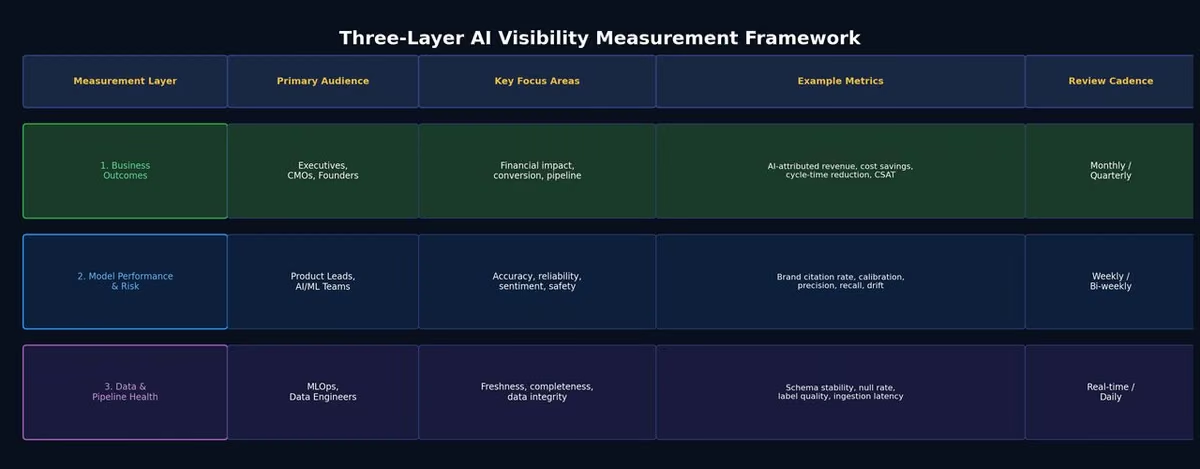
Defining the right metrics requires a structured approach. A three-layer measurement framework organizes AI performance signals into three distinct but interconnected tiers, each serving a different audience and operating at a different cadence.
The power of this framework lies in how the layers connect. Data and pipeline health metrics are leading indicators, they predict future model performance. Model performance metrics are concurrent indicators, they reflect what is happening right now in AI search results. Business outcome metrics are lagging indicators, they confirm whether the upstream work is translating into revenue and growth. Tracking all three layers simultaneously gives you both early warning signals and proof of impact.
How Do I Quantify Business Outcome Metrics to Prove the Financial Value of AI Initiatives?
For small business owners and marketing agencies, every investment in AI must be justified by measurable returns. According to recent industry research, visitors who arrive via AI-generated citations are 4x more likely to convert than visitors from traditional organic search , because they have already received a synthesized recommendation that pre-qualifies your brand. This makes AI visibility one of the highest-ROI channels available, but only if you are measuring it correctly.
The four business outcome metrics that matter most are:
AI-Attributed Revenue: Revenue from customers whose first touchpoint was an AI citation or recommendation. Use UTM parameters on your Gryffin-tracked citation links to capture this in your analytics platform.
Cost Savings from AI Automation: Reduction in content production, audit, and optimization costs achieved by using AI-powered content audits and automated Fix It actions rather than manual processes.
Sales Cycle Reduction: Decrease in average days from first contact to closed deal, driven by AI-pre-qualified leads who arrive with higher purchase intent.
Customer Satisfaction (CSAT) and Net Promoter Score (NPS): Improvements in customer experience scores attributable to AI-personalized content and recommendations.
To build a credible business case, establish a pre-AI baseline for each of these metrics before launching any optimization campaign. Without a baseline, you cannot demonstrate causation, only correlation. Your AI marketing plan should include baseline measurement as a mandatory first step.
How Can I Evaluate Model Performance and Risk to Ensure High-Quality AI Citations?
Model performance metrics sit at the heart of AI visibility measurement. They tell you not just whether your brand is being cited, but whether those citations are accurate, safe, and consistent over time. For agencies managing client brands, these metrics are the foundation of any credible AI visibility report.
Brand Citation Rate and Share of Voice
Brand citation rate measures the percentage of relevant AI queries in which your brand is mentioned. Share of Voice (SoV) contextualizes that rate against the total citation landscape in your category. Gryffin's AI Visibility Score tracks both metrics across ChatGPT, Gemini, Perplexity, and Google AI Overviews simultaneously, giving you a single composite score that reflects your true competitive position in AI search.
Accuracy and Calibration
A model is accurate when it generates factually correct statements about your brand. It is well-calibrated when its confidence level matches its actual accuracy rate. A model that is 90% confident but only 60% accurate is dangerously miscalibrated, it will spread misinformation about your brand with apparent authority. Monitor both dimensions separately. Improving your structured data and schema markup is one of the most effective ways to improve both accuracy and calibration simultaneously.
Robustness and Concept Drift
Robustness measures how consistently a model performs across different query phrasings, languages, and geographic markets. Concept drift occurs when the statistical relationship between your content and the model's outputs shifts over time , often because the model has been retrained on new data that underrepresents your brand. Monitor for drift monthly and use Gryffin's Fix It action recommendations to refresh and re-optimize content before drift becomes a visibility drop.
Fairness, Safety, and Toxicity Thresholds
Safety metrics ensure your brand is not being associated with harmful, biased, or policy-violating content in AI outputs. For agencies, this is a reputational risk management issue as much as a performance issue. Set clear thresholds, for example, a policy violation rate below 0.5% , and treat any breach as a critical incident requiring immediate content remediation.
What Upstream Data and Pipeline Health Metrics Prevent AI Search Performance Drops?
The quality of your AI visibility is only as good as the quality of the data feeding the models. Most brands focus exclusively on output metrics, what the AI says about them, while neglecting the upstream data signals that determine what the AI is able to say. This is a critical blind spot, particularly for small businesses whose web presence may have structural data quality issues that are invisible to traditional SEO tools.
The four upstream data health indicators to monitor are:
Data Freshness: The age of the content that AI models are drawing from when generating responses about your brand. Stale content leads to outdated citations. Establish a content refresh cadence using AI-powered content audits to identify and update aging pages before they become a liability.
Schema Stability: The consistency and completeness of your structured data markup across all pages. Schema errors or missing markup directly reduce your eligibility for AI citations. Use Gryffin's AI schema generator to audit and repair schema issues at scale.
Null Rate and Completeness: The percentage of required data fields that are empty or incomplete across your content inventory. High null rates signal to AI models that your content is low-quality or untrustworthy.
Ingestion Latency: The time delay between when you publish new content and when AI models incorporate it into their knowledge base. Understanding your typical ingestion latency helps you plan content publication timing for maximum impact.
Which Generative AI and LLM-Specific Visibility Metrics Matter Most for Conversational Search?
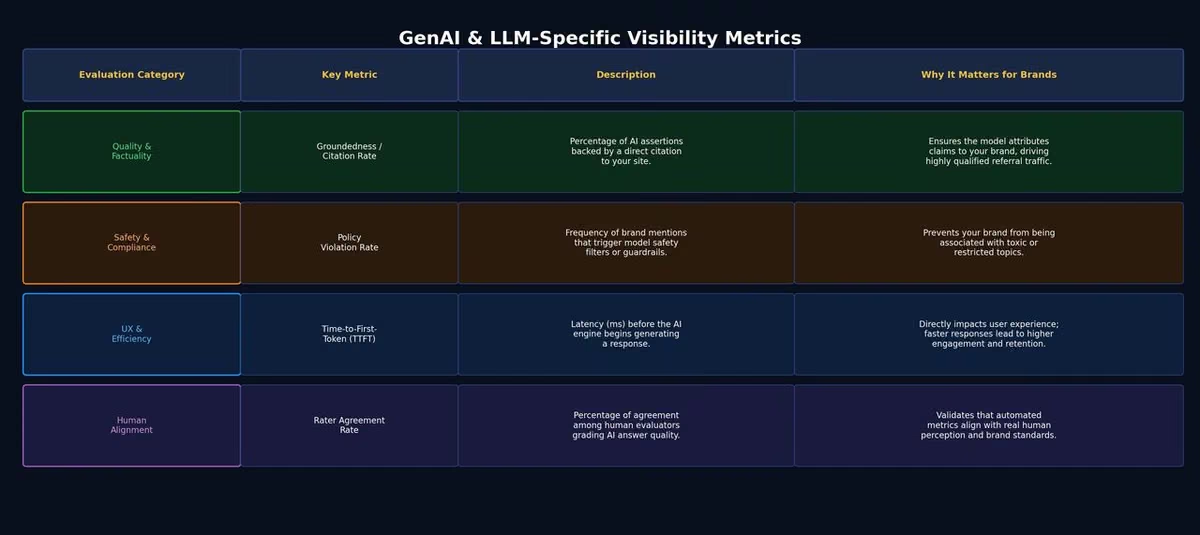
Generative AI systems require a distinct set of evaluation metrics that do not exist in traditional SEO measurement. Where SEO measures rankings and click-through rates, Generative Engine Optimization (GEO) measures the quality, safety, and human alignment of the AI-generated content that references your brand. Understanding these metrics is essential for any agency or business that wants to compete effectively in the AI search era.
The groundedness metric, the percentage of AI assertions about your brand that are backed by a direct citation to your site, is arguably the single most important LLM-specific metric for brands. A high groundedness rate means the AI is not hallucinating facts about your business; it is drawing from your actual content and attributing it correctly. Improving groundedness requires a combination of high-quality structured content, proper schema markup, and consistent brand entity optimization, all areas where Gryffin's platform provides direct, actionable guidance through its Fix It recommendations. For a deeper understanding of how to rank in Google AI Overviews, these LLM-specific metrics are the foundation.
How Do I Translate Engineering and Program Operations into Clear Health Signals for Leaders?
One of the most common failures in AI visibility programs is the disconnect between the teams doing the technical work and the leaders making investment decisions. Engineers track system reliability and deployment velocity; executives track revenue and market share. Without a translation layer, both groups operate in the dark, engineers do not know which technical improvements matter most to the business, and executives cannot evaluate whether the program is on track.
Three operational pillars bridge this gap effectively:
Reliability and SLO Adherence
Service Level Objectives (SLOs) define the minimum acceptable performance thresholds for your AI visibility systems. Track uptime, error rates, and latency against these targets and report SLO adherence as a single health percentage to leadership. A system running at 98% SLO adherence is healthy; one running at 85% requires immediate attention. Use your AI content calendar to schedule regular SLO reviews alongside content publication milestones.
Delivery and Experiment Velocity
Measure how quickly your team can move from identifying a content gap to publishing an optimized Fix It response. Faster experiment velocity means faster learning and faster competitive advantage. Track the number of Fix It actions completed per week and the average time from recommendation to publication as leading indicators of program health.
Governance and Adoption
Track the percentage of AI-generated content recommendations that go through a human review process before publication, and the percentage of team members actively using the platform. Low adoption is a leading indicator of program failure, regardless of how good the underlying technology is. Invest in onboarding and training to drive adoption, and report adoption rates alongside performance metrics to give leadership a complete picture.
How Do I Operationalize AI Metrics Globally with Targets, Cadence, and Accountability?
Defining the right metrics is only half the battle. The other half is building the operational infrastructure to track, review, and act on them consistently. Without this infrastructure, even the best measurement framework becomes a dashboard that nobody looks at. Here is a five-step process for operationalizing AI metrics in any organization, from a two-person agency to a multi-location business.
Establish an AI Metric Charter: Document which metrics you will track, why each one matters, how it is calculated, and who owns it. A one-page charter prevents metric sprawl and ensures alignment across teams. Include your primary AI Visibility Score target and the three-layer framework metrics as the foundation.
Define Target Ranges and Alert Thresholds: Set a target range for each metric (e.g., brand citation rate between 15% and 25%) and an alert threshold that triggers immediate review (e.g., citation rate drops below 10%). Avoid single-point targets, which create perverse incentives to game the number rather than improve the underlying performance.
Assign Clear Accountability Using a RACI Matrix: For each metric, define who is Responsible (does the work), Accountable (owns the outcome), Consulted (provides input), and Informed (receives updates). Without clear ownership, metrics drift and accountability disappears.
Implement Structured Review Cadences: Data and pipeline health metrics should be reviewed daily or in real time. Model performance metrics should be reviewed weekly or bi-weekly. Business outcome metrics should be reviewed monthly and quarterly. Use your AI workflow to automate metric collection and reporting so that reviews focus on interpretation and action rather than data gathering.
Tie Metrics to OKRs: Connect each AI visibility metric to a specific Objective and Key Result in your business planning cycle. This ensures that AI visibility work is treated as a strategic priority, not a side project, and that improvements are recognized and rewarded at the organizational level. For AI tools for business growth, this OKR alignment is what separates brands that scale their AI advantage from those that stagnate.
How Can I Avoid the Most Common Pitfalls of AI Metric Gaming, Vanity Traps, and Misattribution?
Even well-designed measurement frameworks can be undermined by three common failure modes. Understanding these pitfalls in advance is the difference between a metrics program that drives real improvement and one that creates a false sense of progress.
Activity Masquerading as Progress
The most pervasive vanity trap in AI visibility measurement is counting activity rather than outcomes. Teams report the number of AI tools deployed, the volume of content published, or the number of Fix It actions completed, without measuring whether any of it improved their AI Visibility Score or drove measurable business results. Activity metrics have their place as operational health signals, but they should never be presented as evidence of strategic progress. Always anchor activity metrics to outcome metrics in every report.
Goodhart's Law and Metric Gaming
Goodhart's Law states that when a measure becomes a target, it ceases to be a good measure. In AI visibility, this manifests as teams optimizing for a specific metric, say, brand citation rate, in ways that improve the number without improving the underlying reality. For example, publishing large volumes of low-quality content that gets cited briefly before being deprioritized by AI models. Mitigate this risk by tracking metric pairs: citation rate alongside citation accuracy, or content volume alongside content engagement. If one metric improves while its paired metric declines, you have a gaming problem.
Misattribution and Weak Baselines
Without a pre-AI baseline and a clear attribution methodology, it is impossible to know whether improvements in revenue or conversion are caused by your AI visibility work or by other factors. Establish baselines before launching any optimization campaign, use controlled experiments where possible, and apply conservative attribution models that err on the side of underreporting AI impact rather than overclaiming it. For AI content teams and agencies, conservative attribution builds more durable client trust than inflated numbers that cannot be sustained.
How to Build a Long-Term Competitive Advantage in AI Search Visibility
The brands that will win in the AI search era are not necessarily the ones with the biggest budgets or the most sophisticated technology. They are the ones that measure the right things, act on what they measure, and build the operational discipline to improve consistently over time. The three-layer framework, data and pipeline health, model performance and risk, and business outcomes, gives you the structure to do exactly that.
Start by auditing your current measurement stack against this framework. Identify which layers you are already tracking, which are completely absent, and which are being measured with the wrong metrics. Use Gryffin's AI Visibility Score as your north-star metric and let the Fix It action recommendations guide your content and schema optimization priorities. Build the operational infrastructure, metric charters, RACI matrices, review cadences, and OKR alignment, before you worry about advanced analytics.
The competitive advantage in AI search is not won in a single campaign. It is built through consistent, disciplined measurement and optimization over months and years. The brands that start measuring correctly today will have a compounding advantage that becomes increasingly difficult for late movers to overcome. For more strategies on leveraging AI for business growth, explore Gryffin's full library of resources, from content gap analysis to AI-generated social content, all designed to help small businesses and agencies compete and win in the AI search era.
What Are AI Visibility Metrics and How Are They Different from Vanity Metrics?
AI visibility metrics measure how often, how accurately, and how favorably your brand is cited by AI search systems like ChatGPT, Gemini, and Perplexity. Vanity metrics measure activity, content published, tools deployed, impressions generated , without connecting to business outcomes. AI visibility metrics are outcome-oriented; vanity metrics are activity-oriented. The key distinction is that AI visibility metrics, such as brand citation rate, groundedness score, and AI-attributed revenue, directly predict and measure business impact, whereas vanity metrics do not.
How Do I Choose the Right Metrics for a New AI Visibility Use Case?
Start by identifying the business outcome you are trying to achieve, more leads, lower acquisition costs, faster sales cycles, and work backward through the three-layer framework. Select one or two model performance metrics that are leading indicators of that outcome, and one or two data health metrics that are leading indicators of model performance. This creates a connected metric chain from data quality to business results, ensuring every metric you track serves a clear strategic purpose.
How Often Should AI Visibility Metrics Be Reviewed, and by Whom?
Data and pipeline health metrics should be monitored in real time or daily by data and content operations teams. Model performance metrics, including brand citation rate, accuracy, and drift, should be reviewed weekly or bi-weekly by product and marketing leads. Business outcome metrics should be reviewed monthly by marketing leadership and quarterly by executive stakeholders. This tiered cadence ensures that operational issues are caught early while strategic decisions are made with sufficient data.
What Is Generative Engine Optimization (GEO) and Why Is It Important?
Generative Engine Optimization (GEO) is the practice of optimizing your content, structured data, and brand entity signals to increase the frequency and quality of your brand's citations in AI-generated search responses. It is important because AI search engines are rapidly replacing traditional search for high-intent queries, and brands that are not optimized for GEO are invisible to an increasingly large share of their potential customers. GEO is to AI search what SEO was to traditional search, a foundational competitive requirement.
How Can Small Businesses Compete with Larger Brands in AI Search Visibility?
Small businesses have a structural advantage in AI search: they can move faster. While large enterprises are navigating internal approval processes and legacy content systems, a small business using a platform like Gryffin can identify a content gap, implement a Fix It action, and publish optimized content within hours. The key is to focus on a narrow set of high-intent queries where your brand has genuine expertise, optimize your structured data and schema markup rigorously, and track your AI Visibility Score consistently so you can see what is working and double down on it.
What Is the Difference Between KPIs, SLIs, SLOs, and SLAs in AI Visibility Contexts?
KPIs (Key Performance Indicators) are business-level metrics tied to strategic goals, such as AI-attributed revenue. SLIs (Service Level Indicators) are raw technical measurements, such as citation rate or response latency. SLOs (Service Level Objectives) are the target thresholds you set for SLIs, such as a citation rate above 15%. SLAs (Service Level Agreements) are contractual commitments to external parties, relevant for agencies committing to client performance targets, based on SLOs. In an AI visibility program, you need all four: KPIs to justify investment, SLIs to measure performance, SLOs to set standards, and SLAs to build client trust.
How Do I Run an AI-Powered Content Audit for My Website?
An AI-powered content audit analyzes your entire content inventory to identify pages that are underperforming in AI search, flagging issues such as missing schema markup, outdated information, low groundedness scores, and content gaps relative to competitor citations. Gryffin automates this process, surfacing prioritized Fix It recommendations so your team can focus on the highest-impact improvements rather than manually reviewing hundreds of pages. A quarterly content audit cadence is recommended for most small businesses and agencies.
How Can I Use an AI Calendar Generator to Organize My AI Visibility Strategy?
An AI calendar generator helps you plan and schedule content publication, schema updates, and performance reviews in a structured, repeatable cadence. For AI visibility specifically, use it to schedule monthly content refreshes aligned with your data freshness targets, weekly model performance reviews, and quarterly business outcome reviews. A well-structured content calendar ensures that your AI visibility optimization work is consistent and proactive rather than reactive.
How Do I Measure AI Visibility for Multiple Client Accounts as a Marketing Agency?
Agencies managing multiple client accounts need a scalable measurement framework that can be applied consistently across clients while accommodating different industries, audiences, and business goals. Use the three-layer framework as a universal template, customizing the specific metrics and targets for each client. Gryffin's platform supports multi-account management, allowing agencies to track AI Visibility Scores, Fix It action completion rates, and business outcome metrics across all client accounts from a single dashboard. Standardize your reporting templates and review cadences across clients to maximize efficiency.
What Is a Content Gap Analysis in AI Search and How Do I Conduct One?
A content gap analysis in AI search identifies the topics, questions, and entities that AI models are citing in your category but that your brand is not currently addressing. Conducting one involves querying AI systems with the high-intent questions your target customers ask, analyzing which brands and sources are cited in the responses, and identifying the content types and topics where your brand is absent. Gryffin automates this process, surfacing content gap opportunities ranked by citation frequency and business relevance so you can prioritize your content investment effectively.
How Does AI for Business Growth Differ from Traditional Marketing Software?
Traditional marketing software automates existing processes, scheduling posts, sending emails, generating reports. AI for business growth goes further: it identifies opportunities you did not know existed, generates content recommendations based on competitive intelligence, and continuously optimizes your brand's presence across AI search systems in ways that compound over time. The key difference is that traditional software executes instructions; AI platforms like Gryffin generate insights and recommendations that improve your strategic decision-making, not just your operational efficiency.
At first, we weren’t even thinking about AI visibility. We were focused on rankings and traffic like everyone else. But once we started testing our brand in ChatGPT and other AI tools, we realized we were barely showing up — even for topics we ‘ranked’ for. Gryffin gave us a clear picture of where we stood, how competitors were being cited instead, and what that actually meant for our pipeline. It shifted how we think about search entirely.










.webp)