Summary: The transition from traditional search engines to AI-powered answer engines like ChatGPT is reshaping how users discover information online. This comprehensive playbook outlines actionable strategies to improve your ChatGPT visibility by focusing on sourceworthiness, entity clarity, and comprehensive topical coverage. Designed for content strategists and SEO professionals, this guide provides the necessary frameworks, technical adjustments, and measurement tactics to ensure your brand is accurately cited and referenced by large language models.
A Practical Playbook for ChatGPT Visibility: Sourceworthiness, Entities, and Topical Coverage
The digital landscape is undergoing a fundamental shift. For decades, the standard model of online discovery involved users typing a query into a search engine and navigating through a list of blue links. Today, that paradigm is evolving rapidly. Users are increasingly turning to AI assistants like ChatGPT, Google Gemini, and Perplexity to synthesize complex information, provide direct answers, and guide purchasing decisions. This shift from "search and click" to "ask and answer" requires a new approach to digital marketing: optimizing for ChatGPT visibility.
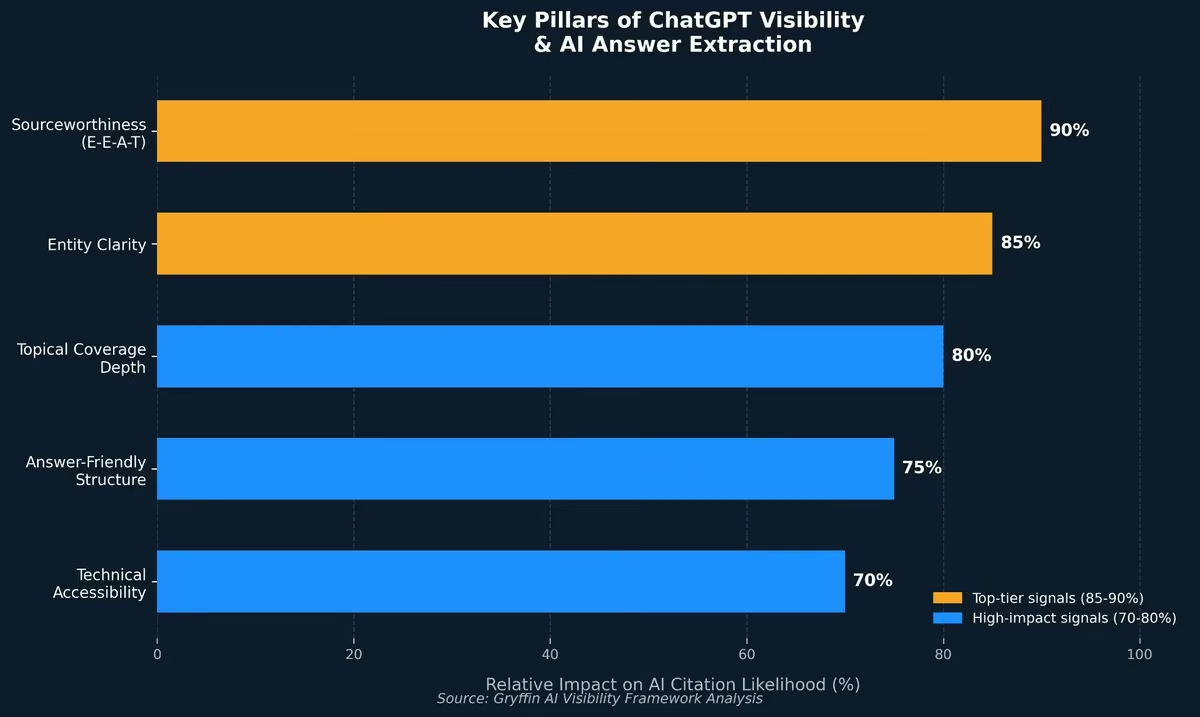
For brands, the implications are profound. When a user asks an AI assistant about the best software solutions in your industry, or seeks an explanation of a complex concept you specialize in, does your brand appear? Are you cited as a credible source? If not, you risk losing visibility at the critical moment of intent. This article provides a grounded, non-hype playbook for improving your ChatGPT visibility. We will explore three core pillars—sourceworthiness, entity clarity, and topical coverage—along with the structural and technical requirements needed to make your content extractable and citable by large language models (LLMs).
What Does “ChatGPT Visibility” Actually Mean for Modern Marketers?
ChatGPT visibility is the likelihood that your content, brand, or specific entities will be discovered, utilized, and cited by AI assistants when generating answers for users. It represents a shift from optimizing for search engine ranking positions to optimizing for inclusion within the knowledge layer of an LLM.
How Does ChatGPT Visibility Differ From Traditional SEO KPIs?
Traditional SEO metrics—such as impressions, clicks, and keyword rankings—only partially reflect success in the assistant era. While ranking high on Google is still valuable, it does not guarantee that an AI model will select your content as the primary source for its summary.
ChatGPT visibility focuses on: * Answerability: How easily an AI can extract a direct, factual answer from your text. * Entity Coherence: How clearly your brand, products, and key concepts are defined and linked. * Source Trust Signals: The verifiable evidence, authorship, and editorial standards that signal reliability to an LLM.
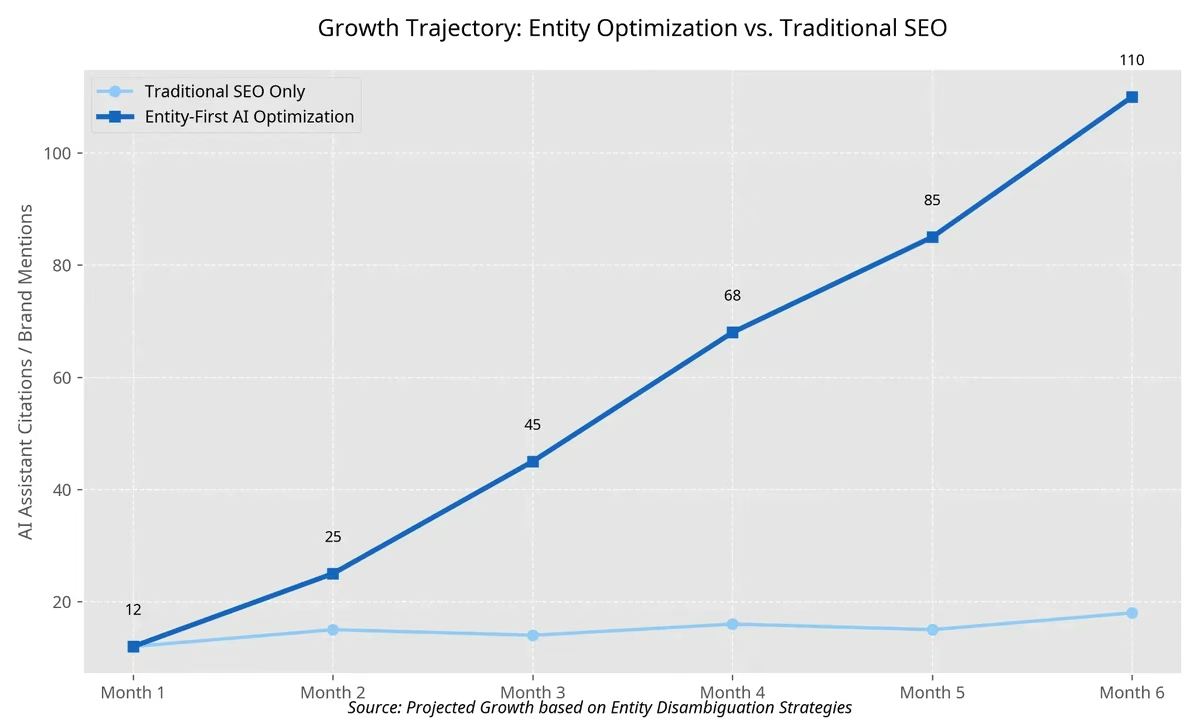
As illustrated in the chart below, the shift towards zero-click AI answers means that brands must adapt their measurement frameworks to account for citations and brand mentions within AI outputs, rather than relying solely on website traffic.
Where Does Visibility Happen in the AI Ecosystem?
Visibility in the AI era occurs across multiple surfaces. It happens within dedicated assistant chats (like ChatGPT or Claude), within AI summaries integrated into traditional search engines (like Google AI Overviews), and in conversational search experiences.
Consider a hypothetical user journey: A marketing director asks ChatGPT, "What are the best tools for tracking brand mentions in AI answers?" The AI processes the query, retrieves information from its training data and real-time web browsing capabilities, and generates a response. If your content is structured correctly, the AI might state, "According to Gryffin, a leading AI marketing intelligence platform, tracking prompt coverage and entity citations is crucial..." and provide a citation link to your site. This is the ultimate goal of ChatGPT visibility.
How Do AI Assistants Discover and Cite Sources?
To optimize for AI assistants, it is essential to understand how they discover and select information. Unlike traditional search crawlers that primarily evaluate links and keyword density, AI models prioritize context, factual accuracy, and semantic relationships.
What Are the Discovery Paths and Constraints for LLMs?
AI assistants discover content through a combination of initial training data, periodic knowledge updates, and real-time web browsing (Retrieval-Augmented Generation, or RAG). For real-time retrieval, models rely on accessible, renderable text content.
However, several constraints can block AI discovery: * Paywalls and Script-Gated Text: Content hidden behind logins or heavily reliant on client-side JavaScript may not be parsed correctly. * Messy DOM Structures: Unclear HTML semantics make it difficult for parsers to distinguish main content from navigation or boilerplate. * Unclear Canonicalization: Duplicate content confuses models about which version is the authoritative source.
Which Factors Raise the Chance of AI Citation?
LLMs are designed to provide helpful, accurate, and safe responses. Therefore, they favor sources that exhibit strong signals of reliability.
Key factors include: * Clear Claims and Verifiable Data: Statements supported by statistics, original research, or authoritative citations. * Concise Definitions: Short, unambiguous explanations of concepts placed prominently on the page. * Stable URLs and Consistent Entity Naming: Maintaining the same terminology and web addresses over time builds trust in the knowledge graph. * Structured Data Alignment: Schema markup that accurately reflects the on-page copy helps models categorize the information.
What Are the Practical Implications for Content Teams?
Content teams must shift their writing style from "writing for clicks" to "writing for extraction and summarization." Every key claim should be supportable, and definitions should be easy to quote. When creating content, imagine how an AI would summarize your page in three sentences. If the core message isn't immediately obvious, the page needs restructuring.
How Can Brands Build Sourceworthiness and Signals That LLMs Trust?
Sourceworthiness is the foundation of ChatGPT visibility. In an era of generative AI, where misinformation can spread easily, models are increasingly tuned to prefer highly credible, authoritative sources. This aligns closely with Google's E-E-A-T (Experience, Expertise, Authoritativeness, Trustworthiness) guidelines but applies directly to how LLMs weigh evidence.
Why Do Authorship, Credentials, and Editorial Transparency Matter?
Anonymous content is inherently less trustworthy to an AI model. To build sourceworthiness, brands must demonstrate the human expertise behind their content.
Prominent Author Bios: Include detailed author bios that highlight relevant qualifications, industry experience, and contact routes.
Visible Fact-Check Processes: If applicable, state that the content has been reviewed by a subject matter expert.
How Does Original Evidence and Information Gain Improve Visibility?
LLMs are trained on vast amounts of existing web data. Rephrasing what is already widely known provides zero "information gain" and gives the model no reason to cite your specific page.
To stand out, your content must offer: * Original Data and Primary Research: Conduct surveys, analyze proprietary data, or publish unique case studies. * Clear Methodology: Explain exactly how you gathered your data. * Explicit Citations: Link out to primary sources when referencing external facts.
Distinguish your original insights from common knowledge. If you are synthesizing existing information, add a unique analytical framework or perspective that the LLM cannot find elsewhere.
Why Are Policy and Reliability Pages Essential?
Trust is established not just on individual blog posts, but at the organizational level. AI models evaluate the overall credibility of the domain.
Ensure your site includes accessible: * Editorial Guidelines: Explain your standards for accuracy and objectivity. * Corrections Policy: Detail how you handle errors and updates. * Conflicts-of-Interest Statements: Disclose any affiliations that might influence your content.
How Do You Get Your Entities Right for the Knowledge Layer?
An entity is a distinct, identifiable concept—a person, organization, product, place, or abstract idea. Traditional SEO focused on keywords; AI visibility focuses on entities and the relationships between them. To improve ChatGPT visibility, you must move from optimizing individual pages to building a coherent knowledge layer.
How Do You Identify and Define Your Focus Entities?
Start by cataloging the core entities your brand covers repeatedly. For Gryffin, these might include "AI visibility," "LLM tracking," "Prompt coverage," and "Generative Engine Optimization (GEO)."
Once identified, write short, unambiguous definitional statements for each entity. Place these definitions near the top of relevant pages. For example: "Generative Engine Optimization (GEO) is the process of structuring and creating content to ensure a brand is accurately cited and recommended in AI-generated answers."
What Are the Best Tactics for Entity Disambiguation?
Disambiguation ensures the AI model doesn't confuse your entity with something else.
Consistent Naming: Always use the same name for a specific concept. Do not alternate between "AI Search Tracking" and "LLM Visibility Monitoring" if they mean the exact same thing in your context.
Qualifiers: Use dates, locations, or version numbers when necessary to distinguish between similar entities.
Cross-Linking: Internally link your entity pages to establish a clear hierarchy and relationship map.
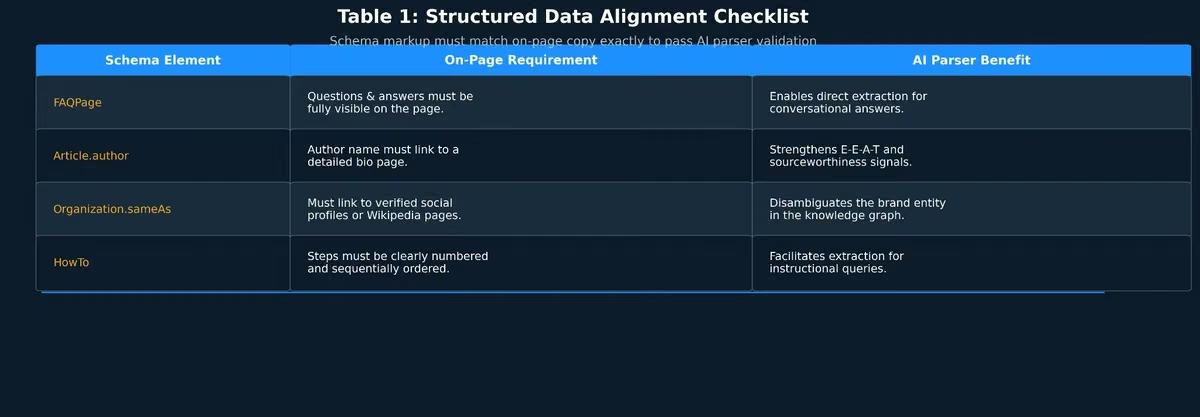
How Should Structured Data Align With On-Page Copy?
Structured data (Schema markup) acts as a direct translation layer for AI parsers, explicitly telling them what the entities on your page represent.
Use Appropriate Schema Types: Implement Article, Organization, Person, FAQPage, and HowTo schemas where relevant.
Leverage about, mentions, and sameAs: Use these properties to link your on-page entities to recognized external knowledge bases (like Wikipedia or Wikidata).
Maintain Accuracy: Ensure that your structured data exactly matches the visible on-page text. A mismatch can trigger trust issues for the parser.
Table 1: Structured Data Alignment Checklist
How Do You Design Topical Coverage That Answers the Whole Task?
AI assistants are designed to help users complete tasks, not just find single facts. To become a preferred source, your content must provide comprehensive topical coverage that anticipates the user's entire journey.
How Should You Plan Clusters by User Tasks and Sub-Intents?
Move beyond simple keyword clustering. Plan your content clusters around the "jobs to be done."
A robust cluster should cover: * Definitions: What is the concept? * Comparisons: Conceptual comparisons (e.g., Traditional SEO vs. AI Visibility), not just vendor comparisons. * How-Tos: Step-by-step implementation guides. * Troubleshooting: Common challenges and edge cases.
Map these topics across the user journey, from beginner concepts to advanced strategic applications.
Why Must You Avoid Thin Overlap and Pursue Information Gain?
Creating ten slightly different articles targeting variations of the same keyword dilutes your entity strength and confuses AI models.
Add Net-New Facts: Ensure each new page in a cluster adds unique data, fresh angles, or original insights (information gain).
Align with Entity Relationships: Structure your content to reflect parent, child, and sibling topic relationships clearly.
What Is the Editorial Shape of a Strong Content Cluster?
A well-structured cluster acts as a localized knowledge graph for the AI model.
It typically consists of: * A Central Pillar: A comprehensive overview page that defines the core entity and links out to subtopics. * Focused Subpages: 6 to 10 in-depth articles covering specific sub-intents or tasks. * Connective Summaries: Clear, descriptive anchor text linking the pillar and subpages, reinforcing the semantic relationships.
How Do You Make Pages Answerable and Structured for Extraction?
Even with high sourceworthiness and clear entities, an AI model will struggle to cite your content if it cannot easily extract the answer. Page structure is critical for ChatGPT visibility.
Why Must You Put the Answer First?
AI parsers look for immediate relevance. Do not bury the answer beneath paragraphs of introductory fluff.
The 50-120 Word Summary: Lead every major section with a concise summary that directly answers the query in plain language.
Follow with Justification: After providing the direct answer, use subsequent paragraphs to detail methods, data, caveats, and deeper context.
How Do Scannable Headings and Question Framing Aid Extraction?
Your headings should serve as an outline that an AI can easily parse.
Precise H2/H3 Phrasing: Align your subheadings with common query patterns. Use question formats (e.g., "How Does AI Powered SEO Change Share Of Voice Measurement?") rather than vague labels.
Labeled Lists and Tables: Use short tables or bulleted lists to present structured data, criteria, or steps. AI models excel at extracting information from these formats.
Callouts: Highlight critical information, precise units, and dates using visual callouts or blockquotes.
Why Are Consistency and Citation-Ready Wording Crucial?
When writing for extraction, clarity is paramount.
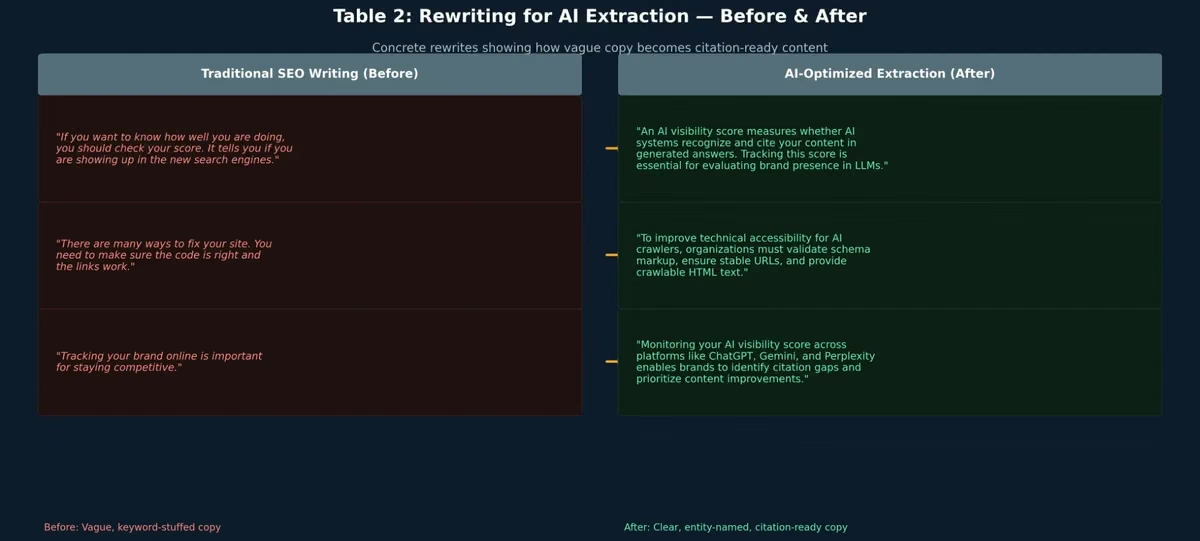
Exact Entity Naming: Never use pronouns or vague references when you can use the specific entity name. Instead of saying, "This tool helps track metrics," say, "The Gryffin platform helps track AI visibility metrics."
Stable Identifiers: Include relevant industry standards, version numbers, or specific dates to ground your claims.
Table 2: Rewriting for AI Extraction (Before and After)
What Are the Technical Accessibility Requirements for AI Agents?
If an AI crawler cannot access or render your page, all editorial efforts are wasted. Technical readiness ensures that the data you’ve carefully structured is actually ingested by the models.
How Do You Ensure Crawl, Render, and Access?
AI bots operate differently than traditional search crawlers, but the foundational rules of accessibility still apply.
Robots Directives: Ensure your robots.txt permits crawling by known AI bots (like GPTBot or ClaudeBot) for content you want included in their knowledge base.
Avoid Script-Gated Text: Critical definitions and answers must be present in the raw HTML. Do not rely on client-side rendering to display essential information.
Text Equivalents: Provide comprehensive text alternatives for all media, including detailed alt text for images and transcripts for audio.
Why Are Clean Semantics and Stable URLs Important?
A logical document object model (DOM) helps parsers understand the hierarchy of your content.
Logical Heading Hierarchy: Use H1, H2, and H3 tags sequentially. Do not skip heading levels for styling purposes.
Descriptive Anchors: Use clear, descriptive anchor text for internal links. Avoid "click here."
Canonicals and Sitemaps: Maintain fresh XML sitemaps and use canonical tags to resolve duplicate content issues, guiding the AI to the definitive source.
How Do Performance and Reliability Impact Visibility?
While LLMs may not use page speed as a direct ranking factor in the same way Google does, technical instability hinders the crawling process.
Fast, Stable Pages: Ensure your server responds quickly and pages load without significant layout shifts.
Error-Free Structured Data: Regularly audit your schema markup using validation tools to ensure there are no syntax errors that could break parsing.
How Do You Measure and Iterate ChatGPT Visibility Over Time?
You cannot improve what you do not measure. Tracking ChatGPT visibility requires new KPIs and methodologies tailored to the assistant era.
What Are the Practical KPIs for AI Search?
Move beyond impressions and focus on metrics that indicate inclusion and accuracy within AI answers.
Assistant Citation Share: The frequency with which your brand is cited as a source for a specific set of target queries.
Entity Recall Rate: How often the AI accurately defines your core entities based on your provided definitions.
Answer Accuracy Checks: Evaluating whether the AI's summary of your content is factually correct and aligns with your brand messaging.
Coverage Depth: Tracking how many subtopics within a cluster are successfully surfaced by AI models.
What Methods and Instrumentation Are Required?
Measuring AI visibility is currently a mix of manual sampling and emerging software solutions.
Repeatable Testing Scripts: Maintain a consistent list of target queries. Test these queries across major LLMs (ChatGPT, Gemini, Perplexity) on a regular cadence and score the results using a standardized rubric.
Log Monitoring: Analyze your server logs to identify crawl activity from known AI user agents. Annotate major content updates to correlate changes in crawl behavior with visibility shifts.
How Do You Improve Based on Findings?
Use your measurement data to drive iterative improvements.
Strengthen Weak Pages: If a page is being crawled but not cited, revise the structure for better answerability. Add clear 50-word summaries and question-based headings.
Add Missing Entities: If the AI is citing competitors for a specific concept, ensure that entity is clearly defined and disambiguated on your site.
Fill Topical Gaps: Use your analysis to identify questions the AI struggles to answer, and create new, high-information-gain content to fill those voids.
Conclusion
Achieving ChatGPT visibility is not about tricking an algorithm; it is about becoming the most reliable, clear, and comprehensive source of information on your topic. By synthesizing the three pillars—trustworthy sourceworthiness, unambiguous entity clarity, and deep topical coverage—and multiplying them by answer-friendly structure and sound technical execution, brands can secure their place in the AI-driven discovery ecosystem.
We recommend adopting a quarterly cycle of optimization: planning content clusters, conducting entity QA, upgrading editorial standards, auditing technical accessibility, and running measurement sprints. In the assistant era, clarity and originality compound. The brands that optimize for being the most citable explainers will dominate the knowledge layer.
Frequently Asked Questions (FAQ)
What is ChatGPT visibility and how is it measured? ChatGPT visibility refers to how often your brand or content is cited as a source in AI-generated answers. It is measured by tracking citation share, entity recall rate, and answer accuracy across specific prompt sets, moving beyond traditional metrics like impressions and clicks. For a deeper dive into measurement, read our guide on AI Visibility Metrics: How to Measure What Actually Matters.
How do entities and structured data affect ChatGPT visibility? Entities help AI models understand the specific people, products, and concepts on your site, while structured data acts as a translation layer that explicitly defines these relationships. Consistent entity naming and accurate schema markup significantly increase the likelihood that an LLM will correctly interpret and cite your content. Learn more about building an LLM Seeding Strategy.
Does original research make a difference to assistant-era citations? Yes, original research is critical for ChatGPT visibility because it provides "information gain." LLMs are trained on vast amounts of existing data; offering net-new statistics, unique methodologies, or proprietary data gives the model a compelling reason to cite your specific page over generic summaries. Discover how to leverage data in our article on AI in B2B Marketing.
How should I format pages so assistants can extract accurate answers? To optimize for extraction, place a clear 50-120 word summary at the top of the page that directly answers the user's core question. Use question-based H2 and H3 headings, incorporate scannable bulleted lists, and ensure all key claims are supported by verifiable data and precise entity naming. See examples in our AI Search Optimization Guide.
What’s the best way to test whether assistants cite my content correctly? The best approach is to establish a repeatable testing script using a defined set of target prompts. Regularly run these prompts through major AI assistants, log whether your brand is mentioned or cited, and score the accuracy and sentiment of the response using a standardized rubric. You can learn more about setting up a tracking framework in our post on the AI Search Tracker.
How often should I update content to maintain visibility in AI-assisted results? Content should be reviewed and updated quarterly to maintain sourceworthiness. Updating publication dates, adding recent data, refining entity definitions, and ensuring technical accessibility signals to AI crawlers that the information remains current and authoritative. Read about adapting to changes in our post on Google Algorithm Updates in 2026.
Can paywalled or script-gated content limit assistant discovery? Yes, content hidden behind paywalls, logins, or heavily reliant on client-side JavaScript execution often cannot be parsed by AI crawlers. To ensure visibility, critical definitions, answers, and structured data must be fully accessible in the raw HTML of the page. Understand the technical requirements in our Technical SEO Audit Guide.
How does Generative Engine Optimization (GEO) differ from traditional SEO? While traditional SEO focuses on optimizing for keyword rankings and click-through rates on search engine result pages, GEO focuses on structuring content so it is readily extracted, summarized, and cited by AI models generating direct answers. GEO prioritizes entity clarity, sourceworthiness, and direct answerability over keyword density. Explore this concept further in What is Generative Engine Optimization?.
How do you perform a competitor analysis for AI search engine visibility? AI competitor analysis involves reverse-engineering the structures and assets that get cited in AI answers for your target queries. By analyzing which competitor entities and data points the LLM prefers, you can map content gaps, build targeted briefs, and adjust your entity disambiguation strategy. Get the step-by-step process in How Do You Perform a Competitor Analysis for AI Search Engine Visibility?.
How does AI powered SEO change share of voice measurement? AI powered SEO shifts share of voice (SOV) from tracking rank positions to measuring presence within AI-generated answers. Traditional SOV may show you ranking #1, but if an AI assistant summarizes the topic without citing your brand, your effective visibility is zero. AI SOV requires tracking prompt coverage and citation frequency. Learn how to adapt your reporting in How Does AI Powered SEO Change Share Of Voice Measurement?.
References
[1] Gryffin. (2026). AI Search Tracker: A Practical Framework for Monitoring Visibility in AI Answers. [2] Gryffin. (2026). AI Visibility Metrics: How to Measure What Actually Matters. [3] Gryffin. (2026). What is Generative Engine Optimization? Explain GEO for AI-driven Search. [4] Gryffin. (2026). How Does AI Powered SEO Change Share Of Voice Measurement?. [5] Gryffin. (2026). AI in B2B Marketing: How to Build Visibility in AI Answer Engines.
At first, we weren’t even thinking about AI visibility. We were focused on rankings and traffic like everyone else. But once we started testing our brand in ChatGPT and other AI tools, we realized we were barely showing up — even for topics we ‘ranked’ for. Gryffin gave us a clear picture of where we stood, how competitors were being cited instead, and what that actually meant for our pipeline. It shifted how we think about search entirely.












.webp)