AI Search Visibility: How Brands Can Appear in AI-Generated Answers
Marcela De Vivo
Marcela De Vivo
May 22, 2026
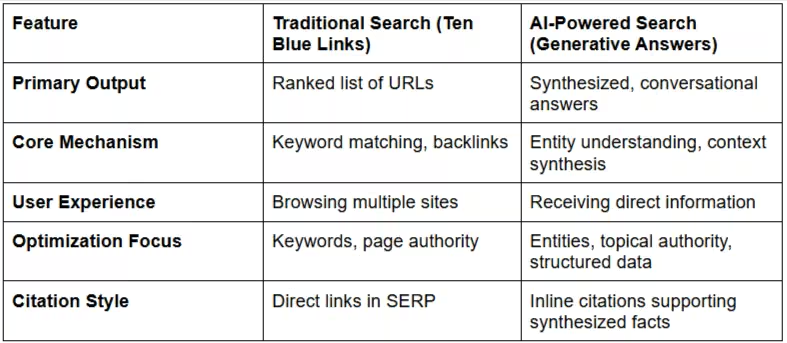
The traditional model of search engines returning ten blue links is rapidly evolving into a paradigm where AI-powered answer engines synthesize information to provide direct, conversational responses. This transformation makes AI search visibility, the measure of how frequently and favorably your brand appears in these AI-generated answers, a critical component of modern marketing strategy.
For brands, AI search visibility is no longer a futuristic concept; it is an immediate necessity for maintaining brand recall and driving consideration. When users query AI systems like ChatGPT, Gemini, or Perplexity, they are not looking for a list of websites to browse; they expect immediate, synthesized, and authoritative answers. If your brand is not part of the foundational data these systems use to generate their responses, you risk becoming invisible to a growing segment of your target audience.
This article provides a comprehensive, vendor-neutral guide to understanding and improving your brand's AI search visibility. We will explore the mechanics of how AI-powered search engines operate, the importance of building an entity-first content strategy, the technical foundations required for machine discoverability, and practical methods for measuring your success in this new ecosystem. By the end of this guide, you will have a clear, actionable roadmap to ensure your brand remains a trusted and frequently cited source in the age of generative search.
How Do AI-Powered Search Engines Find, Synthesize, and Cite Information?
To effectively optimize for AI search visibility, it is essential to understand the underlying mechanics of how these systems operate. Unlike traditional search engines that rely heavily on keyword matching and backlink profiles to rank individual web pages, AI answer engines function as complex synthesizers of information. They read, interpret, and connect vast amounts of data to construct coherent, contextually relevant responses.
The process begins with the ingestion of data. AI models are trained on massive datasets comprising text from across the internet. However, when generating real-time answers, many modern systems utilize Retrieval-Augmented Generation. This means that when a user submits a prompt, the AI first searches an index for relevant, up-to-date information, retrieves the most pertinent sources, and then synthesizes that information to generate an answer.
Crucially, AI systems rely on entities rather than just keywords. An entity is a distinct, well-defined concept, a person, a place, a product, or an organization. The AI builds a knowledge graph that maps the relationships between these entities. When your brand is clearly defined as an entity and strongly associated with relevant topics, the AI is more likely to draw upon your content.
Furthermore, AI answer engines prioritize topical authority and trustworthy signals. They are designed to cite sources that demonstrate expertise and reliability. Concise, well-structured pages that directly address user intent and provide clear, factual information are far more likely to be selected as grounding citations. The context window, the amount of text the AI can process at one time, also plays a role; content that is dense with relevant facts and easy for a machine to parse will naturally perform better.
How Can Brands Build an Entity-First Content Strategy for AI Visibility?
Transitioning to an entity-first content strategy is the cornerstone of improving AI search visibility. This approach requires moving away from traditional keyword stuffing and instead focusing on clearly defining your brand and its associated concepts in a way that machines can easily understand and categorize.
The first step is to map the entities relevant to your domain. This involves identifying the primary concepts, products, people, and industry terms associated with your brand. Once mapped, you must establish clear relationships between these entities. For example, if your brand offers an AI-powered marketing intelligence platform, you need to clearly link your brand entity to concepts like "AI search visibility," "marketing intelligence," and "visibility gaps."
To facilitate this, create an entity home page, a central, authoritative hub that clearly defines your brand and its core offerings. This should be supported by interconnected hub pages that delve into specific subtopics.
Consistency is paramount. Use consistent naming conventions and avoid ambiguous terminology. Implementing glossaries or definition pages can significantly aid AI systems in disambiguating terms and understanding your specific context.
Depth of coverage is also critical. An entity-first strategy requires comprehensive coverage of a primary topic, its related subtopics, and the common questions users ask about them. By providing exhaustive, well-structured information, you signal to AI systems that your brand is a definitive source of knowledge on the subject.
What Content Formats Are Most Likely to Surface in AI-Generated Answers?
AI answer engines have a clear preference for content formats that are easy to parse, extract, and synthesize. To maximize your AI search visibility, you must structure your content in a way that aligns with these machine preferences. The goal is to provide clear, concise, and answerable information.
Q&A blocks and FAQs are highly effective. By directly posing a question and providing a succinct, factual answer, you present information in the exact format AI systems use to respond to users.
Concise definitions are equally important. When introducing a complex topic or industry term, provide a clear, one-to-two sentence definition near the beginning of the section. This makes it easy for the AI to extract and cite your definition.
Step-by-step how-tos and bulleted lists of key takeaways are also highly favored. These formats break down complex processes into easily digestible chunks, which AI systems can readily incorporate into their synthesized responses.
Furthermore, ensure your content utilizes clear, descriptive headings (H2s, H3s) that accurately reflect the section's content. Keep paragraphs relatively short and focused on a single idea.
Tables of key facts are excellent for presenting structured data that AI models can easily compare and synthesize.
Finally, do not neglect multimedia. While AI models primarily process text, providing descriptive alt text and full transcripts for videos and audio ensures that the information contained within these assets is also accessible and indexable by machine learning algorithms.
Content Format Rewrite Example
Before (Traditional Paragraph): Our platform helps marketers understand how their brand is performing in AI search. It looks at different tools like ChatGPT and Gemini and gives you a score. If you aren't showing up, it tells you what to do to fix it, like what content to write or how to change your prompts.
After (Answer-Friendly Q&A): How does Gryffin measure AI search visibility? Gryffin measures AI search visibility by tracking brand mentions across major AI platforms, including ChatGPT, Gemini, and Perplexity. It provides a composite AI Visibility Score, identifies specific prompts where the brand is missing, and offers one-click, actionable recommendations to close those visibility gaps.
How Does Structured Data Improve Machine Understanding for AI Search?
Structured data is the language of machines. It provides explicit, standardized clues about the meaning and context of your content, significantly enhancing an AI system's ability to interpret and trust your information. Implementing appropriate structured data is a non-negotiable technical requirement for optimizing AI search visibility.
By using schema markup (typically in JSON-LD format), you explicitly define the entities on your page. For instance, using the Organization schema clarifies your brand's identity, while the Person or Author schema establishes the credentials of your content creators.
When publishing articles or blog posts, the Article schema helps AI systems understand the headline, publish date, and author, reinforcing the content's timeliness and authority.
For specific content formats, schemas like FAQPage and HowTo are invaluable. They directly map your content to the question-and-answer formats that AI engines favor, increasing the likelihood that your specific answers will be extracted and cited.
Consistent metadata is also crucial. Ensure your title tags, meta descriptions, and publish/update dates are accurate and clearly defined.
Furthermore, utilize internal linking and breadcrumb markup to clarify the hierarchical relationships between your pages. This helps the AI understand the broader context of your site and how different entities relate to one another.
Example: JSON-LD Snippet for Organization and Article
{
"@context": "https://schema.org",
"@type": "Article",
"headline": "AI Search Visibility: How Brands Can Appear in AI-Generated Answers",
"datePublished": "2026-05-18",
"dateModified": "2026-05-18",
"author": {
"@type": "Organization",
"name": "Gryffin"
},
"publisher": {
"@type": "Organization",
"name": "Gryffin",
"logo": {
"@type": "ImageObject",
"url": "https://gryffin.com/logo.png"
}
}
}
How Can Brands Demonstrate Expertise, Experience, Authority, and Trust?
AI answer engines are designed to provide reliable, accurate information. Consequently, they heavily weight signals that demonstrate Expertise, Experience, Authority, and Trust. To improve your AI search visibility, your content must clearly exhibit these qualities.
Authoritative Bios and Credentials: Ensure that content is attributed to specific authors with verifiable expertise. Include detailed author bios that highlight their credentials, experience, and relevant affiliations.
Transparent Sourcing: AI systems look for well-researched content. Provide transparent sourcing by citing credible, authoritative external references. Outbound links to high-quality domains signal that your content is grounded in established facts.
Original Insights and Data: Regurgitating existing information is insufficient. To stand out, provide original insights, proprietary data studies, unique frameworks, or methodologies based on first-hand field experience. AI systems are more likely to cite sources that offer net-new information or unique perspectives.
Editorial Hygiene: Maintain strict editorial standards. Implement fact-checking processes and clearly display update logs or version histories on your articles. This demonstrates a commitment to accuracy and shows that your content is actively maintained.
E-E-A-T Content Checklist
Is the author clearly identified with a detailed bio and credentials?
Are all factual claims supported by citations to authoritative sources?
Does the content include original data, research, or unique frameworks?
Is the publish date and last-updated date clearly visible?
Is there a transparent editorial policy or fact-checking process in place?
What Are the Technical Foundations for Discoverability by AI Crawlers?
Before an AI system can synthesize and cite your content, it must first be able to discover, crawl, and render it. A solid technical foundation is the prerequisite for AI search visibility.
Clean URL Structure and Sitemaps: Maintain a logical, hierarchical URL structure that clearly indicates the content's topic. Ensure your XML sitemaps are up-to-date and accurately reflect your site's architecture, making it easy for AI crawlers to discover new and updated pages.
Canonicalization: Use canonical tags to prevent duplicate content issues. This ensures that AI systems understand which version of a page is the primary source of truth, consolidating your authority signals.
Performance and Rendering: AI crawlers, like traditional search bots, value efficiency. Ensure your pages load quickly and are fully mobile-ready. Crucially, your content must be stable and easily renderable; if critical information relies on complex client-side JavaScript that fails to execute, the AI crawler will miss it.
Robots Directives and Licensing: Establish clear policies for AI agents in your robots.txt file. You must consciously decide which AI crawlers are permitted to access your content. Furthermore, consider the licensing and terms of service regarding how your content can be used by AI models.
Example: robots.txt Pattern for AI Agents
# Allow specific AI crawlers
User-agent: GPTBot
Allow: /public-resources/
Disallow: /private-data/
User-agent: Google-Extended
Allow: /blog/
Disallow: /internal-docs/
How Do Offsite Signals Reinforce Entity Presence in AI Knowledge Graphs?
AI search visibility is not solely determined by what happens on your website. AI models build their knowledge graphs by analyzing relationships and references across the entire web. Therefore, consistent offsite signals are vital for reinforcing your brand's entity presence.
Authoritative Profiles: Ensure your brand maintains active, authoritative profiles on relevant industry directories, association websites, and professional networks. These profiles help establish your brand as a recognized entity within your specific domain.
Editorial Citations: High-quality citations and editorial links from reputable publications remain a strong signal of topical relevance and authority. When other trusted entities reference your brand in connection with specific topics, it strengthens the AI's association between your brand and those concepts.
Consistent NAP and Attributes: Consistency is key to entity disambiguation. Ensure your Name, Address, and Phone number, as well as other key entity attributes (like executive names or core product offerings), are consistent across all offsite profiles and mentions. Discrepancies can confuse AI systems and dilute your entity authority.
Offsite Entity Signal Audit Checklist
Are brand profiles claimed and fully optimized on major industry directories?
Is the brand's NAP information consistent across the web?
Are key executives listed accurately on professional networks and event speaking pages?
Is the brand consistently mentioned in association with its core topics by reputable third-party sites?
How Can Marketers Measure Success in an AI-Search World?
Measuring AI search visibility presents unique challenges, as direct analytics and referral data from AI answer engines are often limited or opaque. However, marketers can employ practical methods to assess their progress and track the impact of their strategies.
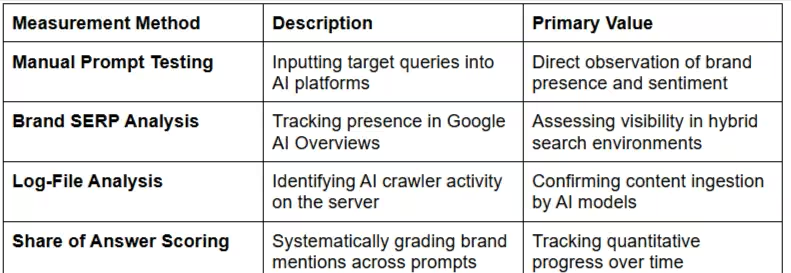
Manual Prompt Testing: The most direct method is manual testing. Regularly input relevant prompts and questions into major AI platforms (ChatGPT, Gemini, Perplexity) and analyze the responses. Is your brand mentioned? Is it cited accurately? Are your competitors appearing instead?
Brand SERP Analysis: Monitor the traditional Search Engine Results Pages for your brand name and core topics. AI-generated overviews (like Google AI Overviews) often appear at the top of these SERPs. Tracking your presence in these overviews provides a strong indicator of your AI visibility.
Tracking Referral Patterns: While direct attribution can be difficult, monitor your web analytics for shifts in referral traffic. Look for increases in direct traffic or traffic from unknown sources that correlate with the implementation of your AI visibility strategies.
Log-File Reviews: Analyze your server log files to identify visits from known AI crawlers (e.g., GPTBot, Google-Extended). This confirms that AI systems are actively crawling and ingesting your content.
Share of Answer Scoring: Develop a lightweight scoring template to track your "share of answer." Define a set of critical prompts, test them regularly across platforms, and score your brand's presence (e.g., 0 = Not mentioned, 1 = Mentioned but not cited, 2 = Cited as a primary source).
Conclusion: Formalizing Your AI Search Visibility Playbook
The shift towards AI-powered search represents a fundamental change in how users discover information and interact with brands. Achieving AI search visibility requires a strategic departure from traditional SEO tactics. It demands an entity-first approach, where content is structured for machine understanding, grounded in verifiable expertise, and supported by a robust technical foundation.
By adopting answer-friendly formats, implementing comprehensive structured data, and actively managing both onsite and offsite trust signals, brands can position themselves as authoritative sources within AI knowledge graphs. Measurement, while challenging, must be approached systematically through prompt testing, SERP analysis, and share-of-answer tracking.
The mandate for modern marketing teams is clear: treat every key page as a precise, citable reference that a machine can confidently understand and attribute. We encourage you to formalize an AI-search playbook and pilot these improvements on one specific topic cluster this quarter. By taking proactive steps today, you can ensure your brand remains visible, relevant, and trusted in the AI-driven future.
Frequently Asked Questions (FAQs): AI Search Visibility
What is AI search visibility and why does it matter?
AI search visibility is the measure of how often and how accurately your brand is mentioned or cited in responses generated by AI-powered answer engines like ChatGPT, Gemini, and Perplexity. It matters because users are increasingly relying on these systems for direct answers rather than browsing traditional search results, making AI visibility critical for brand recall and customer consideration.
How do AI answer engines choose which sources to cite?
AI answer engines prioritize sources that demonstrate strong topical authority, factual accuracy, and clear entity definitions. They favor content that is well-structured, easy to parse, and backed by strong E-E-A-T (Expertise, Experience, Authority, and Trust) signals, such as transparent sourcing and authoritative authorship.
Does structured data really help with AI-generated answers?
Yes, structured data is essential. Using schema markup (like JSON-LD) provides explicit, machine-readable clues about the context and meaning of your content. This helps AI systems accurately identify entities, understand relationships, and extract specific answers, thereby increasing the likelihood of your content being cited.
Should brands allow AI agents to crawl their sites?
Allowing AI agents to crawl your site is generally recommended if you want your content to be included in their knowledge bases and cited in their answers. However, brands should carefully review the terms of service and use their robots.txt file to manage which specific agents are permitted and which sections of the site they can access.
How can I measure whether my content appears in AI answers?
Measurement involves a combination of manual prompt testing across major AI platforms, tracking your brand's presence in traditional SERP AI overviews, analyzing server log files for AI crawler activity, and developing a "share of answer" scoring system to track your visibility for specific target queries over time.
How often should I update content for AI search visibility?
Content should be updated regularly to ensure factual accuracy and timeliness, as AI systems favor up-to-date information. Implement a consistent editorial governance process that includes regular reviews, fact-checking, and the clear display of "last updated" timestamps on your articles.
Are backlinks still relevant for AI-driven discovery?
Yes, but their role is evolving. High-quality editorial links and citations from authoritative sources still serve as strong offsite signals that reinforce your brand's entity presence and topical authority within the AI's knowledge graph.
Can new or smaller brands gain AI search visibility without a large link profile?
Absolutely. Because AI systems prioritize context, structure, and direct answerability, smaller brands can compete by creating highly focused, entity-driven content, utilizing clear structured data, and providing the most concise, accurate answers to specific user queries.
At first, we weren’t even thinking about AI visibility. We were focused on rankings and traffic like everyone else. But once we started testing our brand in ChatGPT and other AI tools, we realized we were barely showing up — even for topics we ‘ranked’ for. Gryffin gave us a clear picture of where we stood, how competitors were being cited instead, and what that actually meant for our pipeline. It shifted how we think about search entirely.









.webp)