How to Run an AI SEO Audit for AI Search Visibility
Marcela De Vivo
Marcela De Vivo
June 16, 2026
12 min read
The landscape of search is undergoing a fundamental transformation. As generative AI engines become the primary discovery mechanism for users, the traditional rules of search engine optimization are no longer sufficient. AI-assisted search changes technical SEO priorities, shifting the focus from simply ranking on a page to ensuring that your content can be seamlessly ingested, understood, and cited by Large Language Models (LLMs). This necessitates a new approach: the AI SEO audit.
The purpose of an AI SEO audit is to ensure your brand's digital presence is fully optimized for this new era. It sets specific expectations for your technical infrastructure, diagnosing AI crawler access, verifying technical accessibility, mapping long-tail "fan-out" queries, and tracking new Key Performance Indicators (KPIs). By conducting a comprehensive AI SEO audit, you can ensure that your brand is not just visible, but authoritative and citable in the age of generative search. If you want to understand how your brand currently appears in AI-generated answers, start with measuring your AI visibility as a baseline before diving into the technical audit.
What is Actually Happening on Your Site: Fan-Out, Phantom Impressions, and Longer Queries
The shift toward AI search introduces complex new behaviors in how users interact with information. One of the most significant phenomena is "fan-out." When a user inputs a complex prompt into an AI engine, the model decomposes that prompt into many sub-queries to gather the necessary context. This results in a surge of highly specific, long-tail queries that traditional SEO tools might struggle to categorize. To keep pace with these signals, many teams are turning to an AI Search Tracker to monitor how these complex queries are forming and where their brand fits into the narrative.
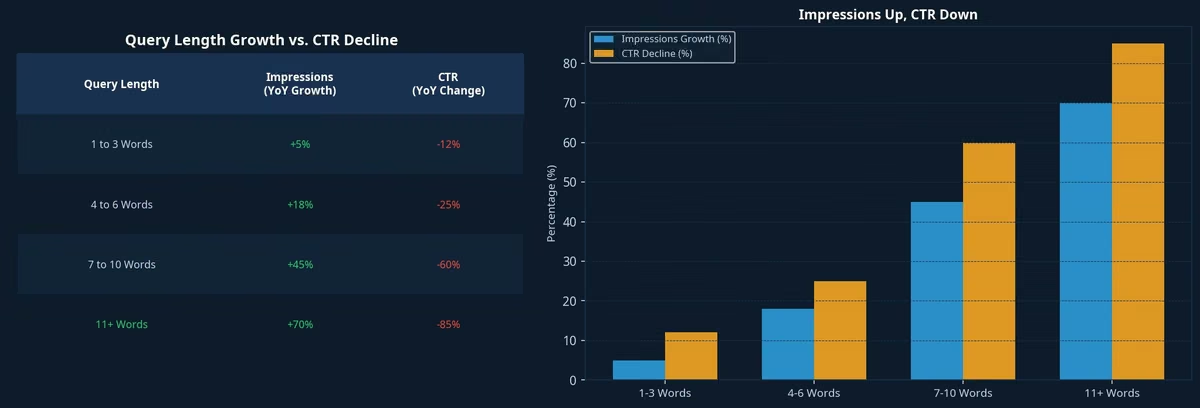
Alongside fan-out, marketers are increasingly observing "phantom impressions." These are instances where your content appears in search results or AI summaries, generating impressions, but yielding minimal direct clicks to your website. If you analyze your Google Search Console (GSC) data, you will likely see a rising trend of 7 to 10 word queries that have high impressions but an exceptionally low Click-Through Rate (CTR). This occurs because machines are reading and extracting information directly to answer the user's prompt without needing to send traffic to the source.
Data represents anonymized industry patterns illustrating the rise of phantom impressions in AI search.
This data highlights a critical reality: visibility no longer guarantees traffic. Your content can be read, cited, and used to answer a user's question without that user ever landing on your site. Understanding this dynamic is the first step toward building a strategy that accounts for it. To track how these patterns evolve over time, teams need dedicated AI visibility metrics that go beyond standard organic traffic reporting.
What an AI SEO Audit Covers and How It Differs from a Traditional Audit
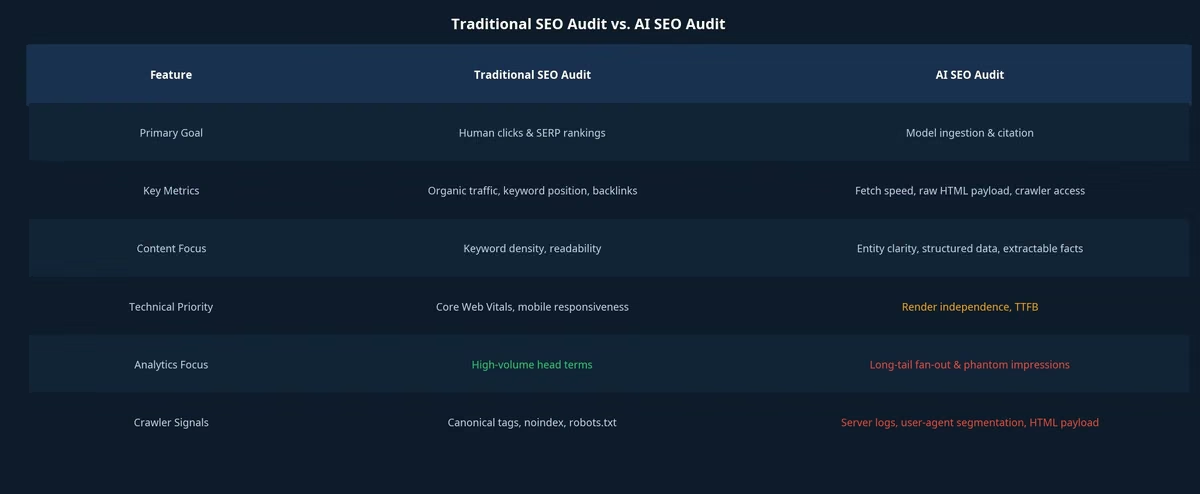
Understanding the distinction between a classic SEO audit and an AI SEO audit is crucial for modern marketing success. A traditional audit centers on rankings, backlinks, and optimizing for human clicks. It prioritizes keyword density, meta tags, and ensuring that pages look good to a human reader. An AI SEO audit operates on an entirely different set of assumptions.
In contrast, an AI SEO audit is a deeply technical process focused on crawler reach, fetch speed, render independence, and answer extraction. It is designed to ensure that the machines building the answers can access your data efficiently. The AI SEO audit rests on three core pillars: Access (ensuring that the specific user-agents associated with AI training and real-time search can reach your content without being blocked or throttled), Structure (verifying that your site architecture allows for deep crawling and that essential information is available in the raw HTML payload), and Answers (structuring your content so that facts, data points, and entity relationships can be easily parsed and extracted by an LLM).
By transitioning from a mindset of human engagement to machine readability, you can begin to optimize your site for the future of search. This is not a replacement for traditional SEO; it is an extension of it. The teams that move fastest are those already using AI for SEO data optimization to automate the diagnostic layer of this work.
How Do You Segment AI Bot Activity in Server Logs?
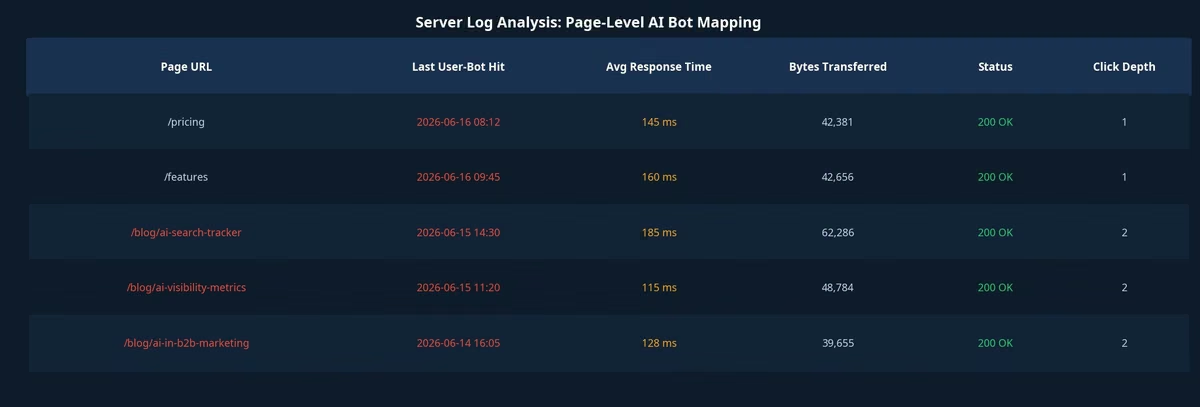
The first diagnostic step in any AI SEO audit is analyzing your server logs. Unlike traditional analytics platforms that rely on JavaScript execution (which many AI bots skip), server logs provide the unvarnished truth about exactly who, or what, is requesting your files. To understand your AI visibility, you must pull your server logs and segment the traffic by user-agent families. It is vital to distinguish between bots used for foundational model training, bots used for real-time search retrieval, and user-initiated bots.
Why does this segmentation matter? Because training visits do not equate to immediate visibility. A model might ingest your entire site during a training run, but that does not mean it will cite you in a live answer. Conversely, user-initiated visits, where an AI agent fetches a page in real-time to answer a specific user prompt, are the closest proxy we have to actual AI impressions. When segmenting, it is also important to verify hostnames and rate patterns to reduce "spoof noise," which refers to malicious actors pretending to be legitimate AI crawlers.
By analyzing these metrics, you can identify bottlenecks and ensure that your most critical pages are being crawled efficiently. This level of analysis is foundational to any serious AI brand visibility tracking program. Pages that are slow to respond, blocked by misconfigured directives, or buried at deep click depths are effectively invisible to the AI agents that matter most.
How Can You Validate the Technical Accessibility of Deep Pages?
AI engines thrive on specificity. When a user asks a complex question, the AI looks for the most detailed, authoritative source available. This means you must audit the pages most likely to answer specific questions: deep product specifications, technical documentation, and comprehensive FAQs. Validating the technical accessibility of these deep pages requires checking several key factors.
The HTML Payload Size must be lightweight and focused on content, rather than bloated with unnecessary scripts. Your server Time to First Byte (TTFB) should be under 200 milliseconds. AI agents operate under strict latency constraints; if your server is slow to respond, the agent will abandon the fetch and move to a faster competitor. Render Independence is equally critical: verify that key content exists in the raw HTML, because many AI crawlers do not execute JavaScript. If your facts are hidden behind a client-side render, they are invisible to the machine. Critical pages should also be no more than four clicks away from the homepage, and interaction blocks like accordions or "view more" buttons that require user interaction to reveal text should be removed entirely.
Emphasize server-side rendering (SSR) or prerendered HTML for your most critical content to ensure that facts are immediately available upon request. If you need help automating these checks, consider utilizing an AI-powered marketing automation platform that can run these diagnostics at scale. The goal is to ensure that every page your brand wants to be cited from can be fetched, read, and understood in a single, fast, clean request.
What Directives Matter for Robots.txt, Sitemaps, and Access Governance?
Controlling how AI crawlers access your site requires a nuanced approach to governance. You must review your robots.txt directives with AI access in mind, ensuring that you are not inadvertently blocking the very agents you want to cite your work. Keep your discovery sitemaps accurate and tightly scoped to your highest-value pages. It is important to explain to your development team that classic SEO signals like canonical tags or noindex directives are not necessarily decision signals for LLM crawlers. These bots do not build classic indexes in the way Googlebot does; they ingest data to build relationships.
The practical reality is that many AI crawlers do not execute JavaScript, and some user-initiated agents may not consistently follow every directive in your robots.txt file. Therefore, you must adopt a "safe-by-default" governance approach. Test representative URLs and monitor actual bot behavior in your logs to ensure compliance. Explicitly allow known, beneficial AI search agents to crawl your informational directories. If you wish to prevent your data from being used for foundational training without compensation, you can disallow specific training user-agents, though this requires constant updating as new bots emerge. Ensure your XML sitemaps only include 200 OK pages that are rich in extractable facts.
By actively managing your access governance, you can guide AI agents toward your most valuable content. For broader strategies on managing your brand's presence in AI-generated results, review our AI Visibility Platform Guide. Teams that take a proactive governance stance are significantly better positioned to control their narrative in AI-generated answers than those who rely on default configurations.
How Do You Map and Prioritize Phantom Impressions and Fan-Out Opportunities?
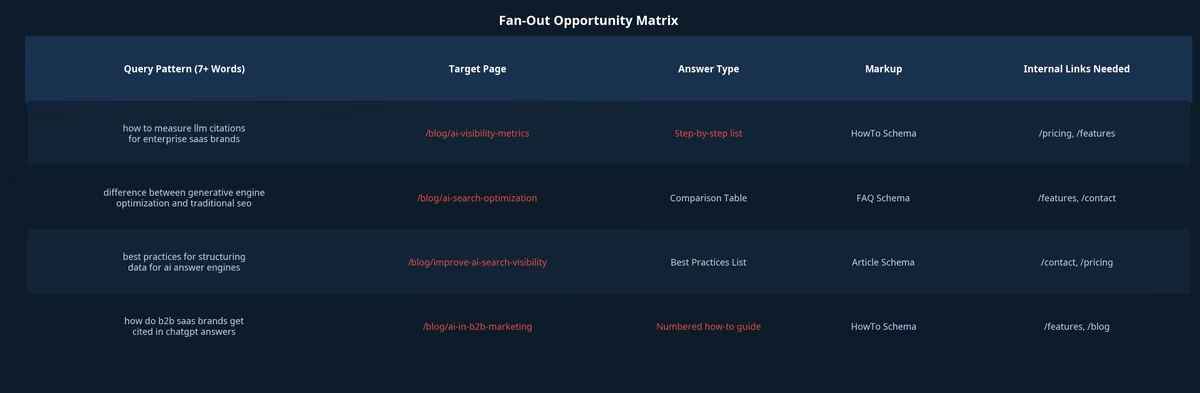
One of the most valuable deliverables of an AI SEO audit is the identification of fan-out opportunities. By using GSC data, you can isolate long queries (7 or more words) that generate impressions but zero clicks. These phantom impressions are the breadcrumbs left behind by AI models probing your topical authority. Group these long-tail queries by topic clusters and map them to affected pages. This allows you to see exactly what specific sub-questions the models are trying to answer, and where your existing content is falling short of providing a complete, extractable response.
Turn this data into a prioritized content backlog. You need to create or revise sections on your site that answer these exact sub-questions. The answers should be formatted as concise, extractable statements, clear definitions, direct comparisons, structured specifications, and straightforward pros and cons lists. This approach is particularly powerful for AI competitor analysis, where understanding which queries your competitors are winning in AI answers can reveal significant content gaps in your own strategy.
By proactively addressing these fan-out queries, you position your brand as the definitive source for complex information. To scale this process, you might explore white label SEO software that incorporates AI analysis and can surface these opportunities across large content libraries automatically.
How Should You Structure Pages for Answer Extraction?
Once you have identified the opportunities, you must translate those findings into page patterns that AI can easily parse. This means moving away from chasing keywords and focusing on structuring content for extraction. Your pages should feature scannable H2 and H3 headers that mirror common prompt types such as list, compare, define, and how-to. Immediately following these headers, provide short "answer capsules" near the top of the section. These are concise, factual summaries that an LLM can easily lift and cite.
Maintain consistent units and specifications across your site, and utilize clean, well-formatted tables for data comparisons. Add structured data such as Product, HowTo, and FAQ schema where appropriate to clarify entities and their relationships. Ensure that deep, informational pages are linked contextually within 3 to 4 clicks from high-authority pages. Remember that interactivity should not gate essential facts. If a user has to click a tab to read a product specification, the AI crawler will likely miss it entirely. Focus on building an entity-first content strategy to maximize your extractability, and consider how your AI search visibility improvements compound over time as more of your structured content gets ingested and cited.
This structural discipline also supports your broader AI sales funnel visibility strategy. When the pages that represent your product's value proposition are structured for extraction, AI engines are more likely to surface them in response to high-intent queries from buyers who are actively evaluating solutions.
What is the New KPI for Technical Accessibility and Ongoing Governance?
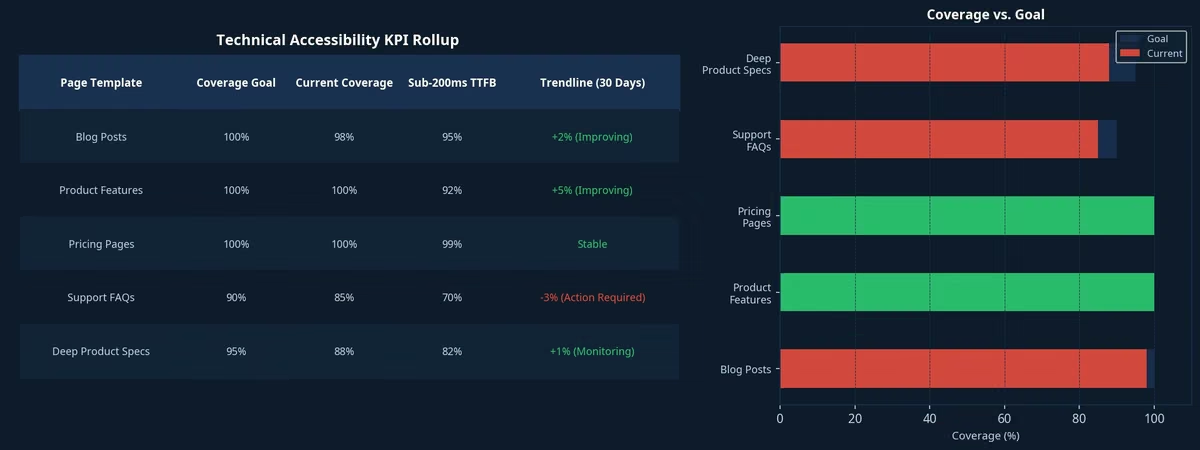
To truly measure the success of your AI SEO audit, you need a new KPI that reflects AI visibility: Technical Accessibility. This metric is defined as the share of priority deep URLs that AI user bots can fetch in under 200 milliseconds, with all required content present in the raw HTML. You should track this metric by page template and site section, and report on it with the same rigor you apply to traditional organic traffic metrics.
Supporting indicators for this KPI include median TTFB across the site, average bytes transferred per page, user-bot coverage by click depth, and changes in long-query phantom impressions. Together, these metrics tell a complete story about how accessible your site is to the AI agents that are increasingly driving brand discovery. For B2B SaaS brands in particular, this kind of measurement discipline is becoming a competitive differentiator, as explored in our analysis of AI in B2B marketing.
To maintain this performance, you must establish a strict monitoring cadence. This includes monthly log segmentation, quarterly robots.txt reviews, ongoing GSC long-query analysis, and continuous Core Web Vitals tracking. Set alert thresholds for access drops, latency regressions, sitemap errors, and falling user-bot coverage. Document your change management processes carefully so that navigation updates or rendering shifts do not unintentionally hide critical content from AI agents. By treating AI agents as a first-class audience for technical accessibility, you ensure that when machines can reliably read your deepest facts quickly, humans benefit too.
Embracing the Mindset Shift for Technical SEO in the Age of AI Search
The transition to AI-assisted search requires a fundamental reframing of technical SEO. AI search rewards sites that are fast to fetch, shallow to reach, and explicit in their answers. The days of relying solely on keyword density and backlinks are fading. Server logs are the new starting point for understanding visibility. The AI SEO audit operationalizes access, structure, and extraction, providing a clear roadmap for the future.
By focusing on how machines ingest and process your data, you can build a robust, future-proof digital presence. The brands that invest in this technical foundation now will be the ones that AI engines cite most frequently as the landscape continues to evolve. If you are looking to integrate these strategies into your broader marketing efforts, consider how the full suite of Gryffin features can support your AI visibility program from audit through to ongoing measurement and optimization.
Frequently Asked Questions About AI SEO Audits
What is an AI SEO audit and how does it help my brand?
An AI SEO audit is a specialized technical review focused on ensuring your website's content can be efficiently crawled, understood, and extracted by Large Language Models (LLMs) and AI search engines. It helps your brand by diagnosing crawler access issues, verifying that essential facts are in the raw HTML, and optimizing your site structure so AI agents can easily cite your information in their generated answers.
How can I confirm whether AI bots are actually crawling my site?
The most reliable way to confirm AI bot activity is through server log analysis. By segmenting your server logs by specific user-agent families associated with AI training and search retrieval, you can see exactly which bots are requesting your pages, how often, and what status codes they are receiving. This provides a much clearer picture than standard JavaScript-based analytics.
Do AI crawlers strictly follow robots.txt and sitemaps?
While many reputable AI crawlers attempt to follow robots.txt directives, compliance is not universal. Some user-initiated agents or newer bots may not consistently adhere to every rule. Similarly, while sitemaps help guide discovery, AI bots do not build traditional indexes, so classic signals like canonical tags or noindex directives may not influence them in the same way they influence traditional search engines. A safe-by-default governance approach is recommended.
Why are long, specific queries rising in impressions but not generating clicks?
This phenomenon, often called "phantom impressions," occurs because of "fan-out." When users ask complex questions, AI engines break them down into many long, specific sub-queries to gather facts. The AI reads your content to construct an answer directly on the search results page. Your site registers the impression for providing the data, but the user gets their answer without needing to click through to your website.
How deep should critical pages be in my website's internal link structure?
To ensure maximum visibility for AI crawlers, critical pages should be no more than four clicks away from your homepage. Deeply buried pages are harder for bots to discover and fetch quickly. A shallow, well-organized site architecture ensures that your most important facts and specifications are readily accessible to AI agents.
Does client-side JavaScript rendering affect my AI search visibility?
Yes, significantly. Many AI crawlers do not execute JavaScript to save on processing power and reduce latency. If your essential content, facts, or data tables are only loaded via client-side JavaScript, they may be completely invisible to the AI. It is crucial to use server-side rendering (SSR) or ensure that key information is present in the raw HTML payload.
Should I use canonical tags or noindex directives to control AI crawler access?
Canonical tags and noindex directives were designed for traditional search engine indexing and are not reliable decision signals for LLM crawlers. Because AI bots ingest data to understand entity relationships rather than building a classic index of URLs, they may still process content marked with a noindex tag. To truly control access, you must use robots.txt directives or server-level blocking based on user-agents.
What is a reasonable Time to First Byte (TTFB) target for AI agents?
You should aim for a server Time to First Byte (TTFB) of under 200 milliseconds. AI search agents operate under strict latency constraints to provide real-time answers to users. If your server is slow to respond, the bot is likely to abandon the request and extract the necessary information from a faster competitor's site instead.
At first, we weren’t even thinking about AI visibility. We were focused on rankings and traffic like everyone else. But once we started testing our brand in ChatGPT and other AI tools, we realized we were barely showing up — even for topics we ‘ranked’ for. Gryffin gave us a clear picture of where we stood, how competitors were being cited instead, and what that actually meant for our pipeline. It shifted how we think about search entirely.












.webp)