LLM SEO Strategies: An Actionable Framework for AI Search Visibility
Marcela De Vivo
Marcela De Vivo
June 16, 2026
14
The rules of search visibility are being rewritten. For years, the path to organic discovery ran through a familiar set of levers: keyword density, backlink profiles, title tag optimization, and page speed. Those signals still matter for traditional search results, but a new and increasingly dominant discovery surface has emerged that operates on an entirely different logic. Large language models powering conversational AI assistants now synthesize answers from the web and deliver them directly to users, often without a single click to a source page. If your brand is not part of that synthesis, you are invisible to a growing share of your most valuable audience.
This shift demands a new framework. AI search optimization is no longer a niche concern for early adopters; it is a core competency for any marketing team that wants to remain competitive. The strategies that earn visibility in AI-generated answers are meaningfully different from those that drive rankings in a traditional results page, and understanding that distinction is the starting point for everything that follows in this guide.
What follows is a practical, cohesive framework for earning and sustaining brand visibility, accuracy, and attribution in the AI-driven search landscape. It covers the full arc from understanding how LLMs construct answers, through the technical and content work required to become a citable source, to the measurement systems that let you track progress over time. Each section builds on the last, because LLM SEO is not a checklist of isolated tactics. It is an integrated discipline that rewards teams who approach it systematically.
What Are the Most Effective LLM SEO Strategies for Earning Visibility in AI-Driven Search?
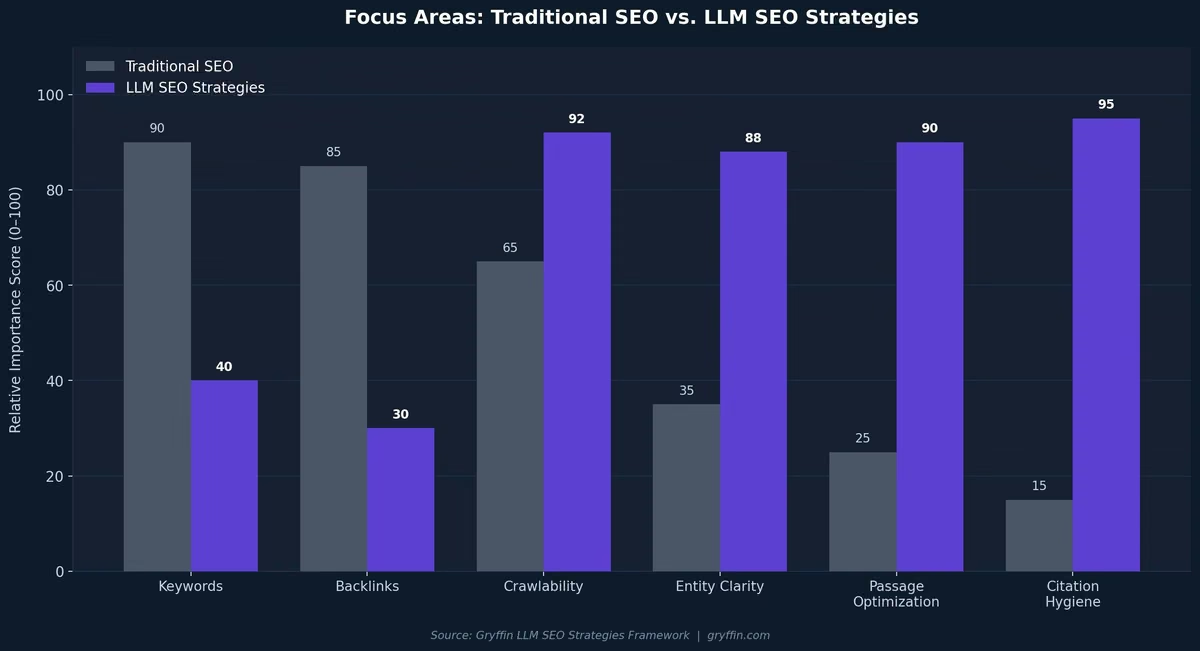
To answer that question well, you first need to understand what you are actually optimizing for. Traditional SEO optimizes for a ranked list of blue links. LLM SEO optimizes for inclusion in a synthesized, conversational answer. The mechanism of retrieval is different, the signals that confer trust are different, and the content formats that perform best are different. The chart below illustrates how the relative importance of key optimization factors shifts between the two paradigms.
Figure 1: Focus Areas - Traditional SEO vs. LLM SEO Strategies. Citation hygiene and passage optimization score highest in the LLM era, while keyword density and raw backlink volume decline in relative importance.
When a user submits a query to an AI assistant, the system does not simply retrieve the highest-ranking page and summarize it. It runs a multi-stage process: first retrieving a broad set of potentially relevant passages from its training data or a live retrieval index, then re-ranking those passages by relevance and credibility, and finally synthesizing a coherent answer that may draw from dozens of sources simultaneously. Your content needs to be accessible at the retrieval stage, credible enough to survive the re-ranking stage, and structured clearly enough to be quoted accurately at the synthesis stage. Failing at any one of these stages means your brand does not appear in the final answer, regardless of how well your pages rank in traditional search.
The most effective LLM SEO strategies, therefore, are not about any single tactic. They are about building a content and technical infrastructure that performs well at every stage of that pipeline. That infrastructure has six interconnected pillars: technical access, entity clarity, content architecture, authority signals, freshness, and measurement. The sections that follow address each pillar in depth, showing how they connect and how to prioritize your work across them.
How to Audit Your Current Representation in AI Answers and Identify Citation Gaps
Before you can improve your LLM SEO performance, you need an honest picture of where you stand today. Most marketing teams have no systematic view of how their brand appears in AI-generated answers, which means they are optimizing blind. A structured audit changes that by giving you a baseline against which to measure progress and a prioritized list of gaps to close.
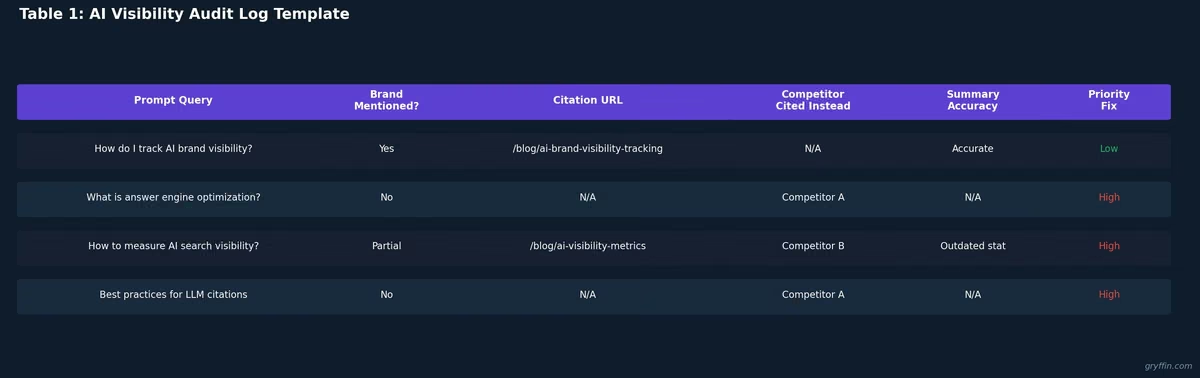
The audit process begins with building a prompt set that mirrors the queries your target audience is actually asking. These should not be keyword strings; they should be full, conversational questions of the kind a user would type into an AI assistant. For a B2B SaaS company focused on marketing technology, that might include questions like "What tools do marketers use to track AI search visibility?" or "How do I measure my brand's presence in AI-generated answers?" Run each prompt through the major AI answer engines and log the results systematically. The table below shows the structure of an effective audit log.
Table 1: AI Visibility Audit Log Template. Log each prompt, whether your brand was cited, which URL was referenced, and whether a competitor appeared instead.
A systematic audit reveals exactly where your brand is missing from AI-generated answers and which topic clusters represent the highest-priority gaps to close.
Once you have logged results across your full prompt set, you can begin to identify patterns. Are you being cited for some topic clusters but not others? Are competitors consistently appearing in answers where you are absent? Is your brand mentioned but the summary is inaccurate or outdated? Each of these patterns points to a different root cause and a different remediation strategy. Gaps in topic coverage point to content creation needs. Competitor displacement often points to authority and citation signal deficits. Inaccurate summaries typically point to structured data and entity clarity issues. The AI search tracker framework helps you run this audit at scale and maintain it as an ongoing monitoring practice rather than a one-time exercise.
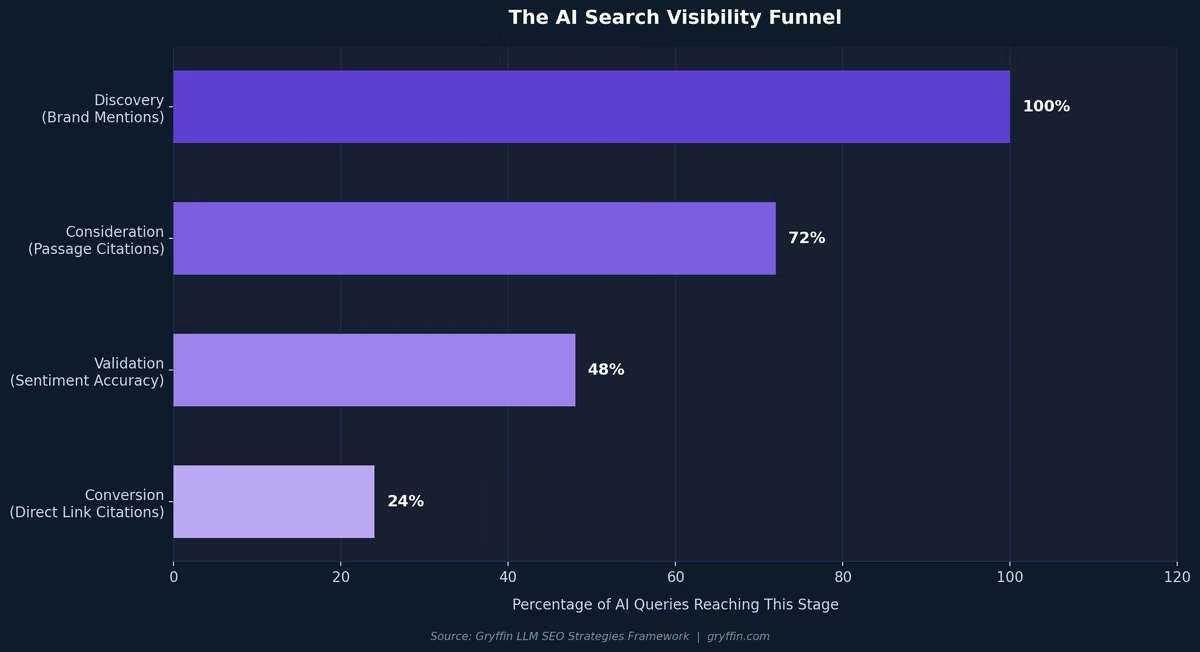
Understanding the AI search visibility funnel is essential context for interpreting your audit results. Not every query type represents the same opportunity, and not every stage of the funnel requires the same intervention.
Figure 2: The AI Search Visibility Funnel. Brands that earn discovery-level mentions must then work to convert those mentions into passage citations, accurate sentiment, and ultimately direct link attribution.
The funnel illustrates a critical insight: broad brand mentions are far more common than direct link citations. Most brands that appear in AI answers do so at the discovery level, where the model references the brand by name without necessarily linking to a specific page. Moving down the funnel toward passage-level citation and direct link attribution requires progressively more sophisticated optimization work. Your audit should tell you at which stage of this funnel your brand currently operates, so you can focus your energy on the right interventions. Tools built for AI brand visibility tracking make it possible to monitor all four funnel stages simultaneously and spot regression before it compounds.
Why Technical Access Is the Non-Negotiable Foundation of LLM SEO Strategies
Every other optimization effort in this guide is contingent on one prerequisite: AI crawlers must be able to access and index your content. This sounds obvious, but a surprising number of sites inadvertently block the crawlers that AI systems use to retrieve and index content. If your pages are not accessible, no amount of structured data, content engineering, or authority building will help, because the model simply cannot see your content.
The first step is auditing your robots.txt file for rules that might block AI-specific user agents. The major AI systems use their own crawlers, and blanket disallow rules that were originally written to block scrapers may be catching these crawlers as collateral damage. Review your directives carefully and ensure that you are not inadvertently excluding the crawlers you want to reach. Beyond robots.txt, check that your server returns clean 200 status codes for your priority pages, that JavaScript-rendered content is accessible to non-browser crawlers, and that your page load times are within acceptable ranges. A technical SEO audit that specifically accounts for AI crawler behavior is the most efficient way to surface these issues systematically.
Crawlability is necessary but not sufficient. Once a crawler can access your content, it needs to be able to understand the structure of your pages. Clean, semantic HTML with logical heading hierarchies, clearly delineated main content areas, and minimal extraneous markup makes it significantly easier for retrieval systems to identify and extract the most relevant passages from your pages. Pages that rely heavily on JavaScript for content rendering, that bury key information in modals or accordions, or that mix navigation and advertising content with editorial content create friction at the retrieval stage that reduces the likelihood of accurate citation.
How Structured Data and Entity SEO Teach AI Models What Your Pages Mean
Once your pages are technically accessible, the next layer of the framework is helping AI models understand not just what your content says, but what it means and who it comes from. This is the domain of structured data and entity SEO, two disciplines that have always been important for traditional search but that take on heightened significance in the LLM era.
Entity SEO and structured data work together to build a machine-readable knowledge graph that AI models can use to understand your brand, your expertise, and the relationships between your content.
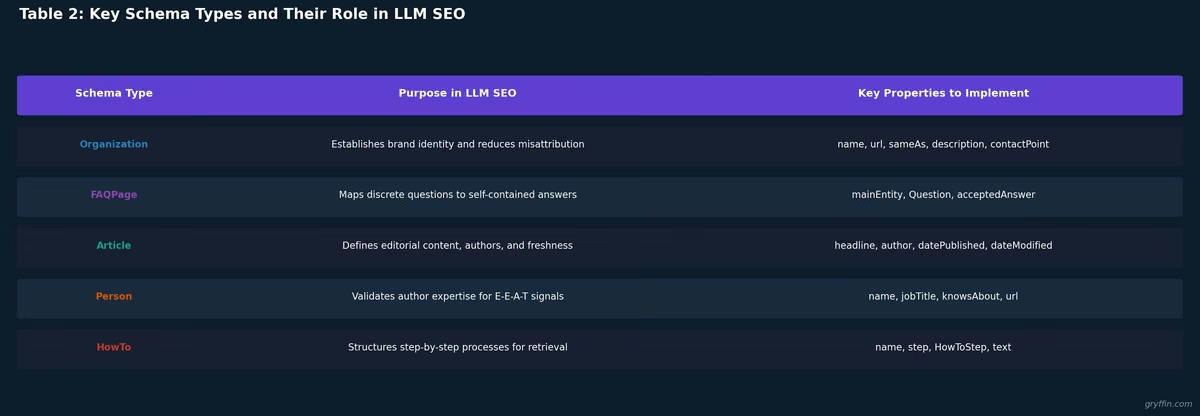
Schema markup is the most direct way to communicate structured information to AI systems. By implementing JSON-LD schema on your pages, you provide machine-readable metadata that tells retrieval systems exactly what type of content a page contains, who authored it, when it was published, and what entities it discusses. The table below summarizes the five schema types that have the highest impact on LLM SEO performance and the specific properties that matter most for each.
Table 2: Key Schema Types and Their Role in LLM SEO. Each schema type serves a distinct purpose in helping AI models understand and accurately represent your content.
Entity SEO extends beyond schema markup to encompass the broader project of establishing your brand, your people, and your products as well-defined, consistently referenced entities across the web. AI models build their understanding of the world from patterns of co-occurrence and cross-reference across massive corpora of text. When your brand name, your key executives, and your core product offerings are consistently described in the same terms across your own site, your social profiles, industry publications, and third-party directories, the model develops a coherent, stable representation of your entity that it can draw on accurately when constructing answers.
The practical implication is that entity consistency is as important as entity presence. A brand that is described differently across different contexts, that uses inconsistent terminology for its products, or whose key personnel are not clearly associated with the organization in publicly accessible content will be represented less accurately and less confidently in AI-generated answers. Auditing your entity footprint and standardizing your descriptions across all touchpoints is foundational work that pays dividends across every other element of your LLM SEO strategy. The generative engine optimization framework provides a useful lens for thinking about entity consistency at scale.
How to Engineer Content Architecture That Makes Answers Easy for AI to Quote
With technical access established and entity clarity in place, the next pillar is content architecture. This is where many teams have the most room for improvement, because the content formats that perform best in AI-generated answers are often meaningfully different from the formats that have historically performed well in traditional search.
Content engineered for LLM SEO contains self-contained, quotable passages that AI systems can extract and incorporate into synthesized answers without losing accuracy or context.
The core principle of LLM-optimized content architecture is passage-level self-containment. AI retrieval systems often operate at the passage level rather than the page level, extracting specific paragraphs or sections that directly answer a query rather than summarizing an entire document. A passage that can stand alone as a complete, accurate answer to a specific question is far more likely to be cited than a passage that requires the surrounding context of the full article to be understood correctly.
This has practical implications for how you structure your content. Each major section of an article or guide should open with a clear, direct statement of the key point it addresses. Definitions should be explicit and self-contained. Claims should be supported by specific data points or citations within the same passage, not by reference to earlier sections. The use of numbered lists and structured comparisons makes it easier for retrieval systems to identify discrete, quotable units of information. Optimizing for AI featured snippets and passage-level retrieval are closely related disciplines, and the content techniques that work for one tend to reinforce the other.
Beyond individual passage structure, your overall content architecture should reflect a hub-and-spoke model organized around the topic clusters that matter most to your audience. A comprehensive pillar page that addresses a broad topic at depth, supported by a constellation of more specific supporting articles that each address a narrower aspect of the same topic, creates a content graph that AI models can navigate to build a comprehensive understanding of your brand's expertise. The semantic SEO principles that underpin this architecture have become even more important in the LLM era, because AI models reward depth and topical coherence in ways that keyword-focused content strategies cannot replicate.
The language of your content also matters at a granular level. Passages that use precise, unambiguous language, that define technical terms explicitly, and that avoid idiomatic expressions or culturally specific references that might be misinterpreted tend to be quoted more accurately. Writing in a style that is clear, direct, and evidence-based is not just good editorial practice; it is a meaningful LLM SEO signal. The generative search optimization writing framework offers detailed guidance on the specific language patterns that perform best in AI retrieval contexts.
How to Build the Authority and Citation Signals That LLMs Actually Trust
The fourth pillar of the framework addresses the question of credibility. AI models do not treat all sources equally. They weight content from sources that demonstrate consistent expertise, that are frequently cited by other authoritative sources, and that have a track record of accuracy. Building these authority signals is a longer-term investment than technical optimization or content architecture, but it is ultimately what determines whether your brand appears in answers to the most competitive and high-value queries.
Authority in the LLM era is built through a network of editorial citations, expert mentions, and cross-platform entity references that collectively signal credibility to AI retrieval systems.
The E-E-A-T framework, which stands for Experience, Expertise, Authoritativeness, and Trustworthiness, provides a useful organizing structure for authority-building work in the LLM era. Experience signals come from content that demonstrates first-hand knowledge: original research, proprietary data, case studies, and documented outcomes. Expertise signals come from clearly identified authors with verifiable credentials and a consistent publication history in a defined domain. Authoritativeness signals come from third-party mentions, citations, and links from other credible sources. Trustworthiness signals come from factual accuracy, transparent sourcing, and consistent brand representation across all touchpoints.
The most impactful authority-building activities for LLM SEO are those that generate genuine third-party citations. Contributing original research or data to industry publications, participating in expert roundups and commentary pieces, earning coverage in trade media, and building a consistent presence on platforms that AI models index heavily all contribute to the citation profile that determines your brand's credibility score in retrieval systems. Conducting an AI competitor analysis to understand which sources are currently citing your competitors in AI answers is one of the most efficient ways to identify the specific publications and platforms where you need to build a presence.
It is important to emphasize that these citation signals must be earned authentically. Tactics that attempt to manufacture authority through low-quality link schemes, fabricated expert profiles, or artificially inflated citation counts are not only ineffective in the LLM era; they actively undermine the trustworthiness signals that AI models use to evaluate credibility. The brands that will win in AI-driven search over the long term are those that invest in genuine expertise, produce original research, and earn citations through the quality of their contributions to their field. Tracking how these efforts translate into AI visibility over time is made significantly more tractable by tracking AI brand sentiment in LLMs as a dedicated measurement practice.
Why Content Freshness and Update Signals Are Critical for Staying Included in AI Answers
The fifth pillar addresses a challenge that many teams underestimate: the ongoing maintenance of content that has already earned AI visibility. AI models are not static; they are updated, fine-tuned, and augmented with new retrieval data on a continuous basis. Content that was accurate and well-cited six months ago may be displaced by newer, more current sources if it is not actively maintained. In fast-moving categories like AI, marketing technology, and digital strategy, the half-life of specific claims, statistics, and recommendations can be surprisingly short.
A systematic content refresh program is therefore not optional for teams serious about LLM SEO. Priority pages, defined as those that address the topic clusters most central to your brand's expertise and most frequently queried by your target audience, should be reviewed on a quarterly basis at minimum. Reviews should check for outdated statistics, superseded recommendations, and claims that are no longer accurate given changes in the market or the technology. When updates are made, they should be substantive enough to trigger a meaningful change in the page's content hash, and the dateModified property in your Article schema should be updated to reflect the change.
Beyond scheduled reviews, teams should monitor for trigger events that warrant an immediate content update: major product launches, significant market developments, new research findings, or changes in the competitive landscape. A content governance calendar that maps trigger events to specific pages and assigns clear ownership for the update process is the operational infrastructure that makes freshness management sustainable at scale. The AI-informed approach to algorithm and model updates provides a useful framework for building this kind of proactive monitoring into your editorial workflow.
What Metrics Should You Use to Measure Success in an Answer-First Landscape
The sixth pillar is measurement, and it requires a fundamental rethinking of the KPIs that marketing teams have traditionally used to evaluate search performance. Organic click-through rate, average position, and impressions in traditional search results are not meaningful proxies for AI search visibility. A brand can be cited in hundreds of AI-generated answers and receive zero clicks to its website, because the user's question was fully answered by the AI without requiring them to visit a source. Conversely, a brand can maintain strong traditional search rankings while being completely absent from AI-generated answers on the same topics.
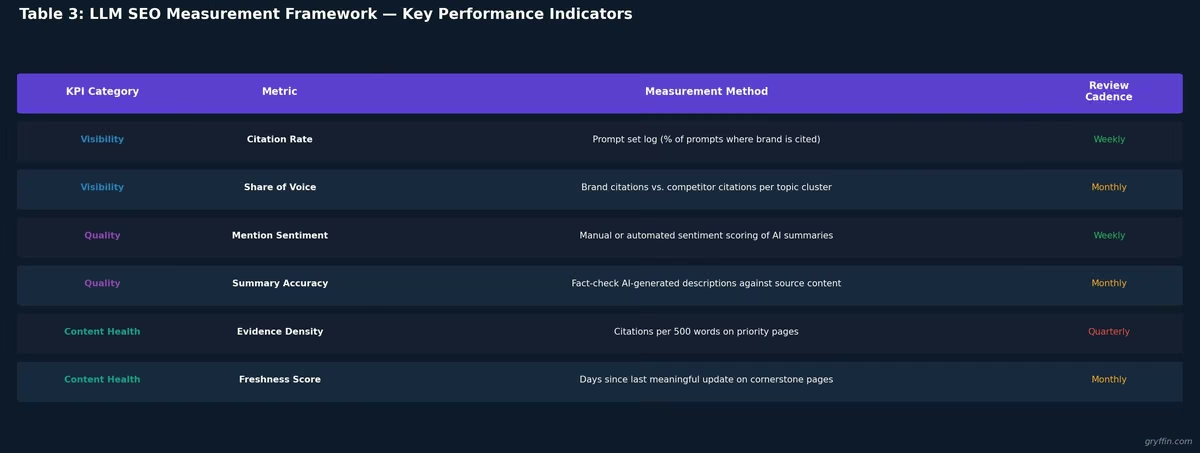
Table 3: LLM SEO Measurement Framework. A complete measurement system tracks visibility, quality, and content health metrics across weekly, monthly, and quarterly review cadences.
The measurement framework above defines six core KPIs organized across three categories: visibility, quality, and content health. Citation Rate and Share of Voice measure the breadth and competitive standing of your AI presence. Mention Sentiment and Summary Accuracy measure whether your brand is being represented correctly and favorably. Evidence Density and Freshness Score measure the underlying content health that sustains AI visibility over time. Together, these six metrics provide a comprehensive view of your LLM SEO performance that no single traditional metric can replicate.
Implementing this measurement framework requires a structured prompt testing protocol. Select a representative set of 20 to 50 prompts that cover your priority topic clusters, run them against the major AI answer engines on a regular cadence, and log the results in a format that allows you to track trends over time. The AI visibility metrics framework provides detailed guidance on how to design this protocol and how to interpret the results in the context of your broader marketing strategy. The AI visibility measurement tools available through Gryffin make it possible to automate much of this data collection and surface insights in a dashboard that your team can act on without manual data wrangling.
How to Establish Governance and Risk Management for AI-Era Content Teams
As your LLM SEO program matures, the operational and governance questions become as important as the technical and content questions. A team that has built strong AI visibility has also built a reputational asset that needs to be protected. AI-generated answers that misrepresent your brand, attribute incorrect claims to your content, or surface outdated information can cause real damage to customer trust, and the mechanisms for correcting these errors are less direct than the mechanisms for correcting a traditional search result.
Effective governance for AI-era content teams starts with clear ownership. Every piece of content that is part of your LLM SEO strategy should have a designated owner who is responsible for its accuracy, its freshness, and its alignment with current brand positioning. That owner should be notified when the content is cited in AI answers, so they can verify that the citation is accurate and flag any discrepancies for remediation. Building this notification and review workflow into your content operations is the difference between a reactive and a proactive approach to AI representation quality.
Risk management in this context also means being thoughtful about the claims you make in your content. Specific statistics, product comparisons, and competitive claims are the categories most likely to be cited inaccurately or out of context by AI models. Where possible, anchor claims to primary sources that are themselves stable and authoritative. Avoid making claims that are highly time-sensitive without including explicit date context. And build a regular audit of your AI citations into your content governance calendar, so that inaccuracies are caught and corrected before they propagate further into the model's training data. The AI visibility platform guide covers the tooling and workflow infrastructure needed to make this kind of ongoing monitoring operationally sustainable.
A 90-Day Plan to Operationalize Your LLM SEO Strategies
The framework described in this guide is comprehensive, and it can feel overwhelming to teams that are just beginning their LLM SEO journey. The most effective approach is to sequence the work deliberately, starting with the foundations that unlock the most downstream value and building progressively toward the more sophisticated elements of the program. The 90-day plan below provides a practical sequencing that has worked well for marketing teams at various stages of AI search maturity.
In the first 30 days, the focus should be entirely on foundations. Run the technical access audit and resolve any crawlability issues. Implement Organization and Article schema on your highest-priority pages. Conduct the AI visibility audit using a representative prompt set and establish your baseline metrics. Identify your top three to five topic clusters where citation gaps are most significant. This phase is about getting a clear picture of where you are and ensuring that the technical prerequisites for everything else are in place.
In days 31 through 60, shift focus to content and entity work. Rewrite your top five to ten priority pages with passage-level self-containment in mind. Standardize your entity descriptions across your own site and your major third-party profiles. Begin the authority-building work by identifying two or three industry publications where you can contribute original research or expert commentary. Implement FAQPage schema on pages that address common audience questions. This phase is about building the content and entity infrastructure that AI models need to represent you accurately and confidently.
In days 61 through 90, focus on authority amplification and measurement infrastructure. Publish your first original research piece and distribute it to the publications you identified in the previous phase. Set up your prompt testing protocol and begin tracking your six core KPIs on the cadences defined in the measurement framework. Establish your content governance calendar with quarterly review dates for all priority pages. Brief your content team on the passage-level writing principles and begin applying them to all new content production. By the end of this phase, you should have a functioning LLM SEO program with clear metrics, clear ownership, and a sustainable operational rhythm.
The AI visibility tools available through Gryffin are designed to support every phase of this program, from the initial audit through ongoing monitoring and measurement. The platform's ability to track brand citations across the major AI answer engines, monitor mention sentiment, and surface content health signals in a single dashboard makes it significantly easier to run a systematic LLM SEO program without requiring a large team or extensive manual data collection. If you are ready to move from ad-hoc experimentation to a structured, measurable approach to AI search visibility, the AI search optimization playbook is the natural next step.
Frequently Asked Questions
What Are LLM SEO Strategies and How Do They Differ from Traditional SEO?
LLM SEO strategies are the practices used to earn brand visibility, accurate representation, and citation in AI-generated answers produced by large language models. They differ from traditional SEO in that they optimize for inclusion in a synthesized conversational answer rather than for a ranked position in a list of blue links. The key signals are different: technical crawlability, entity clarity, passage-level content structure, and third-party citation authority matter more than keyword density or raw backlink volume. The measurement framework is also different, relying on citation rate, share of voice, and mention sentiment rather than impressions and click-through rate.
How Do Answer Engines Choose Which Sources to Cite in Their Responses?
AI answer engines use a multi-stage retrieval and synthesis pipeline. They first retrieve a broad set of potentially relevant passages from their training data or a live retrieval index, then re-rank those passages by relevance and credibility, and finally synthesize a coherent answer that may draw from multiple sources. Sources that are technically accessible to AI crawlers, that have strong entity clarity through structured data, that contain self-contained and clearly structured passages, and that have established authority through third-party citations are most likely to be selected at each stage of this pipeline.
How Do I Check Whether AI Crawlers Can Access My Pages?
Start by reviewing your robots.txt file for rules that might block AI-specific user agents. Then check that your priority pages return clean 200 status codes, that JavaScript-rendered content is accessible to non-browser crawlers, and that your page load times are within acceptable ranges. A technical SEO audit that specifically accounts for AI crawler behavior is the most efficient way to surface these issues. Pay particular attention to blanket disallow rules that were originally written to block scrapers, as these may inadvertently be blocking the AI crawlers you want to reach.
How Do I Structure Content for Passage-Level Retrieval by LLMs?
The core principle is passage-level self-containment. Each major section of your content should open with a clear, direct statement of the key point it addresses. Definitions should be explicit and complete within the passage. Claims should be supported by specific data points or citations within the same passage rather than by reference to earlier sections. Use numbered lists and structured comparisons to create discrete, quotable units of information. Avoid idiomatic language and ensure that each passage can be understood accurately without the surrounding context of the full article.
What Schema Types Matter Most for AI Answer Inclusion?
The five schema types with the highest impact on LLM SEO are Organization, FAQPage, Article, Person, and HowTo. Organization schema establishes brand identity and reduces misattribution. FAQPage schema maps discrete questions to self-contained answers. Article schema defines editorial content, authors, and freshness signals. Person schema validates author expertise for E-E-A-T signals. HowTo schema structures step-by-step processes for retrieval. Implementing all five on your relevant pages creates a comprehensive structured data layer that significantly improves AI model understanding of your content.
What Makes a Passage Quotable for LLMs?
A quotable passage is one that directly answers a specific question, is self-contained enough to be understood without surrounding context, uses precise and unambiguous language, and is supported by specific evidence or data within the passage itself. Passages that begin with a clear topic sentence, use active voice, define technical terms explicitly, and avoid culturally specific idioms tend to be quoted more accurately and more frequently. Length also matters: passages of 40 to 80 words tend to be the most frequently extracted, as they are long enough to provide complete context but short enough to be incorporated cleanly into a synthesized answer.
How Often Should I Refresh Content for AI Search?
Priority pages, those addressing the topic clusters most central to your brand's expertise, should be reviewed on a quarterly basis at minimum. In fast-moving categories, monthly reviews may be warranted. Beyond scheduled reviews, build a trigger-based update process that responds to major product launches, significant market developments, new research findings, or changes in the competitive landscape. When updates are made, ensure they are substantive enough to register as meaningful changes, and update the dateModified property in your Article schema to signal freshness to retrieval systems.
What Metrics Should I Use to Measure AI Search Visibility?
The six core KPIs for LLM SEO measurement are Citation Rate (the percentage of your prompt set where your brand is cited), Share of Voice (your brand citations versus competitor citations per topic cluster), Mention Sentiment (the tone and accuracy of AI summaries that reference your brand), Summary Accuracy (whether AI-generated descriptions of your brand and products are factually correct), Evidence Density (the number of citations per 500 words on priority pages), and Freshness Score (days since the last meaningful update on cornerstone pages). These metrics should be reviewed on weekly, monthly, and quarterly cadences depending on the KPI.
How Do I Ethically Earn Citations That LLMs Will Trust?
Ethical citation building in the LLM era means earning third-party references through the genuine quality of your contributions to your field. This includes publishing original research with proprietary data, contributing expert commentary to industry publications, participating in authoritative roundups, earning coverage in trade media, and building a consistent presence on platforms that AI models index heavily. Tactics that attempt to manufacture authority through low-quality link schemes, fabricated expert profiles, or artificially inflated citation counts are not only ineffective; they actively undermine the trustworthiness signals that AI models use to evaluate credibility.
What Risks Should Editorial Teams Monitor When Optimizing for AI Assistants?
The primary risks are inaccurate representation, outdated citation, and reputational misattribution. AI models may cite your content in contexts where it is technically accurate but misleading, may reference outdated statistics or superseded recommendations, or may attribute claims to your brand that you did not make. Mitigating these risks requires a content governance program with clear ownership, a regular audit of your AI citations, and a proactive update process for time-sensitive claims. Building a notification and review workflow that alerts content owners when their pages are cited in AI answers is the most effective operational safeguard against these risks.
At first, we weren’t even thinking about AI visibility. We were focused on rankings and traffic like everyone else. But once we started testing our brand in ChatGPT and other AI tools, we realized we were barely showing up — even for topics we ‘ranked’ for. Gryffin gave us a clear picture of where we stood, how competitors were being cited instead, and what that actually meant for our pipeline. It shifted how we think about search entirely.











.webp)