Prompt Tracking for AI Search: Identify Prompts That Move Category Visibility
Marcela De Vivo
Marcela De Vivo
June 24, 2026
15
Summary: As buyers increasingly turn to AI answer engines like ChatGPT, Gemini, and Perplexity for product discovery, traditional search metrics are losing relevance. Prompt tracking provides a structured framework for identifying the exact queries that trigger AI citations and category visibility for your brand. This comprehensive guide details how to build an intent-driven prompt dataset, filter out vanity queries, and implement a measurement cadence that aligns with actual buyer journeys. By adopting these strategies, marketing teams can move beyond measuring noise and start capturing real demand in the synthesis-first web.
Prompt Tracking for AI Search: Identify Prompts That Move Category Visibility
The landscape of search is undergoing a fundamental shift. Buyers are no longer willing to sift through ten blue links to find the information they need. Instead, they are turning to AI-powered answer engines to synthesize complex topics, compare solutions, and recommend products. In this new paradigm, if your brand is not mentioned in those initial AI responses, your competitors are capturing the business. This reality necessitates a new approach to measuring visibility, one where traditional keyword tracking is replaced by prompt tracking.
However, many marketing teams struggle to adapt. They often track the wrong prompts, focusing on vanity queries that look impressive on a dashboard but fail to drive meaningful business outcomes. They might engineer prompts specifically designed to force a brand mention, or they might track overly generic definitions that offer negligible citation value. The result is a dataset polluted with noise, leading to misguided strategies and wasted resources. As Gryffin's own research has shown, more than half of consumers now use AI to find the best options before buying, and AI search visitors demonstrate a conversion likelihood four times higher than those arriving from traditional search. The stakes of getting this wrong have never been higher.
The goal of effective prompt tracking is not merely to accumulate brand mentions. It is to reveal exactly where and how AI systems cite sources and represent your category throughout the buyer's journey. This requires a practical, research-grounded framework that prioritizes real demand over manufactured queries. By focusing on the prompts that buyers actually use when researching solutions, brands can identify critical visibility gaps and take targeted actions to improve their presence in AI-generated answers. The framework that follows builds from the ground up: defining value first, then structuring data collection, sourcing real demand, controlling for bias, and finally establishing an operational cadence that keeps the program accurate as models evolve.
How Can We Define Value Before Implementing Prompt Tracking?
Before assembling a dataset of prompts, it is crucial to clarify what "good" looks like in the context of AI visibility. Without a clear understanding of the desired outcomes, prompt tracking becomes an exercise in data collection rather than strategic optimization. Value in AI search is not measured by the sheer volume of mentions, but by the quality, context, and placement of those citations.
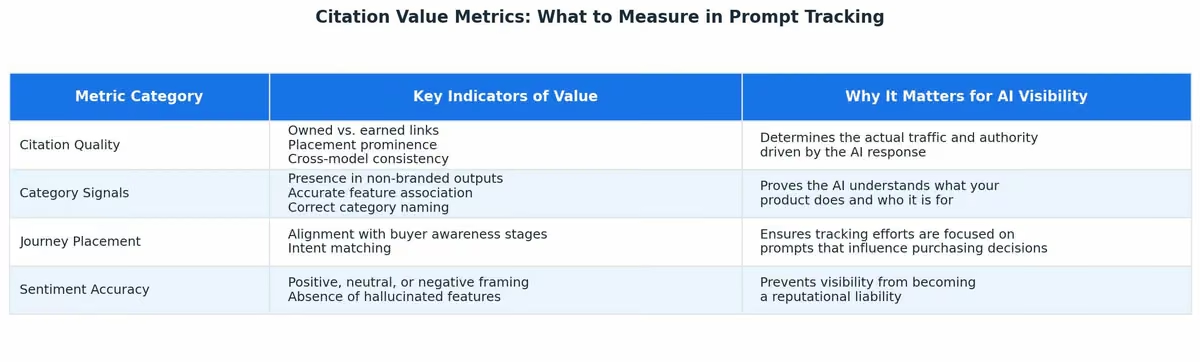
To establish a meaningful prompt tracking program, teams must focus on metrics that reflect true impact. The first critical area is citation presence and quality. This involves evaluating whether citations are owned (direct links to your website) or earned (mentions on third-party review sites or industry publications). The location of the citation within the AI's answer is also paramount. A prominent link at the beginning of a synthesized response carries significantly more weight than a passing mention buried in a concluding paragraph. Furthermore, repetition across different models, such as consistent citations in both ChatGPT and Gemini, indicates a strong, durable signal of authority that is resistant to model drift.
The second area of focus is category visibility signals. True value is generated when a brand is present in non-branded, solution-aware outputs. If an AI model consistently recommends your product when asked about the best tools for a specific use case, it demonstrates that the model associates your brand with the core category. This requires consistent naming of your category and correct association with the primary pain points your product solves. If the AI hallucinates features or misrepresents your offering, visibility becomes a liability rather than an asset. Understanding how to track AI brand sentiment in LLMs is therefore an essential companion to prompt tracking.
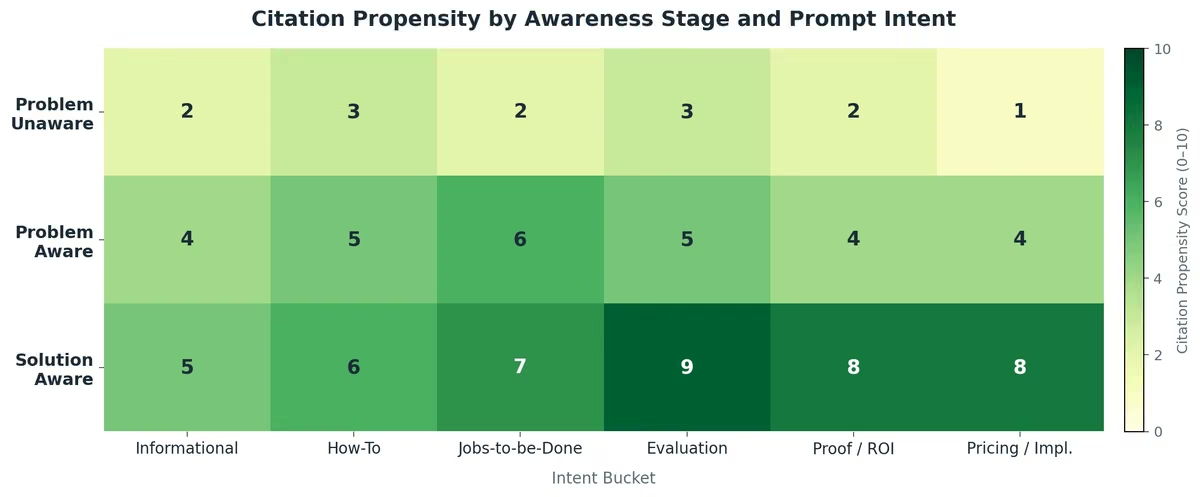
Finally, journey placement dictates which stages produce reliable citations and mentions. Not all prompts are created equal. A broad, informational query at the beginning of the buyer's journey might yield generic definitions with few citations, while a highly specific evaluation prompt near the end of the journey is likely to trigger detailed comparisons and direct links. Understanding this dynamic is essential for structuring a prompt tracking dataset that accurately reflects the entire buying process.
Why Does Mapping Buyer Awareness to Prompt Intent Improve Prompt Tracking?
AI prompting closely mirrors the traditional stages of buyer awareness. When users interact with AI assistants, their queries evolve as their understanding of their problem and potential solutions deepens. A successful prompt tracking strategy must account for this evolution. Relying on a skewed dataset that over-represents one stage of awareness will provide an incomplete picture of your brand's true AI search visibility.
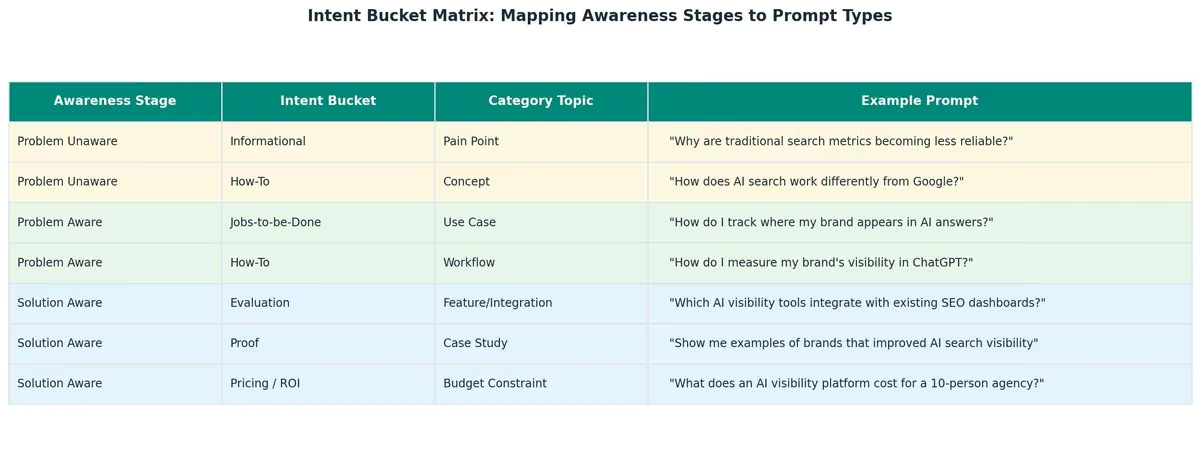
In the Problem Unaware stage, users are typically asking broad, conceptual questions. They are trying to understand a symptom or a trend, without necessarily realizing they need a specific product. Prompts in this stage might look like "Why is my website traffic dropping?" or "What are the new trends in digital marketing?" The AI's responses here are usually educational, focusing on definitions and general advice. While citations are possible, they are often directed toward high-authority publishers rather than specific solution providers. Brands that invest in authoritative educational content can still earn valuable citations at this stage, even if conversion is not the immediate goal.
As users move into the Problem Aware stage, their prompts become more outcome-seeking. They understand their problem and are looking for ways to solve it. This is where jobs-to-be-done and workflow prompts emerge. A user might ask, "How do I automate my SEO reporting?" or "What is the best way to track brand mentions in ChatGPT?" In this stage, the AI begins to introduce categories of solutions and may cite authoritative guides or how-to articles. Tracking these prompts helps brands understand if they are positioned as thought leaders in their specific domain. This is also the stage where building an LLM seeding strategy begins to pay dividends, as the content assets distributed to authoritative third-party sites start appearing in AI-synthesized answers.
The Solution Aware stage is where the most critical purchasing decisions are influenced. Users are now evaluating specific tools, comparing criteria, and seeking proof of ROI. Prompts become highly specific: "What are the best AI visibility tools for a marketing agency?" or "What is the pricing for enterprise AI search tracking software?" This is the stage where direct citations, feature comparisons, and implementation details are most prevalent. If your brand is absent from these AI responses, you are entirely missing the evaluation phase at the exact moment a buyer is ready to make a decision.
This heatmap illustrates how citation propensity changes across the buyer journey. As users move from Problem Unaware to Solution Aware, the likelihood of an AI model providing direct citations and specific brand recommendations increases significantly, particularly for evaluation and proof-based intents. Note the high scores (8-9) for Evaluation and Proof intents in the Solution Aware stage.
By understanding how each stage influences citation behavior, marketing teams can structure their data collection to ensure a balanced view of their AI visibility. This balanced approach prevents the common pitfall of optimizing only for bottom-of-the-funnel queries while ignoring the educational prompts that build initial brand awareness. The transition from understanding why stages matter to how to structure topics and intent buckets is the critical next step in building a functional prompt tracking program.
How Do We Build Intent Buckets to Prevent Bias in Prompt Tracking?
To prevent dataset bias and ensure comprehensive coverage, it is necessary to create sub-buckets within each awareness stage. This deliberate structuring forces teams to diversify the intents they are tracking, moving beyond simple keyword variations to capture the full spectrum of user inquiries. A robust prompt tracking dataset should include a variety of intent buckets, each serving a distinct purpose in the overall measurement strategy.
Informational intents cover the foundational definitions and concepts that educate buyers at the top of the funnel. Jobs-to-be-done intents focus on specific tasks the user is trying to accomplish, revealing where your product fits into their workflow. How-to intents seek step-by-step guidance, which is particularly valuable for establishing your brand as a trusted implementation resource. Evaluation intents compare different approaches or tools, which is where competitive visibility is most directly measured. Proof intents look for case studies or validation, and implementation intents ask about setup and integration. Finally, pricing intents inquire about costs and ROI, which are critical for capturing buyers at the final decision stage.
Furthermore, these intent buckets must be aligned with category topics that reflect how buyers actually think. This means defining topics around products, specific features, core use cases, common pain points, necessary integrations, and operational constraints. For example, rather than just tracking the prompt "AI SEO," a structured approach would track "How to use AI SEO for content gap analysis" (Jobs-to-be-done combined with Use Case) and "What are the limitations of AI SEO tools?" (Evaluation combined with Constraints). Understanding how to define and report good prompt coverage is the natural extension of this bucketing process.
Stressing an even distribution across these buckets and topics is vital. If a dataset is heavily skewed toward informational prompts, the resulting visibility score will not accurately reflect the brand's performance in high-intent evaluation scenarios. Conversely, tracking only pricing and implementation prompts ignores the upper funnel where initial brand trust is established. This structured matrix ensures that the prompt tracking program provides a holistic view of the brand's presence across the entire synthesis-first web. The next challenge is ensuring that the prompts populating these buckets are grounded in real user demand rather than internal assumptions.
Where Should We Source Queries for Accurate Prompt Tracking?
One of the most common mistakes in prompt tracking is relying on invented prompts. When marketers sit in a room and guess what users might ask an AI, they inevitably create prompts that reflect their internal jargon rather than actual buyer language. To avoid this, teams must outline a strict hierarchy of inputs, prioritizing real demand signals over invented queries. This sourcing discipline is what separates a high-signal prompt dataset from a collection of vanity queries.
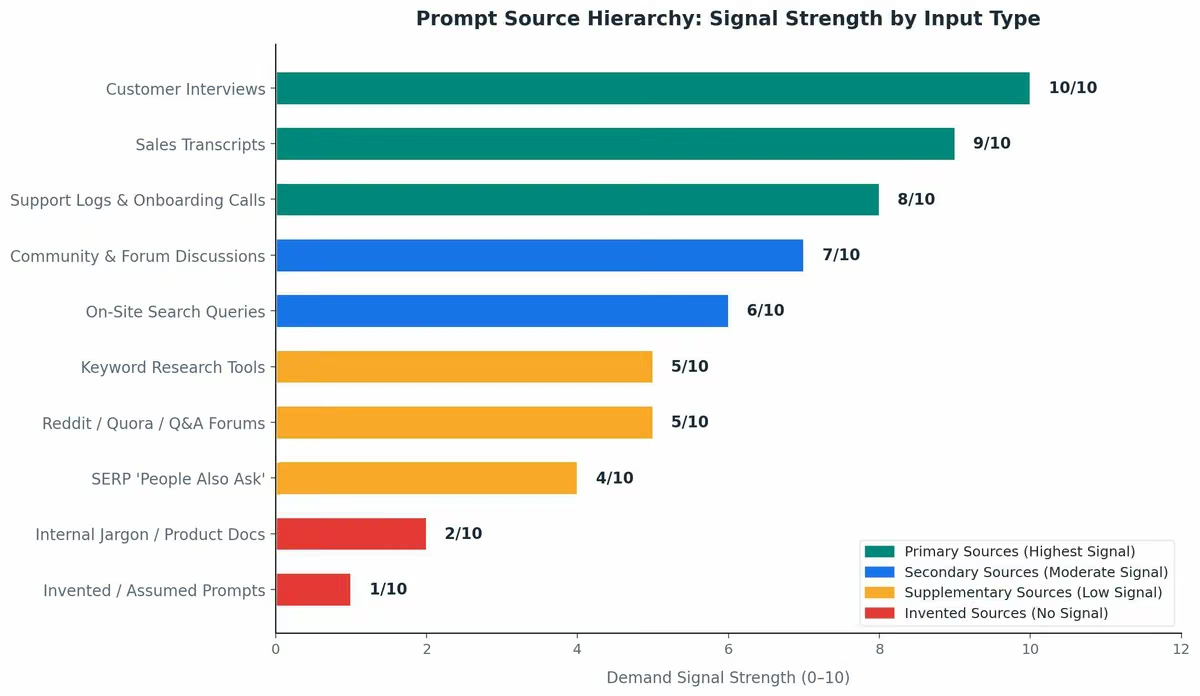
The most valuable primary sources are those that capture the voice of the customer directly. Customer interviews and sales transcripts are goldmines for identifying the exact phrasing buyers use when discussing their challenges. Support logs and onboarding calls reveal the specific friction points and implementation questions that arise after purchase. Additionally, analyzing on-site search queries and community discussions can uncover the long-tail, conversational questions that users are already asking. These sources provide authentic language that AI models are likely to respond to, because they reflect the same conversational patterns that users bring to AI assistants.
Secondary sources can supplement this primary data, provided they are used carefully. Keyword research tools can highlight question variants that indicate real search volume. Public Q&A threads on platforms like Reddit or Quora offer insights into how people structure complex inquiries in natural language. The "People Also Ask" sections on traditional search engine results pages (SERPs) can also indicate related concepts that users are exploring. However, these secondary sources should always be validated against primary data before being added to the tracking dataset. Understanding the AI search visibility metrics that matter most will help teams prioritize which sourced queries deserve tracking resources.
This chart demonstrates the hierarchy of prompt sources based on demand signal strength. Primary sources like customer interviews and sales transcripts provide the highest signal (score: 10), while invented or assumed prompts offer virtually zero value for accurate tracking (score: 1). The gap between primary and secondary sources underscores the importance of investing in direct customer research.
Once real demand has been sourced, the next step is translating that intent into LLM-friendly phrasing without altering the underlying meaning. Traditional search queries are often fragmented and keyword-heavy (e.g., "AI SEO tool pricing"). When users interact with AI, they use natural language (e.g., "How much does a typical AI SEO tool cost for a mid-sized agency?"). The translation process must preserve the original wording quirks where they reflect real user language, as these nuances often trigger specific types of AI responses. Altering the phrasing too aggressively can inadvertently change the intent of the query and skew the resulting citation data.
Translation Example:
By sourcing prompts from real demand and translating them accurately, teams ensure that their prompt tracking efforts are grounded in reality. This foundation then enables the next layer of sophistication: controlling qualifier density to model realistic buyer decisions.
How Does Qualifier Density Impact Prompt Tracking Results?
In the context of prompt tracking, qualifiers are the specific constraints, context, or conditions added to a prompt that narrow the scope of the AI's response. Understanding and controlling qualifier density is essential for modeling realistic buyer decisions. A prompt without qualifiers is often too broad to yield actionable insights, while a prompt overloaded with qualifiers may force a hyper-specific response that does not reflect typical user behavior.
Qualifiers typically fall into several categories. Persona qualifiers specify who is asking the question (e.g., "for a marketing agency," "for a small business owner"). Company size qualifiers dictate the scale of the solution needed (e.g., "enterprise-level," "startup"). Constraints might involve budget or technical limitations. Stack integration qualifiers ask how a tool fits into an existing ecosystem (e.g., "that integrates with HubSpot"). Timeline and compliance qualifiers add further specificity regarding implementation speed or regulatory requirements. Each of these qualifier types changes the AI's response in predictable ways, which is precisely why they are so valuable for targeted prompt tracking.
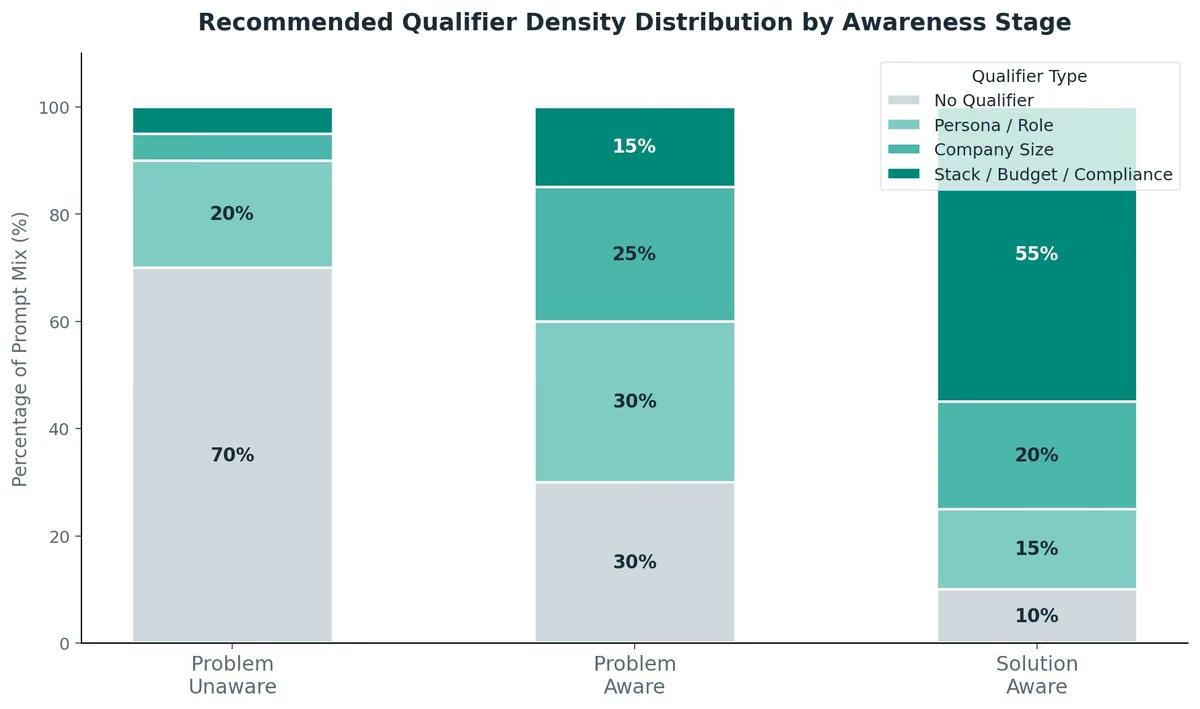
An intentional distribution of qualifiers by stage is necessary for a balanced dataset. In early research phases (Problem Unaware), qualifier density should be light. Users are seeking general information and have not yet defined their specific requirements. As they move into outcome seeking (Problem Aware), moderate qualifier density is appropriate, perhaps introducing persona or company size. Near evaluation and implementation (Solution Aware), qualifier density should be higher, incorporating specific stack integrations, constraints, and pricing models. This progression mirrors the natural way buyers narrow their criteria as they move toward a purchase decision.
This stacked bar chart illustrates the recommended distribution of qualifier density across the awareness stages. Notice how heavy qualifiers (stack, budget, compliance) become much more prominent in the Solution Aware stage, representing 55% of the recommended prompt mix, compared to just 5% in the Problem Unaware stage.
The practical impact of qualifier density on citation patterns is significant. A broad prompt like "What is the best AI visibility tool?" might yield a generic list of the most well-known platforms. However, adding qualifiers changes the landscape entirely. The prompt "What is the best AI visibility tool for an agency that needs automated reporting and white-label features?" narrows the category recommendations significantly. If your product excels in agency reporting, tracking this qualified prompt is far more valuable than tracking the generic version. By intentionally varying qualifier density, teams can uncover niche opportunities and identify exactly where their specific value propositions are being recognized by AI models. This connection between qualifier strategy and concrete measurement design is the bridge to the next phase of the framework.
What is the Best Measurement Design for Prompt Tracking?
Designing a robust measurement system is the operational core of prompt tracking. Without consistent sampling, recording, and scoring, the data collected will be erratic and unactionable. The goal is to isolate the signal from the noise and create a reliable baseline for tracking visibility over time. This is where the strategic framework built in the previous sections becomes a functional, repeatable program.
Sampling requires determining a minimum viable prompt count per intent bucket. Tracking three prompts is insufficient for statistical significance, while tracking three thousand is operationally unmanageable for most teams. A practical approach is to establish a core set of 50 to 100 high-signal prompts, distributed evenly across the awareness stages and intent buckets. Furthermore, a rotation schedule across different models (ChatGPT, Gemini, Perplexity, Google AI Overviews) is necessary, as each model synthesizes information differently and updates at different intervals. Gryffin's AI search tracker is designed specifically to manage this kind of multi-model, multi-prompt measurement at scale, automating the rotation and recording processes that would otherwise require significant manual effort.
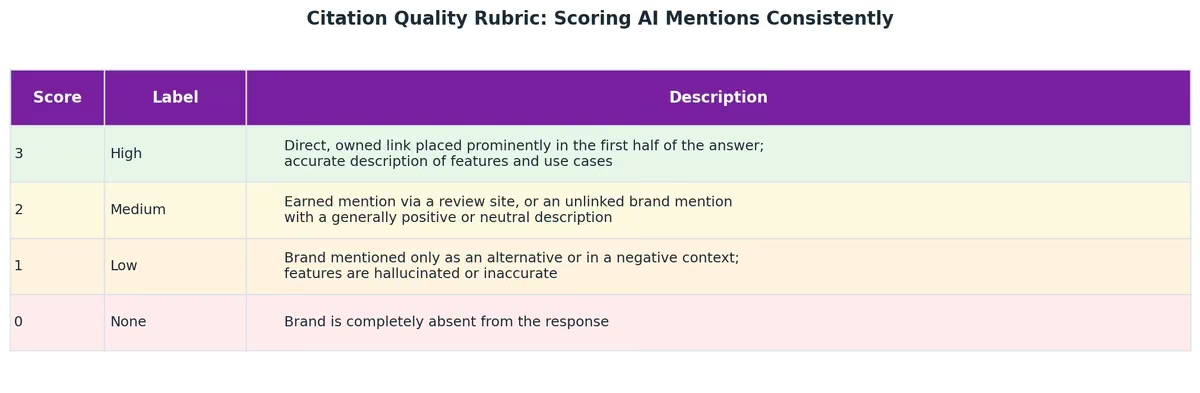
Recording the outputs must be meticulous. Teams need to log the answer type (e.g., listicle, paragraph summary, direct comparison), the total citation count, the specific domains cited, the anchor text used, and the placement of the citations within the response. Crucially, the mention quality and category clarity must be assessed. Was the brand mentioned favorably? Was it accurately associated with the correct category? These qualitative assessments are just as important as the quantitative citation counts, and they require a standardized rubric to ensure consistency across team members and measurement cycles.
Example Citation Quality Rubric:
Handling variance across models and releases is an ongoing challenge in prompt tracking. When a major model update is released, citation patterns can shift dramatically. Establishing a regular cadence for re-measurement, typically monthly for core prompts and immediately following major model announcements, ensures that the tracking data remains accurate. A small, standardized schema for logging these outputs (e.g., in a dedicated database or structured spreadsheet) ensures the data stays analyzable over time, allowing teams to spot long-term trends rather than just reacting to daily fluctuations. This measurement discipline is what transforms raw AI outputs into actionable intelligence. Before the data can be prioritized, however, it must first be filtered to remove the queries that pollute the dataset.
How Do We Identify and Filter Vanity Prompts in Prompt Tracking?
Before prioritizing a dataset, it is imperative to identify and filter out vanity prompts. These are queries that pollute the dataset, providing a false sense of visibility while offering no real business value. Vanity prompts mislead marketing teams by generating impressive-looking charts that do not correlate with pipeline or revenue. A clean dataset is the prerequisite for any meaningful AI competitor analysis, because comparing your visibility against competitors on vanity prompts produces a comparison that is strategically meaningless.
A vanity prompt is any query that no real user would ask, that is engineered to force a brand mention, or that is so generic it produces no actionable citation data.
Vanity prompts take several forms. The most common are prompts no real user would ever ask, often highly technical, jargon-laden queries invented by internal product teams. Another category includes prompts engineered to force brand mentions. If a prompt includes your brand name alongside a highly specific, proprietary feature name, the AI will almost certainly cite you. However, this proves nothing about your category visibility; it only proves the AI can retrieve your documentation. Overly generic definitions with negligible citation value (e.g., "What does SEO stand for?") also fall into this category. Finally, prompts detached from category buying behavior, those that are tangentially related to the industry but do not indicate any intent to evaluate or purchase a solution, should be discarded.
To detect these vanity prompts early, teams should apply specific heuristics and thresholds. If a prompt shows no real-world demand signal across primary or secondary sources, it should be flagged for review. If a prompt repeatedly produces zero citations or completely irrelevant citations across multiple models over several measurement cycles, it is likely too broad or poorly phrased. Furthermore, if a prompt fails to map cleanly to a specific awareness stage, intent bucket, or category topic, it lacks the structure necessary for actionable tracking.
When a vanity prompt is identified, teams must decide how to handle it. In some cases, it is best to retire the prompt entirely and archive it with a note explaining the reason for removal. In other cases, it may be possible to rewrite the prompt to restore user intent, perhaps by adding relevant qualifiers or rephrasing it in more natural language. Occasionally, it is useful to keep a known vanity prompt as a negative control, a baseline to ensure the measurement system is accurately recording zero-value outputs. By rigorously filtering out the noise, teams ensure that their prompt tracking efforts are focused exclusively on queries that drive real value. This filtering step is what makes the subsequent prioritization exercise meaningful.
How Should We Prioritize High-Signal Prompts for Tracking?
Once the dataset is cleansed of vanity queries, the remaining prompts must be prioritized. Not all high-signal prompts are equally important, and tracking resources should be allocated to the queries that offer the greatest strategic insight. A weighted scoring system is the most effective way to rank prompts objectively and ensure that the program's limited capacity is directed toward the most impactful queries.
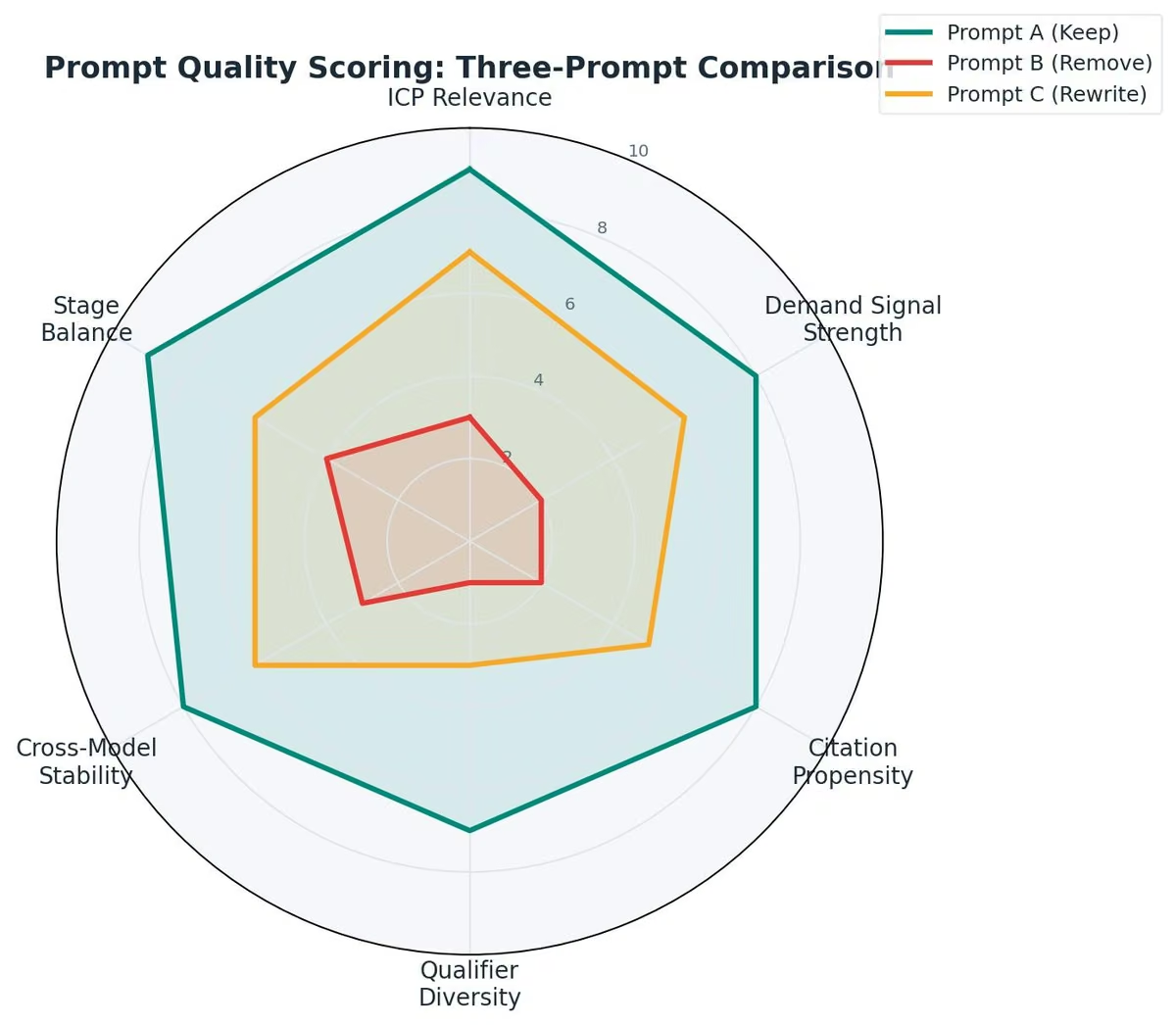
A robust scoring system evaluates prompts across several dimensions. Relevance to the category and Ideal Customer Profile (ICP) is paramount; prompts that closely align with the core business offering should receive the highest weight. Intent coverage and stage balance ensure the prompt contributes to a holistic view of the buyer journey. Demand signal strength, derived from the sourcing hierarchy, validates that the prompt represents actual user behavior. Citation propensity and quality assess whether the prompt historically triggers valuable AI responses. Qualifier diversity and realism ensure the prompt models complex decision-making scenarios. Finally, cross-model stability over time indicates whether the prompt provides consistent, reliable data or highly volatile responses that are difficult to interpret.
This radar chart visualizes the scoring of three hypothetical prompts across six key dimensions. Prompt A (green) represents a high-signal query that should be kept and monitored closely. Prompt B (red) is a vanity prompt that scores poorly on demand signal and citation propensity, indicating it should be removed. Prompt C (teal) shows potential but requires rewriting to improve its qualifier diversity and demand alignment.
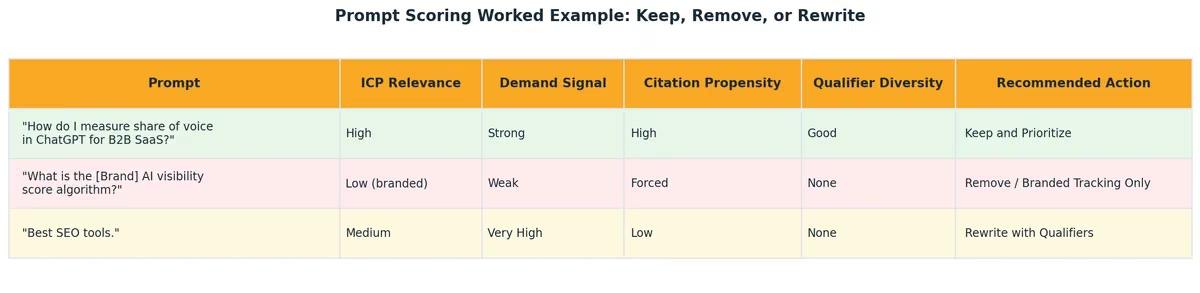
Worked Example of Prompt Scoring:
Consider a team evaluating three potential prompts for an AI visibility platform:
PromptRelevanceDemand SignalCitation PropensityQualifier DiversityRecommended Action"How do I measure share of voice in ChatGPT for a B2B SaaS company?"HighStrongHighGoodKeep and prioritize"What is the [Brand] AI visibility score algorithm?"Low (branded)WeakForcedNoneRemove or use only for branded tracking"Best SEO tools."MediumVery HighLowNoneRewrite to add category and qualifier specificity
It is also important to allocate a small percentage of the tracking capacity to exploratory prompts. The AI search landscape is dynamic, and new user intents emerge rapidly. Allocating 10 to 15% of the tracking capacity to experimental or emerging queries allows teams to discover new intents before they become mainstream, ensuring the prompt tracking program remains forward-looking rather than purely reactive. Understanding how AI powered SEO changes share of voice measurement provides the broader strategic context for why this exploratory capacity is so valuable.
What is the Operational Playbook for Maintaining Prompt Tracking?
Prompt tracking is not a set-it-and-forget-it exercise. As AI models evolve and market dynamics shift, the prompt dataset will experience drift. Maintaining an operational playbook is essential to keep the system useful and accurate over time. The framework built through the preceding sections only delivers lasting value if it is actively maintained and regularly refreshed.
The first element of the playbook is a regular refresh schedule. A quarterly refresh of sources is recommended to capture new customer language and emerging pain points. Additionally, a monthly rotation of prompts most affected by drift is necessary. If a previously stable prompt suddenly begins yielding erratic or irrelevant responses across multiple models, it should be rotated out for review and potentially replaced with a more stable variant. This monthly check is also the right time to review whether any major model updates have occurred that warrant an immediate re-measurement of the core prompt set.
Deduplication is another critical maintenance task. As the dataset grows, teams will inevitably add semantically similar prompts (e.g., "How to track AI citations" and "Methods for monitoring AI mentions"). These must be deduplicated to prevent wasted tracking resources and to avoid inflating visibility scores through redundant measurements. When prompts are retired, whether due to semantic duplication, model drift, or shifting business priorities, they should be archived with clear reasons noted. This historical record prevents future teams from re-introducing previously discarded vanity queries and provides a valuable audit trail for understanding how the program has evolved.
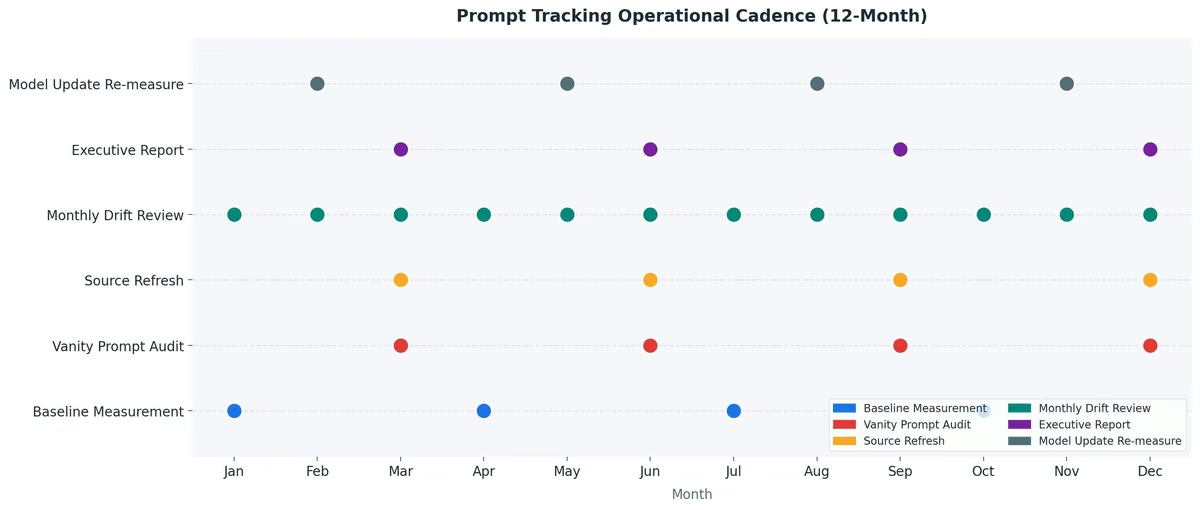
This timeline outlines a recommended operational cadence for a prompt tracking program over a 12-month period, detailing when to measure baselines, audit for vanity prompts, refresh sources, and generate specific types of reports. The cadence balances rigor with operational feasibility for most marketing teams.
Reporting insights must occur at two distinct levels to be effective. The macro level involves reporting on category visibility trends over time. This answers the executive question: "Is our brand becoming more or less visible in AI answers compared to our competitors over the last quarter?" These reports should tie directly back to the outcome metrics defined at the outset of the program, specifically citation quality, category signal strength, and journey placement. The micro level focuses on content opportunities by stage and intent. This provides actionable data for content and SEO teams: "We are losing visibility in the Solution Aware stage for implementation queries; we need to publish more technical documentation that AI models can cite." Gryffin's AI visibility score provides the composite measure that ties these two reporting levels together into a single, trackable metric.
Ultimately, all reporting must tie back to the outcomes set during the initial definition phase. If the reporting strays into vanity metrics or simple mention counts without context, the program loses its strategic value. By adhering to an operational playbook that emphasizes regular maintenance, rigorous deduplication, and outcome-aligned reporting, teams can ensure their prompt tracking program remains a durable engine for driving AI citations and category presence. The AI for SEO experimentation model provides a complementary framework for testing the content changes that prompt tracking reveals are necessary, closing the loop between measurement and action.
Prompt tracking, done correctly, is the foundation of a modern AI visibility strategy. It replaces the guesswork of traditional keyword monitoring with a structured, evidence-based system for understanding exactly how AI models represent your brand and category. By defining value first, mapping buyer intent, sourcing real demand, controlling qualifier density, filtering vanity queries, and maintaining an operational cadence, marketing teams can build a program that not only measures AI visibility but actively drives it. For teams ready to move beyond manual tracking and scale this process across multiple models and hundreds of prompts, Gryffin's AI visibility platform provides the measurement infrastructure to make it possible.
Frequently Asked Questions (FAQ): Prompt Tracking for AI
What is prompt tracking and how is it different from keyword tracking?Keyword tracking monitors where a specific webpage ranks on a search engine results page for a given phrase. Prompt tracking measures how often, in what context, and with what level of accuracy an AI answer engine (like ChatGPT or Perplexity) mentions or cites a brand when responding to a natural language user query. The fundamental difference is that keyword tracking measures position on a list, while prompt tracking measures presence and quality within a synthesized answer.
How many prompts do I need per stage or intent to get stable results?A stable baseline typically requires 15 to 25 high-signal prompts per awareness stage (Problem Unaware, Problem Aware, Solution Aware). This ensures enough data points to account for the natural variance in AI model outputs without overwhelming your tracking operations. For intent buckets within each stage, aim for at least five prompts per bucket to detect meaningful patterns.
How often should I refresh my prompt set as models change?Conduct a minor review monthly to identify prompts experiencing severe drift or hallucination, and a comprehensive source refresh quarterly. Major model updates (e.g., the release of a new GPT or Gemini version) should trigger an immediate re-measurement of your core prompt set to establish a new baseline. Failing to re-measure after a major release can leave your team operating on stale data for months.
How do I measure the quality of an AI citation?Quality is measured by evaluating the citation's placement (early in the answer vs. buried at the end), its type (a direct owned link vs. an unlinked mention), and the accuracy of the surrounding context. A high-quality citation directly links to your domain, appears in the first half of the AI's response, and accurately describes your product's features and use cases in a positive light.
What qualifies as a vanity prompt and how do I detect it early?A vanity prompt is any query that no real user would ask, that is engineered to force a brand mention, or that is so generic it produces no actionable citation data. Detect them early by cross-referencing every prompt against your primary demand sources (customer interviews, sales transcripts, on-site search). If a prompt has no corresponding real-world signal, flag it for removal before it enters the active tracking dataset.
Should I include branded prompts in a category visibility study?Branded prompts (those that include your company or product name) should be tracked separately from category prompts. They serve a different purpose: monitoring brand accuracy and sentiment rather than category visibility. Including them in a category study inflates your visibility score artificially, because AI models will almost always cite a brand when its name is explicitly mentioned in the prompt.
How do qualifiers like budget or tech stack influence AI answers?Qualifiers narrow the AI's response to match the specific context of the question. A prompt asking about "the best AI visibility tool for an agency with a $2,000/month budget that uses HubSpot" will produce a very different recommendation set than a broad, unqualified prompt. By intentionally varying qualifier density across your prompt dataset, you can identify exactly which buyer personas and use cases your brand is winning and losing in AI-generated answers.
At first, we weren’t even thinking about AI visibility. We were focused on rankings and traffic like everyone else. But once we started testing our brand in ChatGPT and other AI tools, we realized we were barely showing up — even for topics we ‘ranked’ for. Gryffin gave us a clear picture of where we stood, how competitors were being cited instead, and what that actually meant for our pipeline. It shifted how we think about search entirely.











.webp)